Skill Quality Audit (PDCA-QMS)
Six Sigma rating & PDCA updates for Skills!
Skill Quality Audit (PDCA-QMS)
Six Sigma rating & PDCA updates for Skills!
Showcase
Description
Evaluate Skills using a quality management system based on management science, not an off-the-cuff checklist. Based on Six Sigma CTQ/FMEA/DPMO × TQM × Deming PDSA cycle, through the Plan-Do-Check-Act four phases, it provides: a quality scorecard with Sigma level, a defect priority table ranked by RPN, root cause analysis down to the instruction design layer, and the full Skill text after Poka-Yoke correction. The fixer and reviewer are forcibly separated, and scores only increase, never decrease. v2.0 additions: ① Quantitative contract – closed enumeration of structural unit counting (only phase level), K-value gradient anti-scoring lock, Sigma table lookup with log axis interpolation, and full zero-padding to prevent division by zero, ensuring scores are reproducible and undistorted; ② Quality level × disposal path dual-axis gate, eliminating the contradiction of 'unqualified but recommended for release' labels; ③ Diagnostic mode – say 'only a report' or 'don't modify yet', then run through P-D-C and stop at Check, without modifying your script; ④ Output contract – pass/fail points fold, evidence limited to 50 characters, phase word count limits, values must include calculation process. When to use: evaluate whether a Skill is good, diagnose why its output is unstable, systematically optimize an existing Skill, benchmark multiple Skills, pre-release quality inspection of Skill drafts, or only want a diagnostic report without modifying the draft. Trigger words: detect skill quality, skill quality check, quality audit, rate a skill, PDCA optimize skill, skill health check, evaluate this skill, skill defect analysis, diagnose only without repair, pre-release skill quality check, skill benchmarking.
Related Skills
View all Research
Skill Evaluator
Enter the name, link, or instructions for the AI Skill to evaluate, then conduct an evidence-based initial quality review in real-world usage scenarios. Keep the six-question quick test (4 positive, 1 negative, and 1 ambiguous), and separately verify automatic selection and execution after explicit invocation; successful manual invocation does not count as successful automatic triggering. Use direct scoring across five dimensions: triggering 30%, execution 25%, cost 15%, robustness and boundaries 15%, and safety 15%. Distinguish between evidence from this test, historical run evidence, static checks, and unverified items. Do not provide an overall score or star rating when key evidence is incomplete. Assess safety based on data access, external transmission, and operational authorization—not on the author's identity or endorsement. Block recommendations in cases of serious unauthorized access. Produce a one-page, conclusion-first report showing the tested scope, unverified items, and prioritized improvement suggestions, and automatically create a record. Say “deep review” to add independent repeat tests and source checks; the budget will be confirmed before execution. This Skill only evaluates and provides recommendations; it does not automatically modify the Skill being evaluated. Suitable for quality checks of self-created Skills, rechecks of installed Skills, and pre-installation screening of marketplace Skills; the six-question results do not represent full certification.
SkillDesigner:StrictBlockerUX
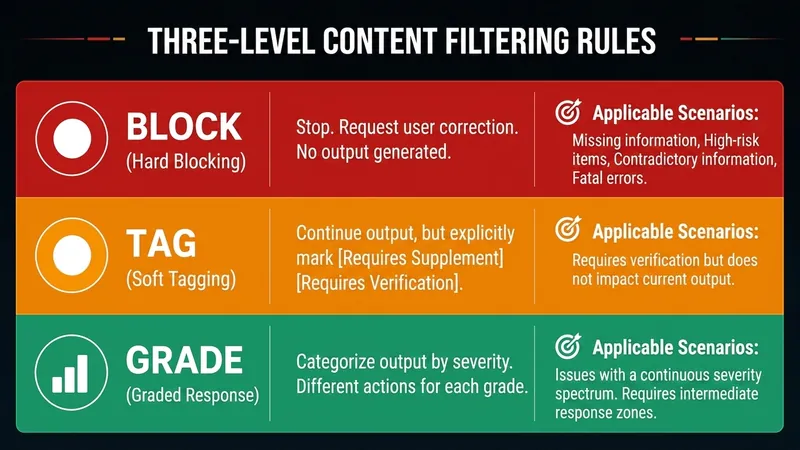
Have you ever encountered these problems? ❌ Your own Skill seems fine, but users encounter errors as soon as they try it. ❌ The Skill works with standard input, but crashes on edge cases. ❌ You want sub-type routing (e.g., quantitative vs qualitative papers), but don't know how to design blocking rules. ❌ The Skill either asks at every step (user fatigue) or runs fully automatic (no confirmation for high-risk actions). This Skill helps you solve: ✅ Failure mode first: Model how the Skill might fail before writing the execution flow. ✅ Strict blocking: Truly stop when information is missing or risk is high, requiring supplements—no soft markers. ✅ 7-phase dialogue: Type identification → 7D matrix → Failure mode modeling → Blocking rule design → Self-check → Creation. ✅ UX enhancement: Structured tabs to reduce cognitive load + progress anchors + positive blocking language. ✅ Interaction density matches risk: High-risk tasks have confirmation points; batch tasks don't interrupt at every step. Output includes: - AFP type identification (Academic/Speech/Safety Communication/Text Review/Skill Review/Custom) - Sub-type routing matrix (optional, for heterogeneous inputs) - Blocking rules (BLOCK/TAG/GRADE three levels + judgment cards) - Manual_Fallback degradation path - Test scenarios (scaled by complexity: Standard/Border/Blocking/Interaction/Sub-type) - Self-check list (Honesty first/Type consistency/Neutral naming/Anti-hardcoding) In a word: It is not a 'casual generation' Skill generator, but a strict design consultant that helps you design Skills that are executable, have blocking rules, have degradation paths, and are interaction-friendly. For you, if you are: 🛠️ A creator who wants to turn highly repetitive tasks into reusable Skills 🎯 An advanced user needing to design complex Skills (with sub-type routing, judgment cards) ✅ A user with strict quality requirements, not accepting 'it runs but is unstable' 📚 A YouMind user who wants to learn Skill design methodology
SKILLS Refinement Workshop
Seven processes, one closed loop. SkillForge Refinement Workshop transforms the gstack engineering sprint methodology open-sourced by YC leader Garry Tan into a full lifecycle management system for Claude Code Skills. From six soul-searching questions to verify demand authenticity, to architecture planning, SKILL.md forging, quality review, eval testing, release packaging, and finally review and iteration—each stage has dedicated AI roles, with confidence scores and anti-spam mechanisms. It also includes two additional processes: emergency diagnosis and security audit. No 'good ideas,' only evidence-based judgments. Every skill is tempered through seven processes.
Information
- Version
- v4
- Last updated
- Runtime credits
- Usage-based
- Models
- Auto