
Buffett's A-Share Playbook?
Adapt value investing for A-share research
Buffett's A-Share Playbook?
Adapt value investing for A-share research
Showcase
Description
Translate value investing into an actionable approach for A-shares and assess whether it can work.
Best for
Investors who want to turn classic value-investing methods into an A-share research framework and define their limits.
How to use this Skill
Provide your input
Provide the stock or industry you want to study, the value-investing framework, and your concerns about A-share market characteristics.
Run the Skill
Compare the value-investing framework with A-share rules, participants, disclosure practices, and valuation conditions. Assess its fit and suggest adjustments.
Review your result
Receive an adaptation analysis, localized research suggestions, usage boundaries, and a list of facts to verify—without specific stocks or ticker symbols.
Related Skills
View all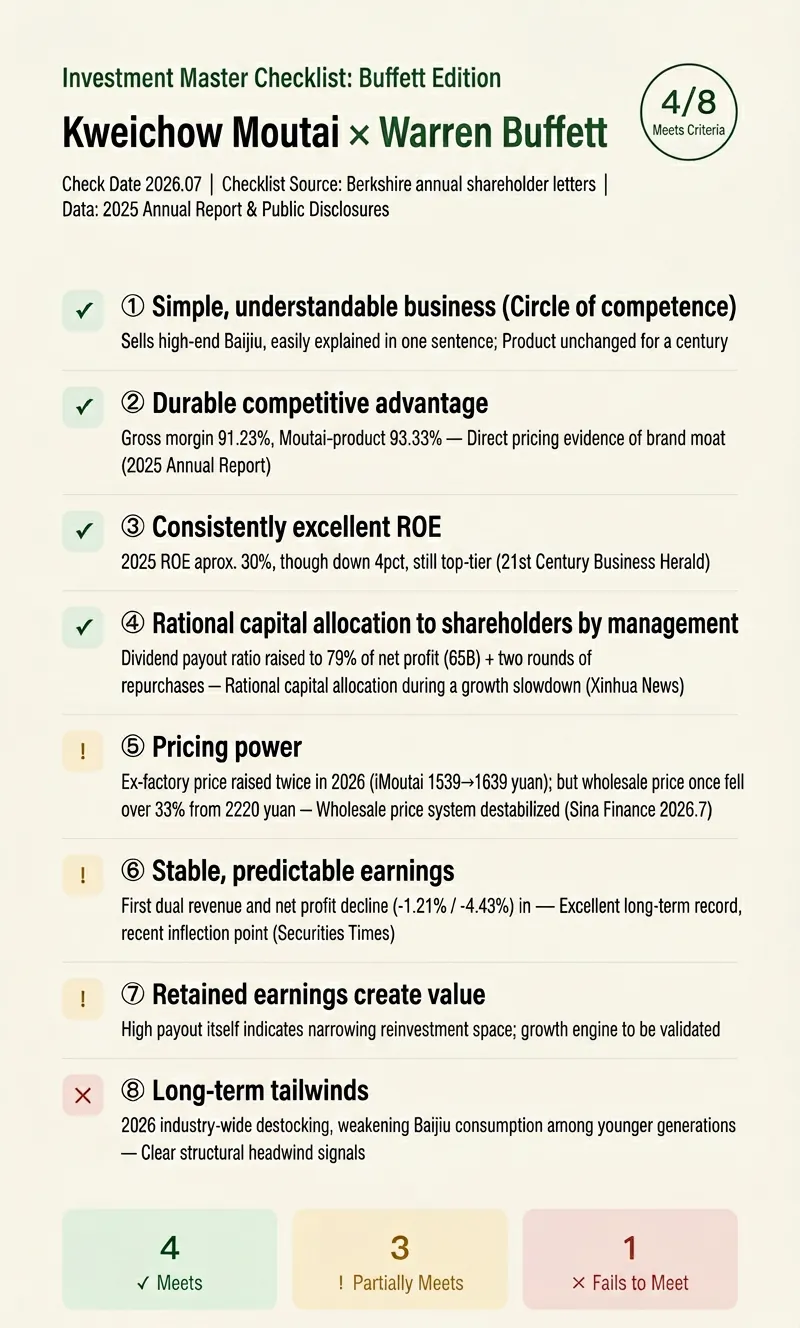
Guru Checklist: Buffett's View
Buffett's shareholder letters, Poor Charlie's Almanack, The Intelligent Investor—the standards of investment masters are public, but no one has ever helped you check them item by item. Enter a company (A-share/H-share/US stock), select a master's perspective: Buffett (default), Munger, Peter Lynch, Fisher, Graham. It will check online for public evidence corresponding to each standard, giving item-by-item judgments: ✅ Meets / ⚠️ Partially meets / ❌ Does not meet / ❓ Insufficient information, and generate a shareable scorecard long image (3:5 vertical, suitable for Xiaohongshu/WeChat Moments). Each delivery: ① Detailed check text: each standard with judgment, evidence, source and timestamp, plus "translation into plain English"—what this standard is really asking ② Scorecard summary (N/8 items met) + three most noteworthy points ③ A scorecard long image in classic value investing colors, ready to post Three golden rules: · Judgment must be backed by evidence; mark ❓ if not found, never fabricate data · Checklist items are faithful to the masters' published works, no fabricated "master standards" · Only present comparison results, do not represent the master's views, and do not constitute investment advice Repeat play: For the same company, check with all five masters, five perspectives cross-validate each other. Suitable for value investing learners, financial content creators, and ordinary investors who want to systematically understand a company.
 Research
Buffett's 73-Check Assistant
Buffett's decision assistant for companies and stocks. Supports opening the 73-item checklist, AI online pre-scoring (automatically searches data such as financial reports, valuations, competition, and scores each item), auto-saves analysis records, queries history, and generates reports. Deeply integrated with the web version of the "Value Investment Decision Elf Assistant".
Stock Valuation Analysis
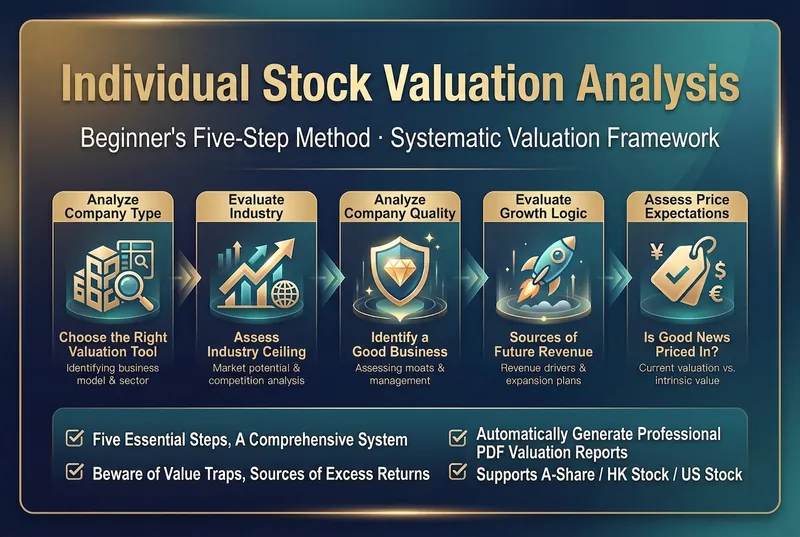
The two biggest fears in stock investing are buying a bad company and overpaying for a good one. Many investors, when they get a stock, first check its PE and PB ratios, compare them with peers, and draw conclusions—this is the biggest misconception in valuation. • 📝 Focusing only on numbers, not the company: Is a low PE always cheap? A low PE for a cyclical stock at the peak of its cycle can actually be a trap; for a growth stock, a high PE isn't necessarily expensive. With the wrong yardstick, you can't measure correctly. • 🤔 Discussing valuation without considering the industry: A contract manufacturer and a tech platform may both have a PE of 20, but their meanings are vastly different. Without first understanding the industry ceiling and business model, any valuation number is a castle in the air. • 📉 Ignoring value traps: A low valuation could be a sign of fundamental deterioration, not an investment opportunity. If the company quality is poor, no matter how 'cheap' it looks, it could still be a trap. • 🎯 Overlooking expectation gaps: Stock price movements don't depend on the absolute level of performance, but on the relative difference between performance and market expectations. If profits rise 30% but the market expected 50%, the stock can still fall. • 📊 Being too precise in valuation can itself be a mistake: Valuation is a range, not an exact number. Better to be roughly right than precisely wrong. This skill is designed to solve these problems. It is based on the 'Five-Step Valuation Method' framework and uses a systematic five-step process that cannot be skipped. It guides you from company type, industry ceiling, company quality, growth logic, and price expectations, progressing step by step to complete a full, professional individual stock valuation analysis. Finally, it outputs a structured valuation report and a downloadable PDF file. It applies to A-shares, Hong Kong stocks, and U.S. stocks.
Information
- Version
- v3
- Last updated
- Runtime credits
- Usage-based
- Models
- Auto
- Use cases
- Research & analysisLearning & educationInvestment & finance
- What you get
- ReportPlan