
Accident Root Cause & Actions
Uncover root causes and actionable fixes
Description
Why we love this skill
Builds a clear direct–contributing–root cause chain from each report and pairs every finding with a specific, actionable improvement while protecting company identity.
Do you find yourself repeatedly asking these questions in safety management? An accident analysis report runs dozens of pages, yet its conclusions still stop at “employee violated procedures” or “weak safety awareness,” leaving the real cause undiscovered? You issue a long list of corrective actions, but they amount to vague statements like “strengthen training” and “improve systems”—with no clear path to implementation, while similar accidents continue to happen? The accident investigation report contains extensive details, but you do not know how to organize them into a clear chain of causation that lets management see the root problem at a glance? When facing a regulatory or group review, you need a rigorous, layered analysis, but the tools available are either too superficial or too theoretical to reflect real-world conditions? You want to use external accident cases for internal safety awareness, but worry that exposing company names could create unnecessary public-opinion risks? Effective safety management is not about assigning “blame” after an incident; it is about identifying causes in advance. Only by uncovering the problems embedded deep within the organization can corrective actions truly take hold. This Skill is an intelligent assistant that provides in-depth analysis and improvement recommendations like an experienced safety expert. What is it? A professional tool that analyzes the root causes of an accident and generates actionable recommendations based on the original accident investigation report. It avoids generalities and stays faithful to the source material you provide, accurately extracting key information, reconstructing what happened, and tracing the causes layer by layer like a detective until it reaches the underlying systemic defects. How does it work? Reach the root cause in three steps Provide the accident investigation report — Upload or paste the complete investigation report, internal notice, or detailed description of the accident; Automatic in-depth analysis — The tool intelligently extracts key information from the report, including the timeline, actions of involved personnel, equipment status, and descriptions of management systems. It objectively reconstructs the accident in detail and ensures that every analysis remains faithful to the source material without subjective assumptions; Get layered diagnoses and improvement prescriptions — You will receive a clearly structured analysis report that can be put into practice directly. Why can its framework “peel back the layers”? Unlike traditional accident analysis, this tool clearly divides causes into three levels, making problems easier to see, address, and fix: Level 1: Direct causes — Identifies the specific actions or conditions that led to the accident, such as “an employee failed to close a valve according to procedure” or “a safety interlock on a piece of equipment failed.” These are the immediate triggers of the accident and the easiest facts to observe. Level 2: Contributing causes — Reveals systemic problems in company management, such as gaps in procedures, insufficient training, inadequate supervision, or incomplete maintenance. For example: “The operating procedure for this position did not specify the emergency shutdown process” or “The equipment had not received a periodic inspection in the past year.” These are the conditions that allowed the direct causes to arise. Level 3: Root causes — Further uncovers deep defects in the company’s safety management system or safety culture, such as “Long-term underinvestment in safety left aging equipment without timely replacement,” “Management prioritized production over safety, with assessment metrics disconnected from safety performance,” or “Safety responsibilities weakened at each level, leaving frontline employees afraid to report hazards.” These are the areas that truly require fundamental corrective action. All analysis remains strictly focused on the company’s internal situation, and company names are anonymized to ensure safe, objective discussion suitable for internal analysis and external communication. Why are the improvement recommendations actionable? For every identified cause, the tool generates specific, executable measures that can be implemented—not empty phrases like “strengthen management.” For example: Identified cause Corresponding improvement recommendation (example) Direct cause: The valve was not closed as required Revise the operating procedure for the position to add a step requiring two-person confirmation and signatures after the valve is closed; install a position sensor on the valve and connect it to the central control system for alarm notifications Contributing cause: No equipment inspection was conducted in the past year Create an annual inspection plan for this type of equipment, specifying the inspection cycle and responsible person; include inspection results in the equipment records, with automatic reminders for overdue inspections Root cause: Insufficient safety investment and aging equipment Create a dedicated budget for safety equipment upgrades in the annual budget; include equipment safety status in the workshop director’s monthly performance evaluation, with a weighting of no less than 15% Every recommendation specifies “who will do what, how, and by when,” avoiding vague language and helping companies effectively prevent similar accidents while continuously improving workplace safety. Broad, practical use cases Accident reviews and internal analysis meetings — Provide objective, in-depth analysis materials and guide discussions from “assigning blame” toward “improvement”; Corrective action planning — Generate a corrective-action task list directly from the analysis conclusions, with clear ownership and specific measures; Submitting accident analysis reports to regulators or group headquarters — Provide a rigorous, clearly structured professional report; Developing safety training materials — Turn your company’s or industry peers’ accident cases into real and persuasive teaching materials; Safety management system reviews and upgrades — Extract systemic issues from individual accidents and drive broader improvements to the management system. More than an analysis report Ultimately, you will receive a complete, ready-to-use deliverables package, including: Accident reconstruction summary: An objective timeline based on the source material; Three-level cause analysis table: A clear side-by-side view of direct, contributing, and root causes; Targeted improvement action list: Every measure corresponds to a specific cause and defines the implementation direction and acceptance criteria; Analysis explanation document: An explanation of the analytical logic and reasoning process, making it easier to explain and advance the findings with your team. All content anonymizes company names to ensure safety and practical use. So, the next time you face an accident report and are no longer satisfied with shallow, incident-by-incident conclusions, do not rely on intuition or generic templates. Give it a real report, and it will return a deep, actionable plan for systematic improvement. Uncover the root cause to truly prevent further loss—and give every “why” an answer.
Related Skills
View all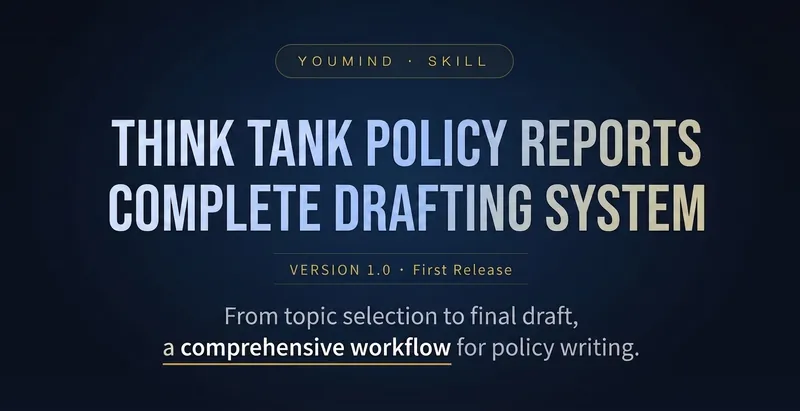
Think Tank Report Writer v1.0
🎯 One sentence policy area, produce a directly submittable advisory report in 30 minutes. It's not about 'letting AI write for you,' but packaging 20 years of think tank writing methodology into an engineered pipeline—from topic selection, four-layer penetration, structured drafting to Red-Blue Team quality check, each step goes deeper than you would on your own. ━━━ Who It's For ━━━ ✅ Think tank researchers, government policy researchers, university policy researchers ✅ Writers of internal reference reports, special reports, and policy recommendation reports ✅ Experienced authors who teach advisory report writing to students/teams ━━━ 4 Core Capabilities ━━━ 🎯 Three-Dimensional Topic Scanning Pain point: Topics lack focus, angles are imprecise, recommendations are broad and fragmented. SKILL: Antenna (high-frequency verbs and gaps in policy documents) + Grounding (grassroots pain points) + Side View (horizontal comparison), outputting 3 candidate angles (A1 Problem-Oriented / A2 Comparative Reference / A3 Major Project Proposal each). 🔍 Four-Layer Penetration Analysis Pain point: Reports stay at the surface level, failing to uncover institutional roots, leading to rejection by superiors. SKILL: Phenomenon → Institution → Interests → History, layer by layer penetration. Dig three layers deeper than peers. 📋 Structured Drafting Pain point: Unfamiliar with party-government document formats, confused by three types of internal reference styles. SKILL: A1 Problem-Oriented / A2 Comparative Reference / A3 Major Project Proposal three styles; format 100% aligned with GB/T 9704-2012; out of the box. 🛡️ Red-Blue Team Adversarial Quality Check Pain point: Can't revise your own draft / Obvious AI feel / Don't know where the issues are. SKILL: Switch to reviewer perspective to critique every sentence, graded as P0 (blocks submission) / P1 (recommended fix) / P2 (optional optimization); built-in four-layer de-AI norms (banned words + sentence restructuring + language strategy + structure strategy). ━━━ 📦 One Input, Five Deliverables ━━━ Not just finished writing, but a set of reusable research assets: 1️⃣ Main report docx — 3500-5000 words, party-government document format, directly submittable 2️⃣ Topic angle candidate library — The 2 unused angles already scanned three-dimensionally, ready for next topic 3️⃣ Four-layer penetration analysis framework card — A thinking template transferable to any policy issue 4️⃣ Policy material card library — Data/policy/cases categorized and archived, an asset that grows with use 5️⃣ Red-Blue Team quality check log — Each edit includes [original text + diagnosis + revised text + rationale] ━━━ How It Works ━━━ ⚙️ Five-station pipeline, user confirmation required at each station Station 1: Three-Dimensional Topic Scanning → Station 2: Four-Layer Penetration Analysis → Station 3: Material Dehydration and Transformation → Station 4: Structured Drafting → Station 5: Red-Blue Team Quality Check ⚙️ Dashboard mechanism Each output includes a progress bar (completed / in progress / pending) + a locked parameter list to counter context drift. ⚙️ User confirmation system At the end of each station: ask if you want to proceed. Unsatisfied? You can redo until it's right. ⚙️ Fast track Experienced users with complete information can enter 'fast track' to skip pre-confirmation and go straight to drafting + quality check. ━━━ What We Don't Do (Aesthetic Lockdown) ━━━ ✕ No 'free style' option — the three special report styles have been validated by party-government organs for 20 years; free combining only leads to loss of control ✕ No 'one-click full auto' mode — five-station mandatory confirmation is a quality baseline, not a bug ✕ No delivery without fixing P0 blocking issues — quality relies on system, not luck ━━━ How to Start ━━━ Just say one sentence after opening: 'I want to write an advisory report on county-level elderly care services' 'I want to write an advisory report on financing difficulties of specialized and new enterprises' 'I want to write an advisory report on implementation of grassroots burden reduction policies' ⏱️ Total time about 30 minutes (compared to 8-12 days for manual writing, time reduction of 99%)
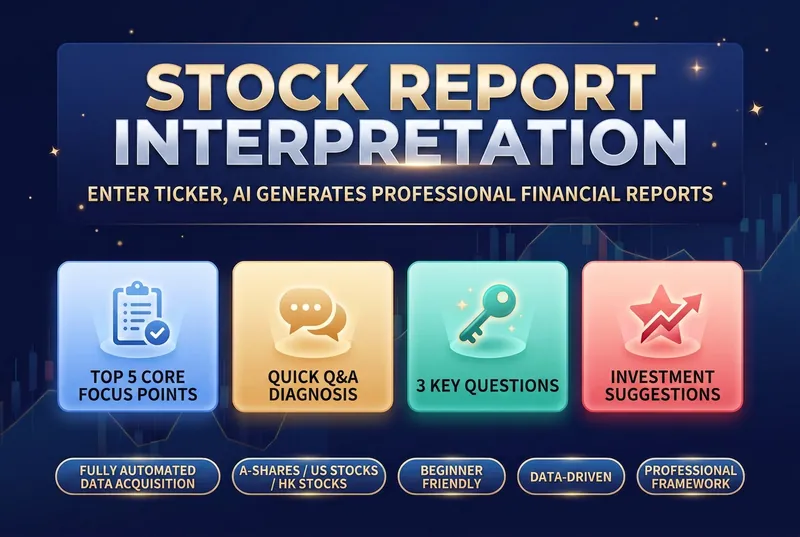
Stock Report Analyzer
Financial reports are a listed company's "physical exam report", but most investors feel lost when faced with pages of dense numbers: • 📝 Can't read the three financial statements — What do the balance sheet, income statement, and cash flow statement tell you? Which numbers matter most? • 🤔 Don't know what to look at — With dozens of pages, which key metrics should you focus on? • 📊 Lack an analysis framework — Even when you find the data, how do you judge good from bad and cross-check it? • 🏭 Industry standards differ — What counts as "good" varies completely by industry; manufacturing and internet companies can't be measured with the same yardstick. • ⏰ Time cost is too high — Manually looking up data, comparing peers, and calculating growth rates can take hours for one report. This skill was built to solve exactly these problems. It automates a professional financial analyst's framework, so you just need to enter a stock code to get a structured, logical, and beginner-friendly financial report interpretation. The tool's core value lies in its rigorous analysis framework, covering multiple dimensions from assessing growth quality to analyzing business models. It not only compares core metrics like revenue, gross margin, net margin, and cash flow, but also runs a quick Q&A on the seven key financial questions investors care about most. It clearly shows whether profits are turning into real cash, and whether receivables and inventory carry potential risks. By benchmarking against industry leaders, it helps you identify a company's true position in its industry chain. When generating the report, it also evaluates valuation levels, core strengths, and potential risks, and offers data-driven recommendations on what to watch. All analysis is presented in intuitive tables and plain, easy-to-understand language, turning complex accounting terms into concrete investment logic. Whether for daily review or deep research, it helps you quickly zero in on the core issue amid massive amounts of data, improving the efficiency and accuracy of your investment decisions.

HE Document Write&Review v3.0
🎯 Got your application rejected? Can't find the highlight for your proposal? Don't know where to start with review comments? Three real scenarios: 🔸 Scenario 1: Application season anxiety—Reviewer feedback: "Insufficient theoretical support, vague policy basis." Unsure which documents to cite or which theoretical framework to use. 🔸 Scenario 2: Proposal writing dilemma—In charge of course construction plan: objectives, tasks, pathways, evaluation… each part needs writing, but you feel the logic is not rigorous enough and worry about being questioned on "feasibility" during review. 🔸 Scenario 3: Review dilemma—Need to write peer review comments: must point out issues while maintaining professionalism, be well-founded but not too harsh. How to strike the balance? 💡 What can this system do for you? Not just give advice—it writes, revises, and reviews for you directly. 📝 Writing Mode: From topic to final document Enter your topic and existing materials. The system automatically identifies the document type (application/proposal/report/review). Automatically matches authoritative policy documents and theoretical support. Generates content chapter by chapter, each with evidence, logic, and facts. Key promise: Never fabricates data; clearly tells you what's missing. 🔍 Review Mode: Expert-level diagnosis Upload your text. Professional scoring across 7 dimensions (value, alignment, completeness, innovation, feasibility, support, expression quality). Precisely identifies problem areas. Provides specific revision suggestions + example rewrites. Not general advice, but paragraph-level specific guidance. ✏️ Revision Optimization Mode: Precision enhancement Strengthens arguments based on existing text. Optimizes expression, eliminates empty talk and clichés. Standardizes terminology and logic. Improves overall competitiveness. ⚡ Three Core Mechanisms (Unique) 🛡️ Firewall Mechanism Built-in "fact boundary": User-provided real data is never fabricated; policy basis must have sources; theoretical support cannot be misapplied. Every sentence you see can be traced back to its source. 🔄 Multi-core Adversarial Engine One core writes, another specifically checks for errors. Like having a strict auditor watching, ensuring no "unsubstantiated facts," "logic gaps," or "policy mismatches" occur. 📊 Stepwise Guidance Doesn't ask you 20 questions at once—identifies the most critical gaps and asks only the 3–5 most necessary questions. After each stage, clearly tells you "what's done," "what's missing," and "what to do next." 🎯 Scope of Application (All Higher Education Scenarios) ✅ Teaching achievement award applications (institutional/provincial/national) ✅ Quality engineering project applications (top courses/teaching teams/textbooks, etc.) ✅ Course construction plans, major construction plans ✅ Major self-assessment reports, course acceptance reports ✅ Expert review comments, peer reviews ✅ Education reform project applications, closing reports 🚀 User Experience Writing an application from scratch: Provide the topic and basic materials → System identifies document type, takes inventory, matches policies and theories → Generates outline → Writes chapter by chapter → Consolidates → Get a draft in 1 hour. Reviewing existing text: Upload document → System automatically scores → Lists main issues → Provides revision suggestions and example rewrites → Get review report in 20 minutes. Optimizing existing plan: Provide existing text and optimization direction → System diagnoses weaknesses → Strengthens arguments, optimizes expression → Get optimized version in 30 minutes. 👉 Try it now—make higher education document writing no longer a burden. This is not just a writing assistant; it's an intelligent engine that understands higher education rules, review standards, and professional expression.
Accident Root Cause & Actions
Uncover root causes and actionable fixes
Description
Why we love this skill
Builds a clear direct–contributing–root cause chain from each report and pairs every finding with a specific, actionable improvement while protecting company identity.
Do you find yourself repeatedly asking these questions in safety management? An accident analysis report runs dozens of pages, yet its conclusions still stop at “employee violated procedures” or “weak safety awareness,” leaving the real cause undiscovered? You issue a long list of corrective actions, but they amount to vague statements like “strengthen training” and “improve systems”—with no clear path to implementation, while similar accidents continue to happen? The accident investigation report contains extensive details, but you do not know how to organize them into a clear chain of causation that lets management see the root problem at a glance? When facing a regulatory or group review, you need a rigorous, layered analysis, but the tools available are either too superficial or too theoretical to reflect real-world conditions? You want to use external accident cases for internal safety awareness, but worry that exposing company names could create unnecessary public-opinion risks? Effective safety management is not about assigning “blame” after an incident; it is about identifying causes in advance. Only by uncovering the problems embedded deep within the organization can corrective actions truly take hold. This Skill is an intelligent assistant that provides in-depth analysis and improvement recommendations like an experienced safety expert. What is it? A professional tool that analyzes the root causes of an accident and generates actionable recommendations based on the original accident investigation report. It avoids generalities and stays faithful to the source material you provide, accurately extracting key information, reconstructing what happened, and tracing the causes layer by layer like a detective until it reaches the underlying systemic defects. How does it work? Reach the root cause in three steps Provide the accident investigation report — Upload or paste the complete investigation report, internal notice, or detailed description of the accident; Automatic in-depth analysis — The tool intelligently extracts key information from the report, including the timeline, actions of involved personnel, equipment status, and descriptions of management systems. It objectively reconstructs the accident in detail and ensures that every analysis remains faithful to the source material without subjective assumptions; Get layered diagnoses and improvement prescriptions — You will receive a clearly structured analysis report that can be put into practice directly. Why can its framework “peel back the layers”? Unlike traditional accident analysis, this tool clearly divides causes into three levels, making problems easier to see, address, and fix: Level 1: Direct causes — Identifies the specific actions or conditions that led to the accident, such as “an employee failed to close a valve according to procedure” or “a safety interlock on a piece of equipment failed.” These are the immediate triggers of the accident and the easiest facts to observe. Level 2: Contributing causes — Reveals systemic problems in company management, such as gaps in procedures, insufficient training, inadequate supervision, or incomplete maintenance. For example: “The operating procedure for this position did not specify the emergency shutdown process” or “The equipment had not received a periodic inspection in the past year.” These are the conditions that allowed the direct causes to arise. Level 3: Root causes — Further uncovers deep defects in the company’s safety management system or safety culture, such as “Long-term underinvestment in safety left aging equipment without timely replacement,” “Management prioritized production over safety, with assessment metrics disconnected from safety performance,” or “Safety responsibilities weakened at each level, leaving frontline employees afraid to report hazards.” These are the areas that truly require fundamental corrective action. All analysis remains strictly focused on the company’s internal situation, and company names are anonymized to ensure safe, objective discussion suitable for internal analysis and external communication. Why are the improvement recommendations actionable? For every identified cause, the tool generates specific, executable measures that can be implemented—not empty phrases like “strengthen management.” For example: Identified cause Corresponding improvement recommendation (example) Direct cause: The valve was not closed as required Revise the operating procedure for the position to add a step requiring two-person confirmation and signatures after the valve is closed; install a position sensor on the valve and connect it to the central control system for alarm notifications Contributing cause: No equipment inspection was conducted in the past year Create an annual inspection plan for this type of equipment, specifying the inspection cycle and responsible person; include inspection results in the equipment records, with automatic reminders for overdue inspections Root cause: Insufficient safety investment and aging equipment Create a dedicated budget for safety equipment upgrades in the annual budget; include equipment safety status in the workshop director’s monthly performance evaluation, with a weighting of no less than 15% Every recommendation specifies “who will do what, how, and by when,” avoiding vague language and helping companies effectively prevent similar accidents while continuously improving workplace safety. Broad, practical use cases Accident reviews and internal analysis meetings — Provide objective, in-depth analysis materials and guide discussions from “assigning blame” toward “improvement”; Corrective action planning — Generate a corrective-action task list directly from the analysis conclusions, with clear ownership and specific measures; Submitting accident analysis reports to regulators or group headquarters — Provide a rigorous, clearly structured professional report; Developing safety training materials — Turn your company’s or industry peers’ accident cases into real and persuasive teaching materials; Safety management system reviews and upgrades — Extract systemic issues from individual accidents and drive broader improvements to the management system. More than an analysis report Ultimately, you will receive a complete, ready-to-use deliverables package, including: Accident reconstruction summary: An objective timeline based on the source material; Three-level cause analysis table: A clear side-by-side view of direct, contributing, and root causes; Targeted improvement action list: Every measure corresponds to a specific cause and defines the implementation direction and acceptance criteria; Analysis explanation document: An explanation of the analytical logic and reasoning process, making it easier to explain and advance the findings with your team. All content anonymizes company names to ensure safety and practical use. So, the next time you face an accident report and are no longer satisfied with shallow, incident-by-incident conclusions, do not rely on intuition or generic templates. Give it a real report, and it will return a deep, actionable plan for systematic improvement. Uncover the root cause to truly prevent further loss—and give every “why” an answer.
Related Skills
View allThink Tank Report Writer v1.0
🎯 One sentence policy area, produce a directly submittable advisory report in 30 minutes. It's not about 'letting AI write for you,' but packaging 20 years of think tank writing methodology into an engineered pipeline—from topic selection, four-layer penetration, structured drafting to Red-Blue Team quality check, each step goes deeper than you would on your own. ━━━ Who It's For ━━━ ✅ Think tank researchers, government policy researchers, university policy researchers ✅ Writers of internal reference reports, special reports, and policy recommendation reports ✅ Experienced authors who teach advisory report writing to students/teams ━━━ 4 Core Capabilities ━━━ 🎯 Three-Dimensional Topic Scanning Pain point: Topics lack focus, angles are imprecise, recommendations are broad and fragmented. SKILL: Antenna (high-frequency verbs and gaps in policy documents) + Grounding (grassroots pain points) + Side View (horizontal comparison), outputting 3 candidate angles (A1 Problem-Oriented / A2 Comparative Reference / A3 Major Project Proposal each). 🔍 Four-Layer Penetration Analysis Pain point: Reports stay at the surface level, failing to uncover institutional roots, leading to rejection by superiors. SKILL: Phenomenon → Institution → Interests → History, layer by layer penetration. Dig three layers deeper than peers. 📋 Structured Drafting Pain point: Unfamiliar with party-government document formats, confused by three types of internal reference styles. SKILL: A1 Problem-Oriented / A2 Comparative Reference / A3 Major Project Proposal three styles; format 100% aligned with GB/T 9704-2012; out of the box. 🛡️ Red-Blue Team Adversarial Quality Check Pain point: Can't revise your own draft / Obvious AI feel / Don't know where the issues are. SKILL: Switch to reviewer perspective to critique every sentence, graded as P0 (blocks submission) / P1 (recommended fix) / P2 (optional optimization); built-in four-layer de-AI norms (banned words + sentence restructuring + language strategy + structure strategy). ━━━ 📦 One Input, Five Deliverables ━━━ Not just finished writing, but a set of reusable research assets: 1️⃣ Main report docx — 3500-5000 words, party-government document format, directly submittable 2️⃣ Topic angle candidate library — The 2 unused angles already scanned three-dimensionally, ready for next topic 3️⃣ Four-layer penetration analysis framework card — A thinking template transferable to any policy issue 4️⃣ Policy material card library — Data/policy/cases categorized and archived, an asset that grows with use 5️⃣ Red-Blue Team quality check log — Each edit includes [original text + diagnosis + revised text + rationale] ━━━ How It Works ━━━ ⚙️ Five-station pipeline, user confirmation required at each station Station 1: Three-Dimensional Topic Scanning → Station 2: Four-Layer Penetration Analysis → Station 3: Material Dehydration and Transformation → Station 4: Structured Drafting → Station 5: Red-Blue Team Quality Check ⚙️ Dashboard mechanism Each output includes a progress bar (completed / in progress / pending) + a locked parameter list to counter context drift. ⚙️ User confirmation system At the end of each station: ask if you want to proceed. Unsatisfied? You can redo until it's right. ⚙️ Fast track Experienced users with complete information can enter 'fast track' to skip pre-confirmation and go straight to drafting + quality check. ━━━ What We Don't Do (Aesthetic Lockdown) ━━━ ✕ No 'free style' option — the three special report styles have been validated by party-government organs for 20 years; free combining only leads to loss of control ✕ No 'one-click full auto' mode — five-station mandatory confirmation is a quality baseline, not a bug ✕ No delivery without fixing P0 blocking issues — quality relies on system, not luck ━━━ How to Start ━━━ Just say one sentence after opening: 'I want to write an advisory report on county-level elderly care services' 'I want to write an advisory report on financing difficulties of specialized and new enterprises' 'I want to write an advisory report on implementation of grassroots burden reduction policies' ⏱️ Total time about 30 minutes (compared to 8-12 days for manual writing, time reduction of 99%)
Stock Report Analyzer
Financial reports are a listed company's "physical exam report", but most investors feel lost when faced with pages of dense numbers: • 📝 Can't read the three financial statements — What do the balance sheet, income statement, and cash flow statement tell you? Which numbers matter most? • 🤔 Don't know what to look at — With dozens of pages, which key metrics should you focus on? • 📊 Lack an analysis framework — Even when you find the data, how do you judge good from bad and cross-check it? • 🏭 Industry standards differ — What counts as "good" varies completely by industry; manufacturing and internet companies can't be measured with the same yardstick. • ⏰ Time cost is too high — Manually looking up data, comparing peers, and calculating growth rates can take hours for one report. This skill was built to solve exactly these problems. It automates a professional financial analyst's framework, so you just need to enter a stock code to get a structured, logical, and beginner-friendly financial report interpretation. The tool's core value lies in its rigorous analysis framework, covering multiple dimensions from assessing growth quality to analyzing business models. It not only compares core metrics like revenue, gross margin, net margin, and cash flow, but also runs a quick Q&A on the seven key financial questions investors care about most. It clearly shows whether profits are turning into real cash, and whether receivables and inventory carry potential risks. By benchmarking against industry leaders, it helps you identify a company's true position in its industry chain. When generating the report, it also evaluates valuation levels, core strengths, and potential risks, and offers data-driven recommendations on what to watch. All analysis is presented in intuitive tables and plain, easy-to-understand language, turning complex accounting terms into concrete investment logic. Whether for daily review or deep research, it helps you quickly zero in on the core issue amid massive amounts of data, improving the efficiency and accuracy of your investment decisions.
HE Document Write&Review v3.0
🎯 Got your application rejected? Can't find the highlight for your proposal? Don't know where to start with review comments? Three real scenarios: 🔸 Scenario 1: Application season anxiety—Reviewer feedback: "Insufficient theoretical support, vague policy basis." Unsure which documents to cite or which theoretical framework to use. 🔸 Scenario 2: Proposal writing dilemma—In charge of course construction plan: objectives, tasks, pathways, evaluation… each part needs writing, but you feel the logic is not rigorous enough and worry about being questioned on "feasibility" during review. 🔸 Scenario 3: Review dilemma—Need to write peer review comments: must point out issues while maintaining professionalism, be well-founded but not too harsh. How to strike the balance? 💡 What can this system do for you? Not just give advice—it writes, revises, and reviews for you directly. 📝 Writing Mode: From topic to final document Enter your topic and existing materials. The system automatically identifies the document type (application/proposal/report/review). Automatically matches authoritative policy documents and theoretical support. Generates content chapter by chapter, each with evidence, logic, and facts. Key promise: Never fabricates data; clearly tells you what's missing. 🔍 Review Mode: Expert-level diagnosis Upload your text. Professional scoring across 7 dimensions (value, alignment, completeness, innovation, feasibility, support, expression quality). Precisely identifies problem areas. Provides specific revision suggestions + example rewrites. Not general advice, but paragraph-level specific guidance. ✏️ Revision Optimization Mode: Precision enhancement Strengthens arguments based on existing text. Optimizes expression, eliminates empty talk and clichés. Standardizes terminology and logic. Improves overall competitiveness. ⚡ Three Core Mechanisms (Unique) 🛡️ Firewall Mechanism Built-in "fact boundary": User-provided real data is never fabricated; policy basis must have sources; theoretical support cannot be misapplied. Every sentence you see can be traced back to its source. 🔄 Multi-core Adversarial Engine One core writes, another specifically checks for errors. Like having a strict auditor watching, ensuring no "unsubstantiated facts," "logic gaps," or "policy mismatches" occur. 📊 Stepwise Guidance Doesn't ask you 20 questions at once—identifies the most critical gaps and asks only the 3–5 most necessary questions. After each stage, clearly tells you "what's done," "what's missing," and "what to do next." 🎯 Scope of Application (All Higher Education Scenarios) ✅ Teaching achievement award applications (institutional/provincial/national) ✅ Quality engineering project applications (top courses/teaching teams/textbooks, etc.) ✅ Course construction plans, major construction plans ✅ Major self-assessment reports, course acceptance reports ✅ Expert review comments, peer reviews ✅ Education reform project applications, closing reports 🚀 User Experience Writing an application from scratch: Provide the topic and basic materials → System identifies document type, takes inventory, matches policies and theories → Generates outline → Writes chapter by chapter → Consolidates → Get a draft in 1 hour. Reviewing existing text: Upload document → System automatically scores → Lists main issues → Provides revision suggestions and example rewrites → Get review report in 20 minutes. Optimizing existing plan: Provide existing text and optimization direction → System diagnoses weaknesses → Strengthens arguments, optimizes expression → Get optimized version in 30 minutes. 👉 Try it now—make higher education document writing no longer a burden. This is not just a writing assistant; it's an intelligent engine that understands higher education rules, review standards, and professional expression.
Find your next favorite skill
Explore more curated AI skills for research, creation, and everyday work.