
Research Report Generator
Generate a draft with outline—no fabrication.
Description
📝 Value in one sentence: Enter a topic or upload materials, and AI handles the entire process from organizing sources to drafting. 🔍 Core features: Smart source integration: Upload multiple documents and AI automatically extracts key viewpoints, critical data, and representative cases, while removing duplicates and flagging conflicts. Automatic outline generation: Based on the topic or source content, it creates a logically clear and well-structured article outline. One-click draft writing: Generates content section by section according to the outline, with every data point and case study source-tagged and traceable. Five writing styles: Supports formal reports, WeChat articles, Xiaohongshu notes, academic papers, and business briefings. Transparent citations: Every figure and viewpoint is marked with its source—no fabrication or invention. Automated content workflow: Source parsing → viewpoint extraction → outline generation → writing in five styles. 🎯 Use cases: 📊 Industry research: Enter "Humanoid Robot Industry 2026" to generate a draft analysis report with data and case studies. 📝 Content creation: Upload 3 related articles to combine into an in-depth WeChat article. 📚 Academic writing: Upload multiple paper abstracts to create a literature review draft. 📋 Competitor analysis: Upload several competitor documents to instantly generate a comparative analysis report. 🧠 Personal learning: Enter a new-domain topic to quickly generate a knowledge overview. 💼 Business decisions: Input business data and background information to produce a decision brief for the CEO. 👩💼 Who it's for: Researchers, analysts, content creators, product managers, students, and consultants—anyone who needs to quickly produce high-quality first drafts.
Related Skills
View all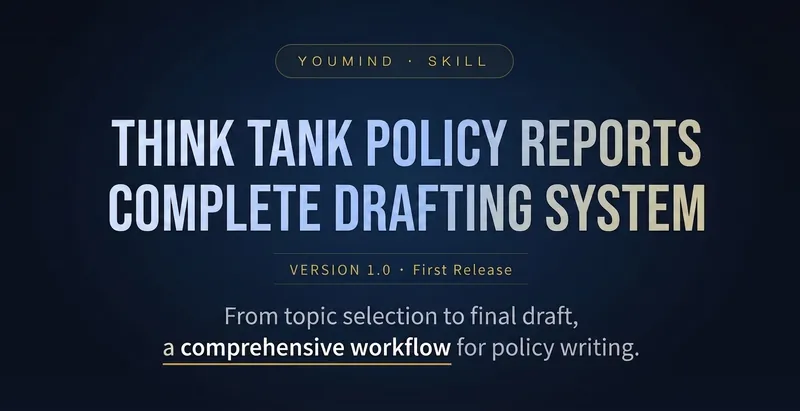
Think Tank Report Writer v1.0
🎯 One sentence policy area, produce a directly submittable advisory report in 30 minutes. It's not about 'letting AI write for you,' but packaging 20 years of think tank writing methodology into an engineered pipeline—from topic selection, four-layer penetration, structured drafting to Red-Blue Team quality check, each step goes deeper than you would on your own. ━━━ Who It's For ━━━ ✅ Think tank researchers, government policy researchers, university policy researchers ✅ Writers of internal reference reports, special reports, and policy recommendation reports ✅ Experienced authors who teach advisory report writing to students/teams ━━━ 4 Core Capabilities ━━━ 🎯 Three-Dimensional Topic Scanning Pain point: Topics lack focus, angles are imprecise, recommendations are broad and fragmented. SKILL: Antenna (high-frequency verbs and gaps in policy documents) + Grounding (grassroots pain points) + Side View (horizontal comparison), outputting 3 candidate angles (A1 Problem-Oriented / A2 Comparative Reference / A3 Major Project Proposal each). 🔍 Four-Layer Penetration Analysis Pain point: Reports stay at the surface level, failing to uncover institutional roots, leading to rejection by superiors. SKILL: Phenomenon → Institution → Interests → History, layer by layer penetration. Dig three layers deeper than peers. 📋 Structured Drafting Pain point: Unfamiliar with party-government document formats, confused by three types of internal reference styles. SKILL: A1 Problem-Oriented / A2 Comparative Reference / A3 Major Project Proposal three styles; format 100% aligned with GB/T 9704-2012; out of the box. 🛡️ Red-Blue Team Adversarial Quality Check Pain point: Can't revise your own draft / Obvious AI feel / Don't know where the issues are. SKILL: Switch to reviewer perspective to critique every sentence, graded as P0 (blocks submission) / P1 (recommended fix) / P2 (optional optimization); built-in four-layer de-AI norms (banned words + sentence restructuring + language strategy + structure strategy). ━━━ 📦 One Input, Five Deliverables ━━━ Not just finished writing, but a set of reusable research assets: 1️⃣ Main report docx — 3500-5000 words, party-government document format, directly submittable 2️⃣ Topic angle candidate library — The 2 unused angles already scanned three-dimensionally, ready for next topic 3️⃣ Four-layer penetration analysis framework card — A thinking template transferable to any policy issue 4️⃣ Policy material card library — Data/policy/cases categorized and archived, an asset that grows with use 5️⃣ Red-Blue Team quality check log — Each edit includes [original text + diagnosis + revised text + rationale] ━━━ How It Works ━━━ ⚙️ Five-station pipeline, user confirmation required at each station Station 1: Three-Dimensional Topic Scanning → Station 2: Four-Layer Penetration Analysis → Station 3: Material Dehydration and Transformation → Station 4: Structured Drafting → Station 5: Red-Blue Team Quality Check ⚙️ Dashboard mechanism Each output includes a progress bar (completed / in progress / pending) + a locked parameter list to counter context drift. ⚙️ User confirmation system At the end of each station: ask if you want to proceed. Unsatisfied? You can redo until it's right. ⚙️ Fast track Experienced users with complete information can enter 'fast track' to skip pre-confirmation and go straight to drafting + quality check. ━━━ What We Don't Do (Aesthetic Lockdown) ━━━ ✕ No 'free style' option — the three special report styles have been validated by party-government organs for 20 years; free combining only leads to loss of control ✕ No 'one-click full auto' mode — five-station mandatory confirmation is a quality baseline, not a bug ✕ No delivery without fixing P0 blocking issues — quality relies on system, not luck ━━━ How to Start ━━━ Just say one sentence after opening: 'I want to write an advisory report on county-level elderly care services' 'I want to write an advisory report on financing difficulties of specialized and new enterprises' 'I want to write an advisory report on implementation of grassroots burden reduction policies' ⏱️ Total time about 30 minutes (compared to 8-12 days for manual writing, time reduction of 99%)

Viral Title Workshop
💡 **One-line value**: Enter your content topic, and AI generates 10 high-click titles from 10 classic formulas, then tells you which title fits best on which platform. 🔍 **Core features**: - **10 title formulas**: suspense / data / story / twist / practical / pain point / trend / authority / contrast / minimalist — covering every viral title style - **4 platform adaptations**: WeChat Official Account / Xiaohongshu / Zhihu / Douyin, with automatic style tuning to each platform - **Logic breakdown**: Each title includes a click-driven breakdown of “why it works” - **Selection guide**: Recommends the best title based on your goal (open rate / virality / professionalism / precision) - **Full article analysis**: Input a complete article and AI automatically extracts the core topic and key selling points 🎯 **Use cases**: - 📝 Long articles for WeChat Official Account / Zhihu: need information-rich titles of 20–30 characters - 📕 Xiaohongshu notes: need recommendation-style titles with Emoji + numbers - 🎬 Douyin / WeChat Channels: need conflict-driven titles of 5–15 characters - 📊 Industry reports: need data/authority-driven titles - 🎓 Paid knowledge courses: need practical/pain-point titles 👩💼 **Target audience**: Content creators, new media operators, knowledge bloggers, video creators, marketing planners — anyone who needs a great title.
Paper Quick Note Generator
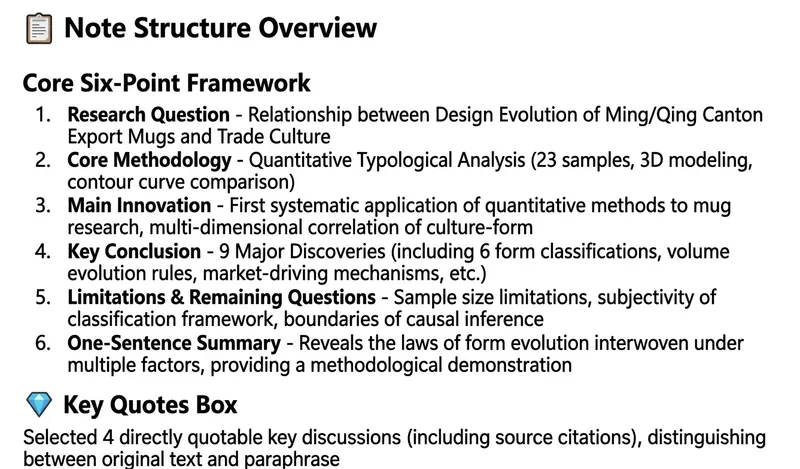
A 30-page paper due for tomorrow's group meeting; 40 papers to review for literature survey, each read from scratch, only to forget key points and lose that quotable line. Half of research time is spent on 'reading.' Paste an arXiv link or paper text and instantly receive a structured speed-reading note ready for use. ✨ Core Capabilities 1. Six-part speed-reading framework: Research Question / Core Method / Main Innovation / Key Conclusion / Limitations & Doubts / One-Sentence Summary 2. Automatically extracts 'quotable quotes' with location markers; copy directly for literature reviews. 3. Contribution breakdown: What's new compared to existing work, explained in plain language. 4. Critical perspective: Methodological flaws, overclaims, reproducibility risks pointed out point by point. 5. Optional outputs: Group meeting presentation outline / literature card / draft review paragraph / multi-paper comparison table. 6. Chinese-English terminology glossary, not machine-translated. 📱 Use Cases Graduate student thesis proposals and literature reviews, group meeting paper sharing, researchers tracking frontiers, tech professionals diving into technical papers; output can be posted on Zhihu or WeChat public accounts as academic content to attract readers. Make papers thinner—so you spend more time thinking than slogging through text.
Research Report Generator
Generate a draft with outline—no fabrication.
Description
📝 Value in one sentence: Enter a topic or upload materials, and AI handles the entire process from organizing sources to drafting. 🔍 Core features: Smart source integration: Upload multiple documents and AI automatically extracts key viewpoints, critical data, and representative cases, while removing duplicates and flagging conflicts. Automatic outline generation: Based on the topic or source content, it creates a logically clear and well-structured article outline. One-click draft writing: Generates content section by section according to the outline, with every data point and case study source-tagged and traceable. Five writing styles: Supports formal reports, WeChat articles, Xiaohongshu notes, academic papers, and business briefings. Transparent citations: Every figure and viewpoint is marked with its source—no fabrication or invention. Automated content workflow: Source parsing → viewpoint extraction → outline generation → writing in five styles. 🎯 Use cases: 📊 Industry research: Enter "Humanoid Robot Industry 2026" to generate a draft analysis report with data and case studies. 📝 Content creation: Upload 3 related articles to combine into an in-depth WeChat article. 📚 Academic writing: Upload multiple paper abstracts to create a literature review draft. 📋 Competitor analysis: Upload several competitor documents to instantly generate a comparative analysis report. 🧠 Personal learning: Enter a new-domain topic to quickly generate a knowledge overview. 💼 Business decisions: Input business data and background information to produce a decision brief for the CEO. 👩💼 Who it's for: Researchers, analysts, content creators, product managers, students, and consultants—anyone who needs to quickly produce high-quality first drafts.
Related Skills
View allThink Tank Report Writer v1.0
🎯 One sentence policy area, produce a directly submittable advisory report in 30 minutes. It's not about 'letting AI write for you,' but packaging 20 years of think tank writing methodology into an engineered pipeline—from topic selection, four-layer penetration, structured drafting to Red-Blue Team quality check, each step goes deeper than you would on your own. ━━━ Who It's For ━━━ ✅ Think tank researchers, government policy researchers, university policy researchers ✅ Writers of internal reference reports, special reports, and policy recommendation reports ✅ Experienced authors who teach advisory report writing to students/teams ━━━ 4 Core Capabilities ━━━ 🎯 Three-Dimensional Topic Scanning Pain point: Topics lack focus, angles are imprecise, recommendations are broad and fragmented. SKILL: Antenna (high-frequency verbs and gaps in policy documents) + Grounding (grassroots pain points) + Side View (horizontal comparison), outputting 3 candidate angles (A1 Problem-Oriented / A2 Comparative Reference / A3 Major Project Proposal each). 🔍 Four-Layer Penetration Analysis Pain point: Reports stay at the surface level, failing to uncover institutional roots, leading to rejection by superiors. SKILL: Phenomenon → Institution → Interests → History, layer by layer penetration. Dig three layers deeper than peers. 📋 Structured Drafting Pain point: Unfamiliar with party-government document formats, confused by three types of internal reference styles. SKILL: A1 Problem-Oriented / A2 Comparative Reference / A3 Major Project Proposal three styles; format 100% aligned with GB/T 9704-2012; out of the box. 🛡️ Red-Blue Team Adversarial Quality Check Pain point: Can't revise your own draft / Obvious AI feel / Don't know where the issues are. SKILL: Switch to reviewer perspective to critique every sentence, graded as P0 (blocks submission) / P1 (recommended fix) / P2 (optional optimization); built-in four-layer de-AI norms (banned words + sentence restructuring + language strategy + structure strategy). ━━━ 📦 One Input, Five Deliverables ━━━ Not just finished writing, but a set of reusable research assets: 1️⃣ Main report docx — 3500-5000 words, party-government document format, directly submittable 2️⃣ Topic angle candidate library — The 2 unused angles already scanned three-dimensionally, ready for next topic 3️⃣ Four-layer penetration analysis framework card — A thinking template transferable to any policy issue 4️⃣ Policy material card library — Data/policy/cases categorized and archived, an asset that grows with use 5️⃣ Red-Blue Team quality check log — Each edit includes [original text + diagnosis + revised text + rationale] ━━━ How It Works ━━━ ⚙️ Five-station pipeline, user confirmation required at each station Station 1: Three-Dimensional Topic Scanning → Station 2: Four-Layer Penetration Analysis → Station 3: Material Dehydration and Transformation → Station 4: Structured Drafting → Station 5: Red-Blue Team Quality Check ⚙️ Dashboard mechanism Each output includes a progress bar (completed / in progress / pending) + a locked parameter list to counter context drift. ⚙️ User confirmation system At the end of each station: ask if you want to proceed. Unsatisfied? You can redo until it's right. ⚙️ Fast track Experienced users with complete information can enter 'fast track' to skip pre-confirmation and go straight to drafting + quality check. ━━━ What We Don't Do (Aesthetic Lockdown) ━━━ ✕ No 'free style' option — the three special report styles have been validated by party-government organs for 20 years; free combining only leads to loss of control ✕ No 'one-click full auto' mode — five-station mandatory confirmation is a quality baseline, not a bug ✕ No delivery without fixing P0 blocking issues — quality relies on system, not luck ━━━ How to Start ━━━ Just say one sentence after opening: 'I want to write an advisory report on county-level elderly care services' 'I want to write an advisory report on financing difficulties of specialized and new enterprises' 'I want to write an advisory report on implementation of grassroots burden reduction policies' ⏱️ Total time about 30 minutes (compared to 8-12 days for manual writing, time reduction of 99%)
Viral Title Workshop
💡 **One-line value**: Enter your content topic, and AI generates 10 high-click titles from 10 classic formulas, then tells you which title fits best on which platform. 🔍 **Core features**: - **10 title formulas**: suspense / data / story / twist / practical / pain point / trend / authority / contrast / minimalist — covering every viral title style - **4 platform adaptations**: WeChat Official Account / Xiaohongshu / Zhihu / Douyin, with automatic style tuning to each platform - **Logic breakdown**: Each title includes a click-driven breakdown of “why it works” - **Selection guide**: Recommends the best title based on your goal (open rate / virality / professionalism / precision) - **Full article analysis**: Input a complete article and AI automatically extracts the core topic and key selling points 🎯 **Use cases**: - 📝 Long articles for WeChat Official Account / Zhihu: need information-rich titles of 20–30 characters - 📕 Xiaohongshu notes: need recommendation-style titles with Emoji + numbers - 🎬 Douyin / WeChat Channels: need conflict-driven titles of 5–15 characters - 📊 Industry reports: need data/authority-driven titles - 🎓 Paid knowledge courses: need practical/pain-point titles 👩💼 **Target audience**: Content creators, new media operators, knowledge bloggers, video creators, marketing planners — anyone who needs a great title.
Paper Quick Note Generator
A 30-page paper due for tomorrow's group meeting; 40 papers to review for literature survey, each read from scratch, only to forget key points and lose that quotable line. Half of research time is spent on 'reading.' Paste an arXiv link or paper text and instantly receive a structured speed-reading note ready for use. ✨ Core Capabilities 1. Six-part speed-reading framework: Research Question / Core Method / Main Innovation / Key Conclusion / Limitations & Doubts / One-Sentence Summary 2. Automatically extracts 'quotable quotes' with location markers; copy directly for literature reviews. 3. Contribution breakdown: What's new compared to existing work, explained in plain language. 4. Critical perspective: Methodological flaws, overclaims, reproducibility risks pointed out point by point. 5. Optional outputs: Group meeting presentation outline / literature card / draft review paragraph / multi-paper comparison table. 6. Chinese-English terminology glossary, not machine-translated. 📱 Use Cases Graduate student thesis proposals and literature reviews, group meeting paper sharing, researchers tracking frontiers, tech professionals diving into technical papers; output can be posted on Zhihu or WeChat public accounts as academic content to attract readers. Make papers thinner—so you spend more time thinking than slogging through text.
Find your next favorite skill
Explore more curated AI skills for research, creation, and everyday work.