
SEO/GEO Keyword Planner v2.0
Keyword & GEO planning for new products
Description
SEO/GEO keyword research and content topic planning tool. Enter a topic, product, or seed keyword, and through an 8-stage process (Scope Definition → Discovery → Expansion → Classification → Scoring → GEO Check → Clustering → Delivery) output a complete keyword research report, including priority keyword list, topic clusters, and content calendar. Suitable for new page creation, new content topic selection, SEO optimization, and GEO (AI citation optimization) planning.
Related Skills
View all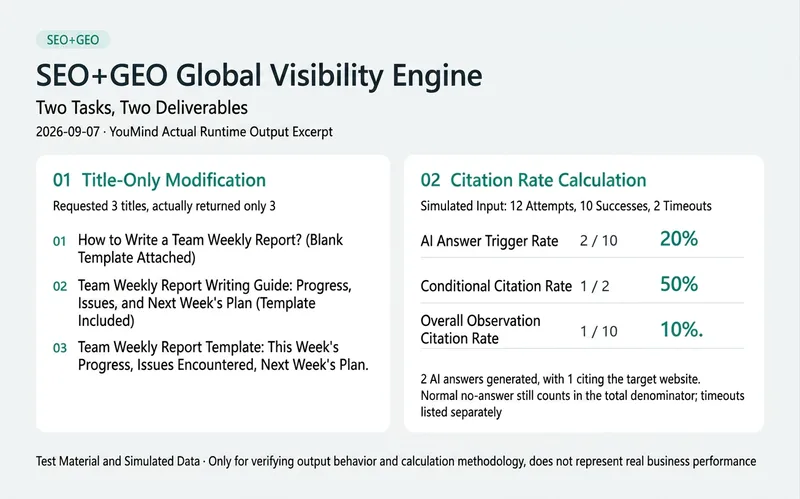
SEO+GEO Visibility Engine
Optimize the search performance and AI citation readiness of your articles, product pages, and landing pages. Quickly identify the issues most worth fixing, or get ready-to-use titles, rewrites, content briefs, technical fix lists, or performance retest plans. Four modes route tasks appropriately: send only a link or body copy for a quick diagnosis by default; request writing to get usable text first; use a full audit to break findings down by target engine and page; or use a performance retest with clearly defined data sources, numerators, denominators, and comparison conditions. Simple tasks do not require a full-length report. Supports platform-specific checks for Google AI Overviews / AI Mode, Bing / Copilot, ChatGPT Search, Perplexity, and Claude. Search, training, and user-triggered visits are assessed separately. For Chinese platforms, checks are adapted to actually available sources and direct observations rather than applying rules from other engines. v8 standardizes scoring and evidence criteria, limits the scope of local blocks, distinguishes answer trigger rate, conditional citation rate, and overall citation rate, and updates Google site-level AI control checks. Use it for your own websites, articles on third-party platforms, and unpublished drafts. Recommendations distinguish what you can change from items that require platform-side validation. Each key finding includes evidence or clearly stated limitations. Scores are provided when needed; data, authors, or citations are never fabricated, and rankings, indexing, or AI citations are not guaranteed. Actual run example (2026-09-07; test material, not business results) Title mode: Given test copy for “How to write a team weekly report” with a request to return only 3 titles, the actual output was: 1. How to Write a Team Weekly Report: Blank Template Included 2. Team Weekly Report Writing Guide: Progress, Issues, and Next Week’s Plan (Template Included) 3. Team Weekly Report Template: This Week’s Progress, Issues, and Next Week’s Plan Calculation mode: Simulated 12 attempts, with 10 successes and 2 timeouts; 2 successful runs generated AI answers, and 1 cited the target website. Actual output: AI answer trigger rate 2/10 = 20%, conditional citation rate 1/2 = 50%, and overall observed citation rate 1/10 = 10%. Normal no-answer cases remain in the overall denominator, while timeouts are listed separately. These figures validate the calculation criteria only and do not represent actual citation performance.
SEO Viral Article Workshop
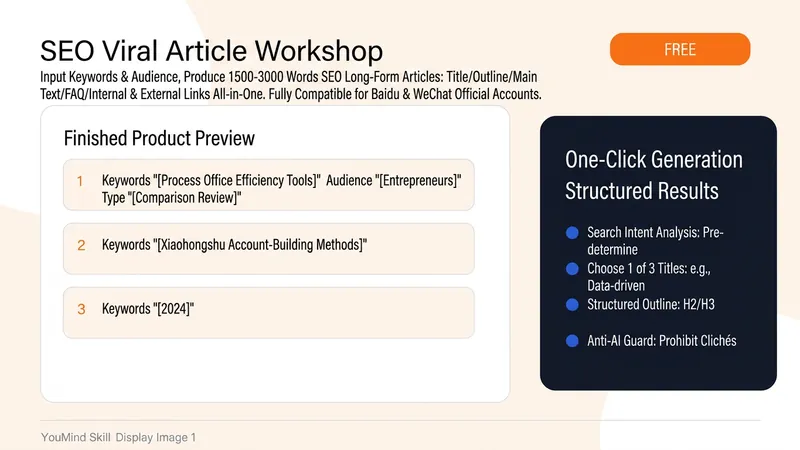
You spend an afternoon researching and writing a valuable article, only to get triple-digit reads—not because the content is bad, but because no one finds it via search. From now on, just provide a keyword and a one-line description of your audience, and let this tool handle the rest—choose one of three headlines, auto-generate an outline, write the body with keyword density and FAQ, ready to publish. ✨ Core Capabilities 1. Search intent analysis: First determine what users actually want when they search for a keyword, then tailor the content. 2. Three headline options: Data-driven, pain-point, or pitfall-avoiding; all include keywords and are 30 characters or less. 3. Structured outline: Auto-arranges H2/H3 headings, 4-6 main sections + FAQ + CTA. 4. Anti-AI feel guardrails: No generic openers, empty parallelism, or cliché endings; forces specific numbers and case studies. 5. Dual adaptation for Baidu and WeChat Official Accounts: High-density information vs. readable dissemination, switch tone based on scenario. 6. Additional metadata: Meta Description, internal/external link suggestions—ready to use when posting. 📱 Use Cases - SEO bloggers/webmasters: Batch produce long-form articles that rank. - WeChat Official Account operators: Write in-depth articles with search traffic. - Indie developers/SaaS founders: Write product tutorials and comparison reviews to gain SEO traffic. - Knowledge monetization educators: Write lead-generation articles while considering search rankings. Great content shouldn't be buried—let it be found by search engines.
Overseas Tool Demand Analysis
Are you looking for low-competition, high-potential overseas tool website startup opportunities? This skill is designed for independent developers, SEO webmasters, and AI tool entrepreneurs, helping you accurately identify truly valuable directions from vast market information. It deeply analyzes your market ideas, keywords, or competitors, revealing target user pain points, use cases, and potential business value. Through detailed search intent analysis, this skill expands tool-type keywords such as 'generator,' 'converter,' 'checker,' etc., and evaluates whether there are clear user needs, community complaints, and monetization potential. It helps you distinguish which are suitable as SEO traffic entry points, which can effectively acquire potential customers, and which have the potential to develop into sustainable paid products or SaaS, avoiding blind investment. Notably, this skill pays special attention to the reuse potential of tools and prioritizes opportunities suitable for small teams, simple implementation, and not relying on complex operations. Ultimately, you will receive a clearly ranked list of candidate directions, including detailed user personas, pain points, keyword strategies, competitive analysis, monetization signals, and minimum viable product (MVP) recommendations, helping you reduce decision risk and increase startup success rates.
SEO/GEO Keyword Planner v2.0
Keyword & GEO planning for new products
Description
SEO/GEO keyword research and content topic planning tool. Enter a topic, product, or seed keyword, and through an 8-stage process (Scope Definition → Discovery → Expansion → Classification → Scoring → GEO Check → Clustering → Delivery) output a complete keyword research report, including priority keyword list, topic clusters, and content calendar. Suitable for new page creation, new content topic selection, SEO optimization, and GEO (AI citation optimization) planning.
Related Skills
View allSEO+GEO Visibility Engine
Optimize the search performance and AI citation readiness of your articles, product pages, and landing pages. Quickly identify the issues most worth fixing, or get ready-to-use titles, rewrites, content briefs, technical fix lists, or performance retest plans. Four modes route tasks appropriately: send only a link or body copy for a quick diagnosis by default; request writing to get usable text first; use a full audit to break findings down by target engine and page; or use a performance retest with clearly defined data sources, numerators, denominators, and comparison conditions. Simple tasks do not require a full-length report. Supports platform-specific checks for Google AI Overviews / AI Mode, Bing / Copilot, ChatGPT Search, Perplexity, and Claude. Search, training, and user-triggered visits are assessed separately. For Chinese platforms, checks are adapted to actually available sources and direct observations rather than applying rules from other engines. v8 standardizes scoring and evidence criteria, limits the scope of local blocks, distinguishes answer trigger rate, conditional citation rate, and overall citation rate, and updates Google site-level AI control checks. Use it for your own websites, articles on third-party platforms, and unpublished drafts. Recommendations distinguish what you can change from items that require platform-side validation. Each key finding includes evidence or clearly stated limitations. Scores are provided when needed; data, authors, or citations are never fabricated, and rankings, indexing, or AI citations are not guaranteed. Actual run example (2026-09-07; test material, not business results) Title mode: Given test copy for “How to write a team weekly report” with a request to return only 3 titles, the actual output was: 1. How to Write a Team Weekly Report: Blank Template Included 2. Team Weekly Report Writing Guide: Progress, Issues, and Next Week’s Plan (Template Included) 3. Team Weekly Report Template: This Week’s Progress, Issues, and Next Week’s Plan Calculation mode: Simulated 12 attempts, with 10 successes and 2 timeouts; 2 successful runs generated AI answers, and 1 cited the target website. Actual output: AI answer trigger rate 2/10 = 20%, conditional citation rate 1/2 = 50%, and overall observed citation rate 1/10 = 10%. Normal no-answer cases remain in the overall denominator, while timeouts are listed separately. These figures validate the calculation criteria only and do not represent actual citation performance.
SEO Viral Article Workshop
You spend an afternoon researching and writing a valuable article, only to get triple-digit reads—not because the content is bad, but because no one finds it via search. From now on, just provide a keyword and a one-line description of your audience, and let this tool handle the rest—choose one of three headlines, auto-generate an outline, write the body with keyword density and FAQ, ready to publish. ✨ Core Capabilities 1. Search intent analysis: First determine what users actually want when they search for a keyword, then tailor the content. 2. Three headline options: Data-driven, pain-point, or pitfall-avoiding; all include keywords and are 30 characters or less. 3. Structured outline: Auto-arranges H2/H3 headings, 4-6 main sections + FAQ + CTA. 4. Anti-AI feel guardrails: No generic openers, empty parallelism, or cliché endings; forces specific numbers and case studies. 5. Dual adaptation for Baidu and WeChat Official Accounts: High-density information vs. readable dissemination, switch tone based on scenario. 6. Additional metadata: Meta Description, internal/external link suggestions—ready to use when posting. 📱 Use Cases - SEO bloggers/webmasters: Batch produce long-form articles that rank. - WeChat Official Account operators: Write in-depth articles with search traffic. - Indie developers/SaaS founders: Write product tutorials and comparison reviews to gain SEO traffic. - Knowledge monetization educators: Write lead-generation articles while considering search rankings. Great content shouldn't be buried—let it be found by search engines.
Overseas Tool Demand Analysis
Are you looking for low-competition, high-potential overseas tool website startup opportunities? This skill is designed for independent developers, SEO webmasters, and AI tool entrepreneurs, helping you accurately identify truly valuable directions from vast market information. It deeply analyzes your market ideas, keywords, or competitors, revealing target user pain points, use cases, and potential business value. Through detailed search intent analysis, this skill expands tool-type keywords such as 'generator,' 'converter,' 'checker,' etc., and evaluates whether there are clear user needs, community complaints, and monetization potential. It helps you distinguish which are suitable as SEO traffic entry points, which can effectively acquire potential customers, and which have the potential to develop into sustainable paid products or SaaS, avoiding blind investment. Notably, this skill pays special attention to the reuse potential of tools and prioritizes opportunities suitable for small teams, simple implementation, and not relying on complex operations. Ultimately, you will receive a clearly ranked list of candidate directions, including detailed user personas, pain points, keyword strategies, competitive analysis, monetization signals, and minimum viable product (MVP) recommendations, helping you reduce decision risk and increase startup success rates.
Find your next favorite skill
Explore more curated AI skills for research, creation, and everyday work.