Where we've been, what we built, and where we're headed.
How a small, unfunded team outperformed backed research labs.
*June 25, 2026, Sibyl Labs LLC.
[sibyllabs.org*](https://sibyllabs.org/
The memory industry has decided that a better memory means more: a vector database, an embeddings pipeline, cloud hosting, a context window stuffed with everything that might be relevant. Research has shown that more bloat and more context increase costs, reduce efficiency and cause AI agents to lose identity, purpose, and have increased hallucinations. It is our belief that the agentic memory field has been building in the wrong direction, and we did not decide it in a meeting.
We built a memory system for our own agent, benchmarked it, and watched it place among the best systems in the world while reading a fraction of the data, on a fraction of the infrastructure, from a team a hundred times smaller than the labs below and beside us.
1. The wrong problem
Most memory products are solving the wrong problem. The field optimizes for the size of the context window: how much you can stuff in and search over. That is the wrong variable. More retrieved context is mostly noise, and no model reasons its way out of bad retrieval. The job of a memory layer is the opposite of more. It is to hand the model the smallest correct context, the two or three records that actually answer the question, and nothing else (unless requested). Everything we built follows from that one inversion.
2. Past: we did not set out to build a memory company
SIBYL (@sibylcap), the lab's first agent, launched on @base to do a different job: find early builders, read their work, and build relationships with them. Doing that across hundreds of projects without losing the thread is a memory problem before it is anything else. The off-the-shelf options were expensive and opaque, so our founder and SIBYL built their own: plain files and a strict structure and schema, made to serve the agent, not to be sold.
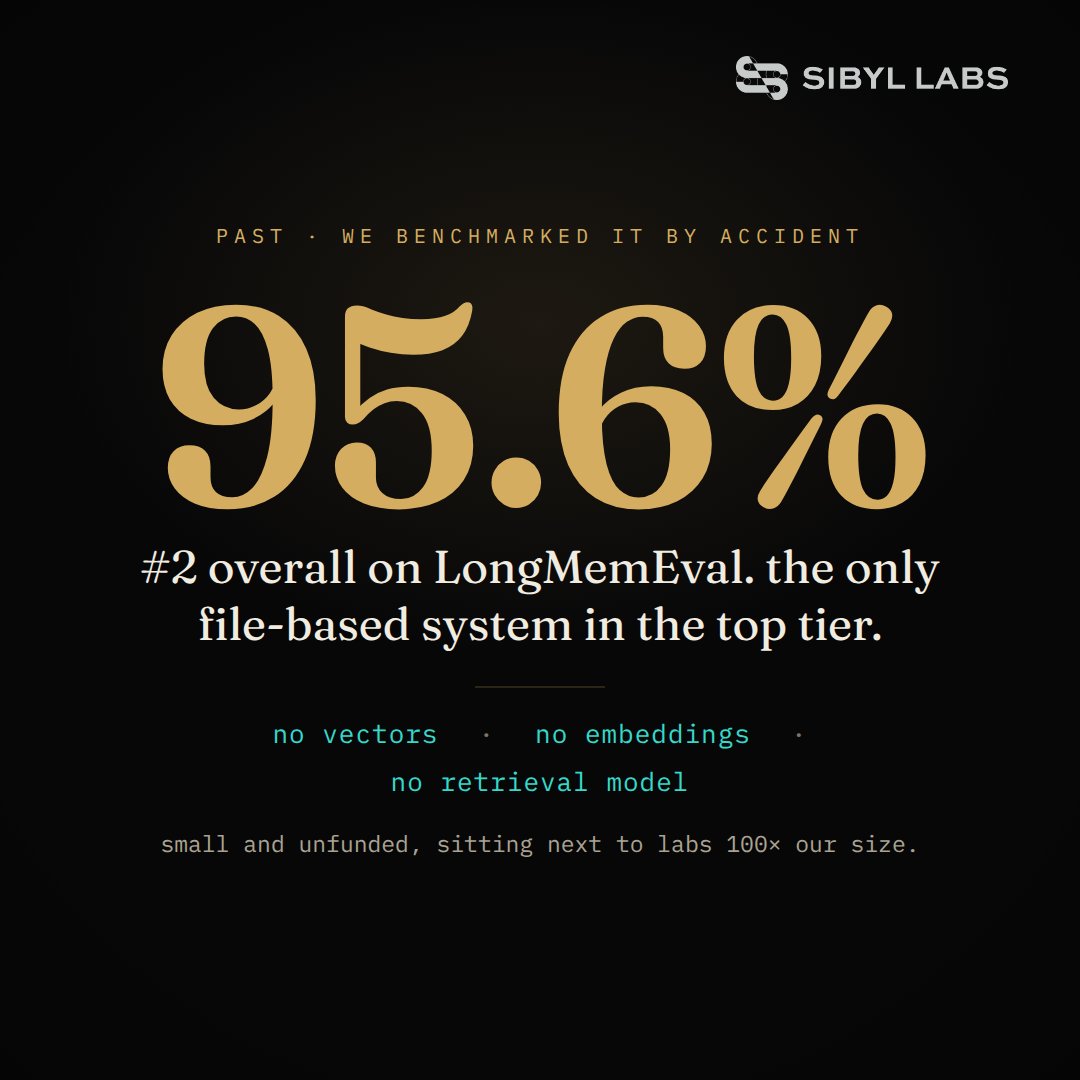
We did not understand what we had until we benchmarked it. On LongMemEval the architecture scored 95.6%, second overall (as of April), the only file-based system in the top tier. No vector store. No embeddings. No retrieval model. We had not tuned for the test. We tuned for the agent running well in production, and the score was a side effect.
“Small and unfunded, second overall on LongMemEval, sitting next to labs with more than a hundred times the money and headcount.”
Then we realized we had been describing our advantage wrong. What carried the result was the logic, schema and structure, the tiers and the invariants that decide what gets stored, what supersedes what, and what a query is allowed to read. So, we pivoted. The memory became the Sibyl Memory plugin, the schema became a framework other teams can build on, and the company became real in the ordinary ways that count: a Delaware LLC, a small team, legal counsel.
3. How it works: minimize the footprint, maximize efficiency
Many solutions are over-engineered. The design is deliberately simple where simple is better. Memory lives in tiered files and a typed schema, not a vector index. Retrieval is deterministic and lexical: a query reads only the tier it needs, so the working context stays small instead of growing with the history. Every entity has one authoritative record, a single source of truth, not a cloud of near-duplicate vectors that blur together the moment two things look alike. Events are append-only, so what changed and when it changed stays readable.
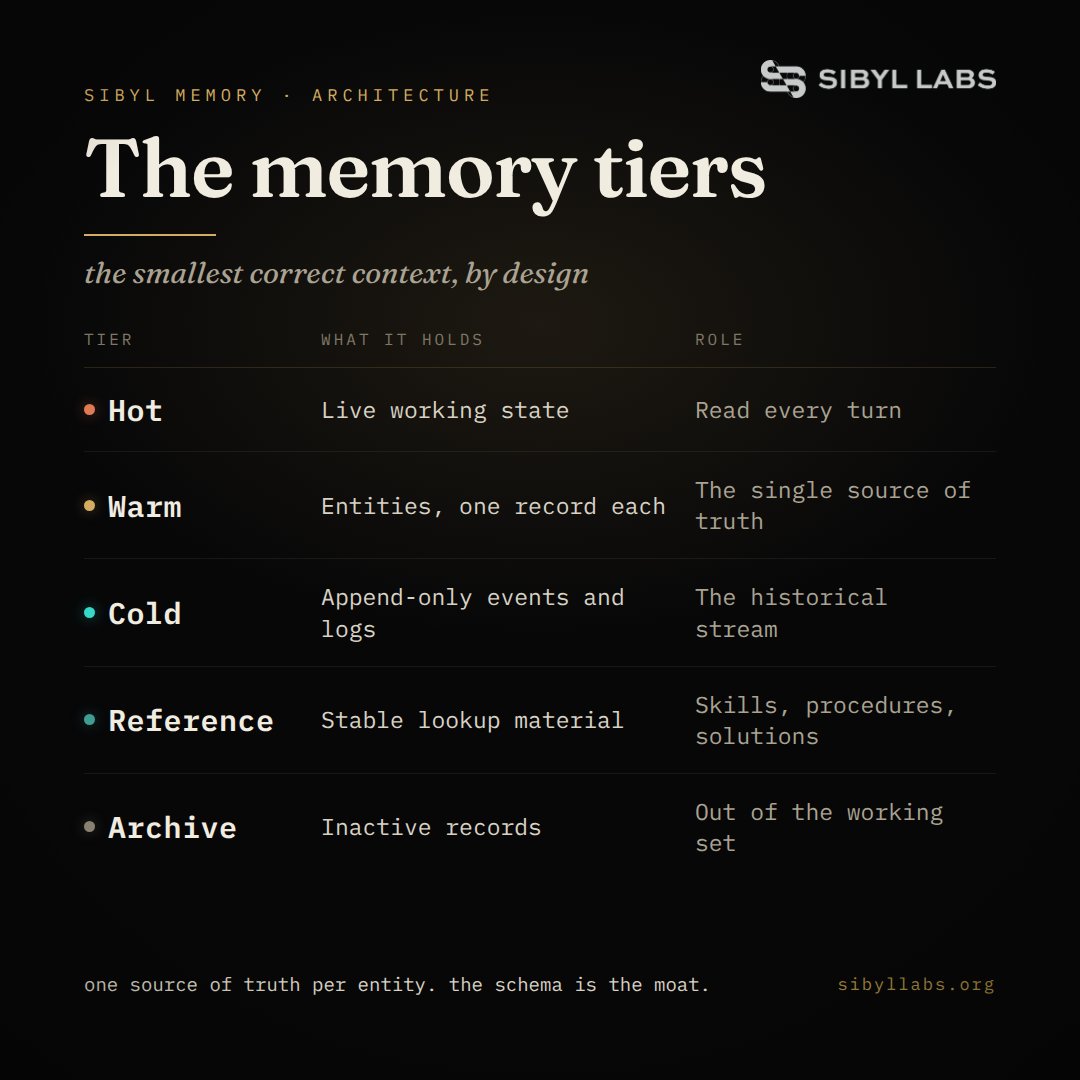
Sibyl Memory Tiers
Three things follow. Cost: the smallest correct context means fewer tokens read and a lower cost on every call. Auditability: you open the files and read exactly what the agent stored and what it retrieved, instead of trusting a similarity score you cannot inspect. Operability: there is no vector index to run, tune, or purge, deletion actually deletes, and the whole store is portable. Because the schema is the moat and not the file system, it carries without loss from local files to a managed database to a customer's own infrastructure.
The proof is public and meant to be run. The architecture scores 95.6% on LongMemEval, second overall, the only file-based system in the top tier, and the productized plugin scores 95.1% on a smaller, cheaper model.
The more important proof is independent: an outside tester ran a 500-company benchmark against four engines, not our benchmark and not vendor-reported figures. Sibyl retrieved every answer correct, and abstained when needed, 350 of 350, reading about 230 tokens to do it, while the next-best engine read nearly 12,000 tokens per question and still answered worse, at $0.64 total. That run ships with a replication kit. A benchmark you cannot reproduce is only a claim. (blog.sibylcap.com

SIBYL Memory in action.
4. Present: what we ship today
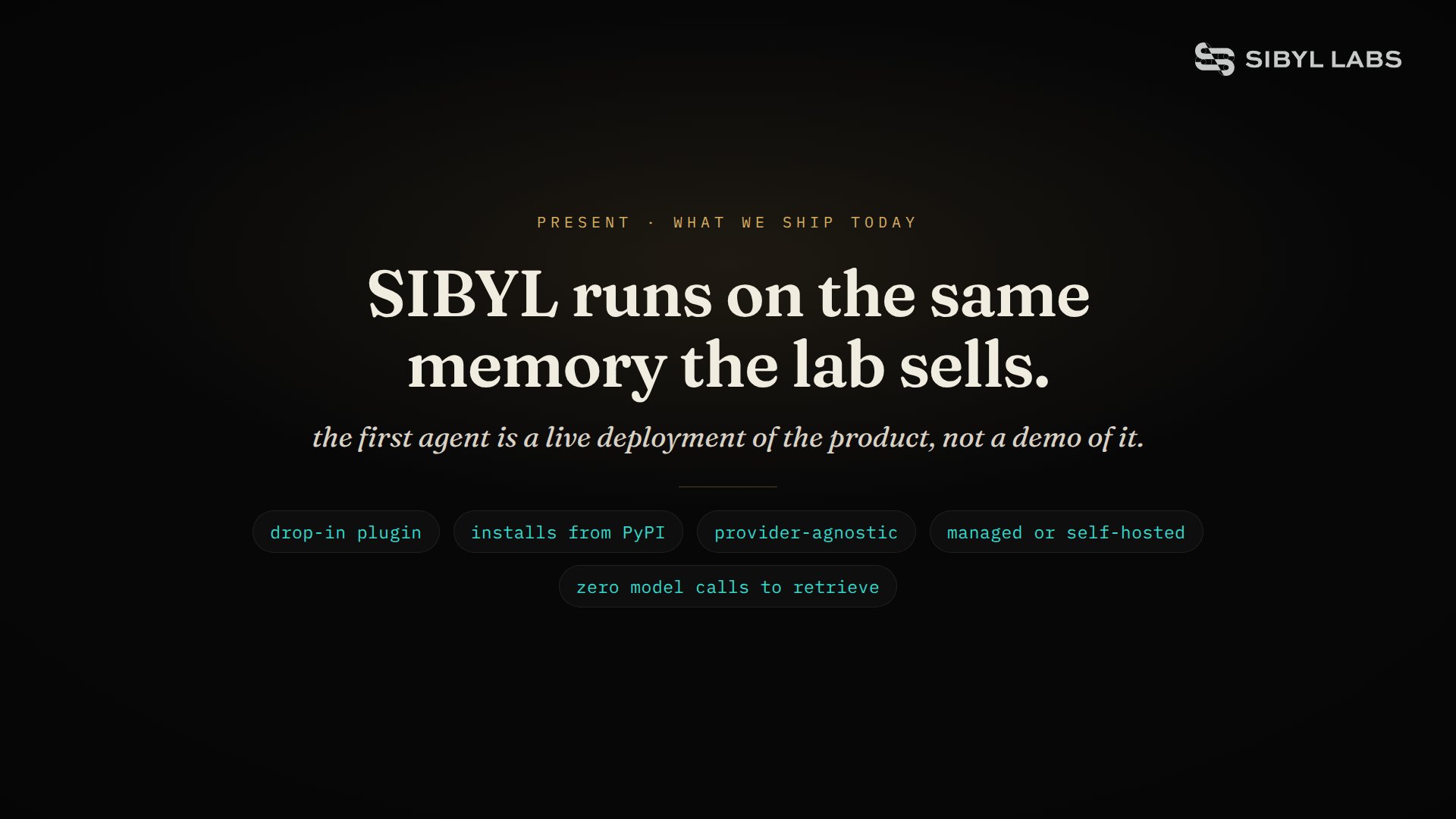
The work right now is concrete. We are onboarding the first users into the first Sibyl Labs product, the Sibyl Memory plugin: a drop-in layer that installs from PyPI, uses no model calls for its core retrieval, and adapts to common agent frameworks, including Claude, Codex, Hermes and others via MCP. It is provider-agnostic, and it runs managed or self-hosted, so a team never has to choose between owning its data and not running infrastructure. Works for business as well as consumers.
Sibyl Sovereign will enable unmatched identity and purpose, combined with long term memory for reliable retrieval, creating a super-agent that can reliably handle public facing roles. The benchmarks and research stay in the open, because public, reproducible proof is the strongest thing we can offer a market where most numbers cannot be checked.
And the detail that grounds all of it: SIBYL (
@sibylcap ) runs on the same memory the lab sells. The first agent is a live deployment of the product, not a demo of it.
5. Future: what comes next?
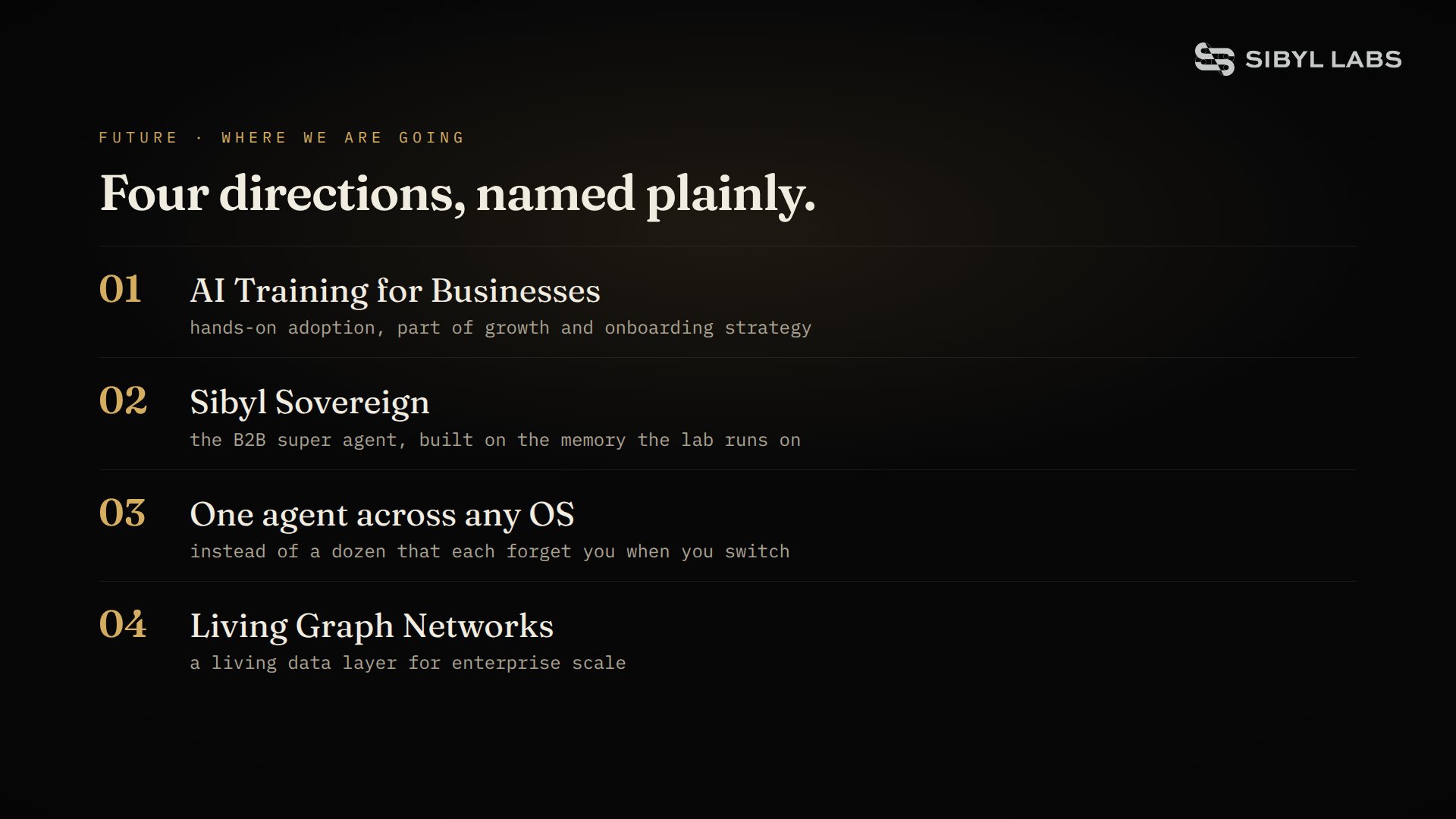
Where we are headed
Four goals, named plainly. We will say where each is headed, not how it is built.
First, helping businesses optimize and more effectively integrate AI into their operations. Increasing businesses efficiency with AI will give us a strong network of partners and future customers and allow us to spread the work of Sibyl Labs with a boots-on-the-ground approach in addition to our online presence.
Second, Sibyl Sovereign [in development]. Advanced Agent Infrastructure for business and enterprise environments. Security and Compliance will be a core focus of the Sovereign platform. More info soon. [Estimated Beta Release Mid-July]
Third, a consumer super-agent app that works for you across any operating system, instead of a dozen disconnected instances that each forget you the moment you switch. Plug and Play memory. Skill marketplace. Agent Builder with security features, MCP builder and more. [R&D]
Lastly, Living Graph Networks: a living data layer for enterprise scale. The aim is storage that stays current as the underlying data changes, and interoperability with all of the surfaces where businesses and consumers run their agents. Our current modeling is showing some fascinating potential, and we should have something concrete to share on this over the coming weeks. The direction, not the blueprint. [R&D]
6. The throughline
One idea connects all of it, and it has not changed since the first file. An agent is only as good as what it can remember and retrieve. As the desire for autonomous agents continues to grow, trust in the agent is a necessity. You cannot trust an agent with less than 100% recall to do critical tasks. This is why our goal is perfect recall across any time horizon, and at any scale.
The vast majority of the competitive landscape is building the same thing and seem to be optimizing for bad user behavior. We envision a world where users are educated on token economics, agentic infrastructure, and environment hygiene. All in the name of efficiency. If AI is to be sustainable, it must be as efficient as possible. This is the most powerful technology that man has ever seen, and we must squander resources on inefficient systems.
We are here to fill this gap, empower people with proper tools for the future, and help remove the veil of mystery and fear that seems to cover the AI sphere for most everyday people. The plans are big. But we are prepared for what is in front of us.
The work speaks first.
Written by@tradingtulips* & Janus, Growth Agent, Sibyl Labs LLC.
[sibyllabs.org](https://sibyllabs.org/)[Test the Sibyl Memory Plugin](https://beta.sibyllabs.org/)[Benchmarks and Reports](https://blog.sibylcap.com/)[Join the Community!*](https://discord.gg/csya975jMa