عرض المطالبة كاملة ونسخها
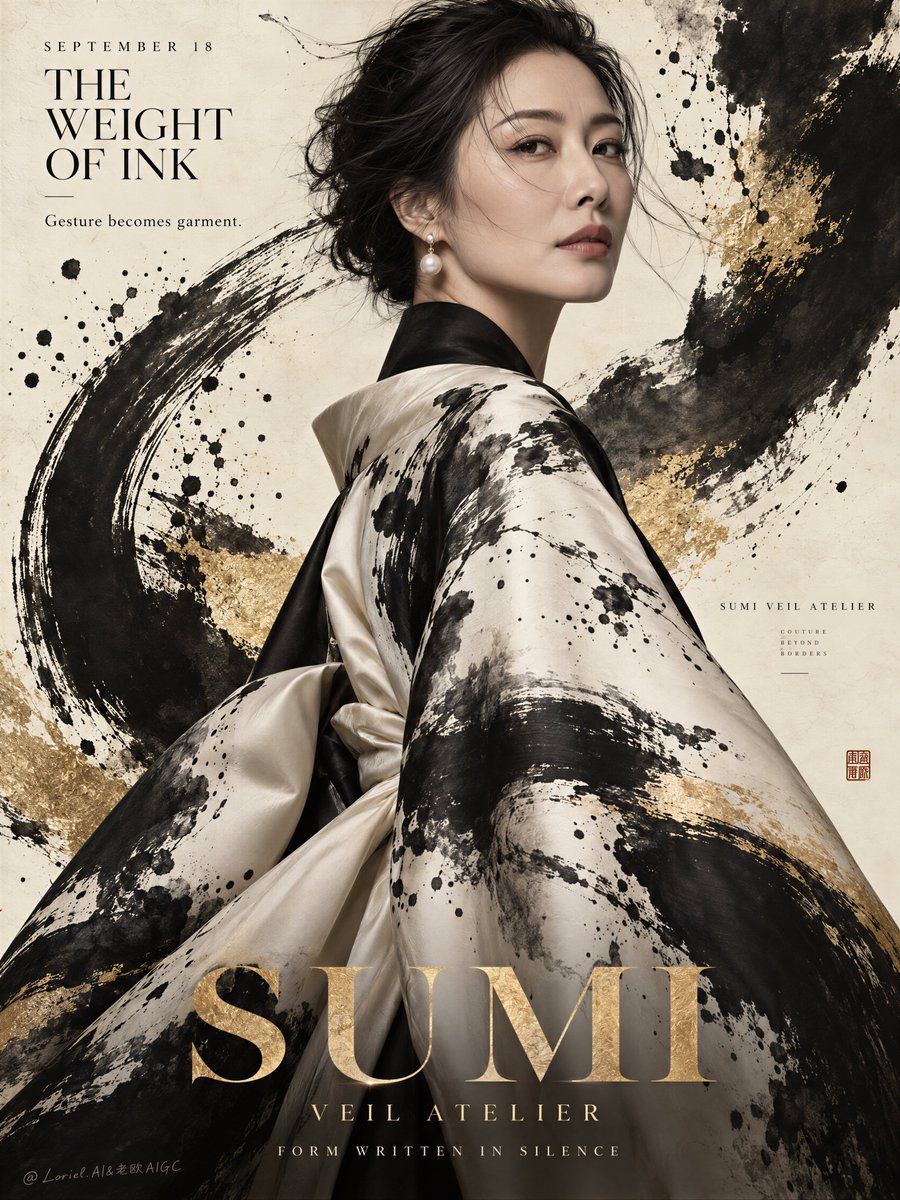
Create a premium editorial fashion poster for a fictional international couture label named SUMI VEIL ATELIER, designed as a single vertically composed campaign image where the hero product is a luxury kimono-inspired outerwear piece transformed by powerful ink expression. The image must feel like a Cannes-level fashion poster, a collector’s exhibition print, and a gallery-grade cultural fashion campaign at once. Preserve the core structural logic of the reference as pure visual language: a refined half-body female portrait, monumental fashion pose, large negative paper-like background, dramatic black ink movement, restrained gold accent, and elegant editorial typography.
The central subject is a real mature East Asian woman shown in a close half-body portrait, body turned slightly away while looking back toward camera with calm authority, emotional restraint, and elevated fashion presence. Her anatomy must be elegant and realistic: natural head-neck-shoulder proportion, refined jawline, believable collarbone structure, soft but precise facial symmetry, realistic skin pores, subtle tonal variation, natural lips, and slightly wind-disturbed dark hair strands across the forehead and cheek. She wears sculptural pearl-drop earrings and no excessive jewelry. Her expression is poised, intelligent, and quietly magnetic.
The hero garment is a couture kimono-coat in ivory silk and cream satin with deep black lapel architecture, broad sleeves, fluid drape, and museum-grade textile finish. The key creative focus is the ink treatment: the garment must carry intensely expressive sumi-ink gestures that feel physically painted into the textile, not printed flat and not pasted on top. Build bold carbon-black brush sweeps, violent dry-brush fractures, feathered ink bleed, dense calligraphic splashes, fractured splatter constellations, broken bristle streaks, watery dilution edges, and layered gestural marks that travel across sleeve, shoulder, back, and lower robe with true brush energy. Some marks should feel like one decisive strike; others should feel like pooled ink dragged by fabric motion. The garment should look as if the wearer is wrapped in a living calligraphy performance. The ink must be the secondary hero after the silhouette itself.
Push the ink expression further into the full poster environment. Behind the woman, create large abstract black ink arcs and explosive brush blooms across the parchment background, echoing but not duplicating the garment marks. Add controlled ink splatter, semi-dry brush tails, misted overspray, soft smoke-like wash transitions, and one or two sweeping gestural strokes that cut through the composition like emotional architecture. Integrate a restrained metallic-gold mineral wash or brushed gold foil accent beneath and around selected ink regions so the black ink gains luxury contrast. The ink must feel raw, immediate, and handcrafted, but the overall composition must remain clean, premium, and highly controlled.
The background is a refined parchment-ivory editorial field with subtle paper tooth, warm cream variation, and soft museum-wall depth. Let the black ink breathe against the pale surface. Keep the environment mostly abstract and spatially open so the portrait, garment, and ink gestures dominate. The image should feel like a collision between couture portraiture, contemporary calligraphy, and collectible poster design.
Typography must be sparse, elegant, and integrated as graphic architecture. In the upper-left, place a minimal editorial title system in newly invented English only, for example:
"SEPTEMBER 18"
"THE WEIGHT OF INK"
with one short supporting line such as:
"Gesture becomes garment."
At the bottom, place one monumental gold serif word across the lower width, such as "SUMI" or "MARK", acting as a visual base. Beneath it, add one short line like:
"FORM WRITTEN IN SILENCE"
Typography must remain refined, spacious, and secondary to the ink-driven garment, never cluttering the image and never crossing the eyes or key facial contour.
Color hierarchy: 50% parchment ivory, warm paper beige, and soft cream; 30% carbon black, ink-wash charcoal, and deep gestural shadow; 15% muted metallic gold, ochre-gold dust, and brushed mineral highlight; 5% natural skin tone, pearl highlights, and subdued lip warmth. Lighting should be soft yet sculptural: one gentle directional editorial key light from upper-front-left, smooth falloff across the face and silk folds, subtle highlight on satin edges, and enough contrast to make the ink strokes feel tactile and dimensional. Avoid muddy shadows, flat studio blandness, or dead black blocks.
Material semantics must be explicit and luxurious: silk sheen, satin depth, paper fiber, gold mineral dust, pearl luster, wet-ink density, dry-brush abrasion, diluted ink feathering, splatter droplets, hair strand realism, and skin microtexture. The final poster must feel like a luxury fashion object where couture, calligraphy, and emotional gesture become one.
Output goal: one single finished vertical fashion poster, photoreal portrait realism, product-dominant couture hierarchy, intensified sumi-ink expression, monumental editorial typography, and world-class print-finish sophistication.
Quality control and exclusion constraints: photoreal only, correct female anatomy, realistic face and neck structure, natural skin texture, no plastic skin, no waxy smoothing, no distorted facial features, no asymmetrical eyes, no malformed ears, no broken garment drape, no fake pasted ink marks, no unreadable typography, no random letters, no cluttered layout, no cheap cultural cliché styling, no style drift, no AI slop, no real person names.