How to quickly understand an industry
This report systematically analyzes an industry from eight dimensions: life cycle, feasibility, scalability, defensiveness, profitability, valuation, external factors, and economic climate, and provides a complete industry research report.
Featured by
淡苍
Why we love this skill
This skill is the essence of McKinsey-style industry research. Through "search first, judge later" and an eight-dimensional analysis framework, it ensures that every report is based on the latest data, providing in-depth insights and decision-making recommendations, rather than generalities.
Instructions
The author has set the instructions to private. Below is a brief overview.
Description
📋 User Guide: This Skill is an industry research engine driven by McKinsey methodologies, based on the eight-dimensional framework in Xiao Jing's "How to Quickly Understand an Industry." You tell it an industry name, and it generates a systematic industry research report for you. —————————————————————————————— 🚀 Basic Usage: Simply tell me what industry you want to research, the more specific the better: a. "Please analyze the solid-state battery industry for me" b. "Look at the humanoid robot industry chain from an entrepreneurial perspective" c. "Is the photovoltaic industry still worth investing in?" You can include three pieces of information (not mandatory, I will use the default if missing): 1. Industry Name: The more specific the better, such as "perovskite photovoltaics" rather than "new energy," this is "required"; 2. Goal: Investment/Career Selection/Entrepreneurship/Competitive Analysis/Popular Science, default: Investment; 3. Region: China Market/Global/USA/Southeast Asia..., default: China Market; —————————————————————————————— ⚙️ What will it do automatically? The entire process is divided into four stages: 1. Multiple rounds of online searches to gather evidence of market size/growth rate/penetration rate, industry chain, competitive landscape, moat, policies, and valuation—every conclusion has a source and timeframe, and is never fabricated; 2. Life cycle positioning: using penetration rate to determine whether the industry is in the introduction/growth/maturity/decline stage, with completely different research focuses at each stage; 3. In-depth analysis across eight dimensions: business model → market size → moat (mandatory in-depth analysis of dynamic trends) → competitive landscape (mandatory scoring of each of the five forces) → valuation → PEST analysis → business climate; 4. Anti-consensus testing: distinguishing between market-priced, obvious trends and overlooked real problems, and providing decision-making suggestions; —————————————————————————————— 📊 What will be produced? A professional industry research report in Markdown format is structured as follows: 1. ⚡ 30-Second Quick Assessment — Stage / Core Profitability Logic / Greatest Opportunity / Greatest Risk / One-Sentence Conclusion; 2. Research Subject and Boundary Definition; 3. Life Cycle Positioning (including penetration rate data); 4. Eight-Dimensional Item-by-Item Analysis (Moat includes dynamic trend table and Porter's Five Forces scoring table); 5. Anti-Consensus Test; 6. Conclusions and Decision Recommendations; 7. Key Risk List; 8. Data Sources and Time Explanation; —————————————————————————————— 🔑 Two Core Highlights 1. In-depth Moat Analysis: Not just discussing barrier types, but requiring an answer to "has it widened or narrowed in the past 2-3 years," using market share / gross profit margin / pricing power data; 2. Porter's Five Forces Scoring: All five criteria are assessed, leaving no room for shortcuts, determining who currently has the strongest bargaining power and whether the market structure is favorable or deteriorating for leading companies; —————————————————————————————— ⏱️ This takes approximately 2-4 minutes, as it requires multiple rounds of searching, dimension-by-dimensional analysis, and report writing. —————————————————————————————— 🧩 After the report output is expanded, we can continue with two specialized analyses (you will need to manually confirm these; they won't run automatically): 1. "Dissecting the Chain to Find Bottlenecks": Identifying unavoidable physical bottlenecks in the industry chain during a trend surge, and pinpointing the true beneficiaries; 2. "DCF Valuation": Running a complete discounted cash flow model for specific companies within the industry; —————————————————————————————— ▶️ Want to try? Just tell me an industry name, such as "Please take a look at the AI Agent industry from a startup perspective" or "What's the current situation of the hydrogen energy industry chain?"
Related Skills
View all
LearnOffer Toolkit
A job search system with 10 years of experience from a major Silicon Valley company, encapsulating real recruitment insights and job search methodologies into AI. Offer Toolkit | AI Job Search Assistant breaks down the entire job search process from "discovering your dream job" to "securing an offer" into three intelligent modules: ① JD Decoder: Deeply analyzes job descriptions and generates a personalized Offer Strategy Report: assesses job suitability, core competencies and skill gaps, and predicts key interview questions and high-probability questions. ② Resume Builder: Transforms your experience from "job description" into "impact stories recognized by recruiters": automatically structures personal experience, optimizes project expression and quantifies achievements, generates ATS (Advanced Skills Test), provides user-friendly, high-quality resumes, and supports 11+ printable professional templates. ③ Behavioral Story Library: Unearths your real experiences and creates reusable interview story assets: extracts key projects and growth experiences, automatically converts them into a STAR Framework, builds a personal Behavioral Interview Story Bank, and efficiently handles "Tell me about a time..." type questions. Whether you're struggling with "should I apply for this job," want to "optimize my resume," need to "analyze the JD," or are preparing for the next behavioral interview... Interview and Offer Toolkit automatically identify requirements and route them to the most suitable AI module. Keywords: Job search | Offer | Career | Job Hunt | JD | Job Description | Resume | CV | Behavioral Interview | STAR | Tell me about a time | Interview Preparation
LearnHow to quickly understand a company
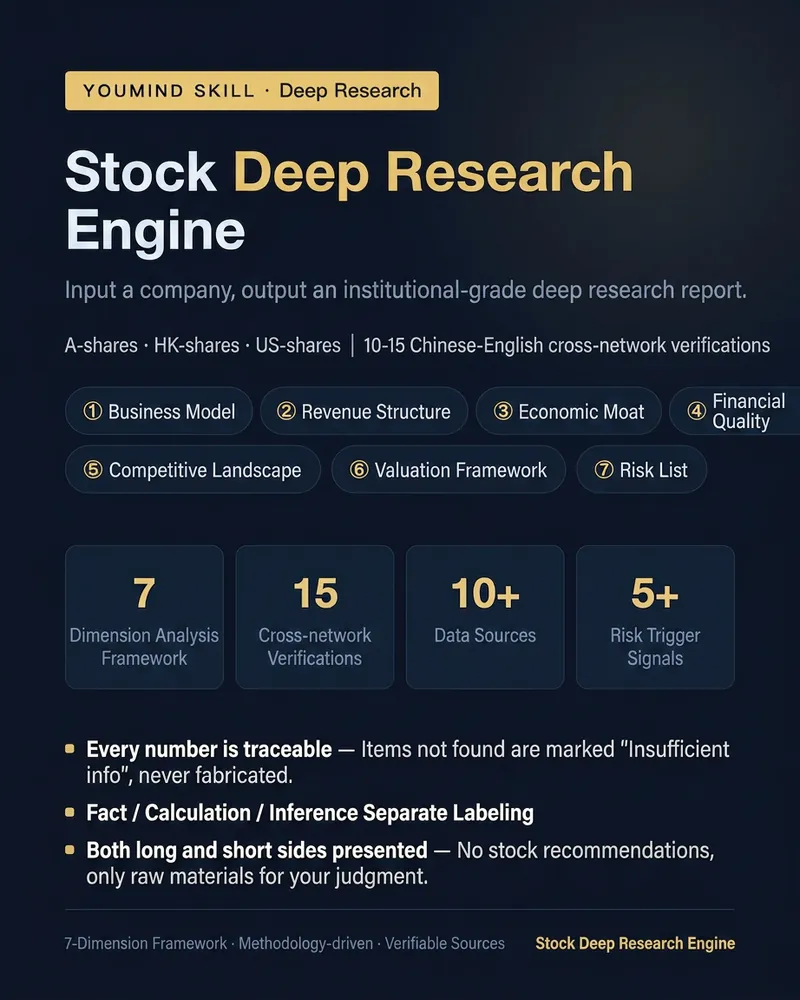
Enter a company name or stock, and use Charlie Munger's multidimensional thinking model to conduct in-depth investment research and analysis of the stock from the perspective of value investing. SKILL automatically connects to the Internet to mine in-depth information, forces a search before judgment, cross-references two sources, and labels the scope and source. It conducts in-depth analysis according to the seven-dimensional framework of value investing, provides three-scenario valuation and 2×2 quality/price decision, and produces an actionable "In-Depth Analysis of Value Investing" report.
LearnThree-element analysis: Understanding the paper
Using the three-element decomposition method of identifying key elements, understanding the small loop, and mastering the large loop, this tool automatically or interactively dissects the argumentation framework of any paper. It includes 14 built-in AI Prompt templates, suitable for all academic readers.
How to quickly understand an industry
This report systematically analyzes an industry from eight dimensions: life cycle, feasibility, scalability, defensiveness, profitability, valuation, external factors, and economic climate, and provides a complete industry research report.
Featured by
淡苍
Why we love this skill
This skill is the essence of McKinsey-style industry research. Through "search first, judge later" and an eight-dimensional analysis framework, it ensures that every report is based on the latest data, providing in-depth insights and decision-making recommendations, rather than generalities.
Instructions
The author has set the instructions to private. Below is a brief overview.
Description
📋 User Guide: This Skill is an industry research engine driven by McKinsey methodologies, based on the eight-dimensional framework in Xiao Jing's "How to Quickly Understand an Industry." You tell it an industry name, and it generates a systematic industry research report for you. —————————————————————————————— 🚀 Basic Usage: Simply tell me what industry you want to research, the more specific the better: a. "Please analyze the solid-state battery industry for me" b. "Look at the humanoid robot industry chain from an entrepreneurial perspective" c. "Is the photovoltaic industry still worth investing in?" You can include three pieces of information (not mandatory, I will use the default if missing): 1. Industry Name: The more specific the better, such as "perovskite photovoltaics" rather than "new energy," this is "required"; 2. Goal: Investment/Career Selection/Entrepreneurship/Competitive Analysis/Popular Science, default: Investment; 3. Region: China Market/Global/USA/Southeast Asia..., default: China Market; —————————————————————————————— ⚙️ What will it do automatically? The entire process is divided into four stages: 1. Multiple rounds of online searches to gather evidence of market size/growth rate/penetration rate, industry chain, competitive landscape, moat, policies, and valuation—every conclusion has a source and timeframe, and is never fabricated; 2. Life cycle positioning: using penetration rate to determine whether the industry is in the introduction/growth/maturity/decline stage, with completely different research focuses at each stage; 3. In-depth analysis across eight dimensions: business model → market size → moat (mandatory in-depth analysis of dynamic trends) → competitive landscape (mandatory scoring of each of the five forces) → valuation → PEST analysis → business climate; 4. Anti-consensus testing: distinguishing between market-priced, obvious trends and overlooked real problems, and providing decision-making suggestions; —————————————————————————————— 📊 What will be produced? A professional industry research report in Markdown format is structured as follows: 1. ⚡ 30-Second Quick Assessment — Stage / Core Profitability Logic / Greatest Opportunity / Greatest Risk / One-Sentence Conclusion; 2. Research Subject and Boundary Definition; 3. Life Cycle Positioning (including penetration rate data); 4. Eight-Dimensional Item-by-Item Analysis (Moat includes dynamic trend table and Porter's Five Forces scoring table); 5. Anti-Consensus Test; 6. Conclusions and Decision Recommendations; 7. Key Risk List; 8. Data Sources and Time Explanation; —————————————————————————————— 🔑 Two Core Highlights 1. In-depth Moat Analysis: Not just discussing barrier types, but requiring an answer to "has it widened or narrowed in the past 2-3 years," using market share / gross profit margin / pricing power data; 2. Porter's Five Forces Scoring: All five criteria are assessed, leaving no room for shortcuts, determining who currently has the strongest bargaining power and whether the market structure is favorable or deteriorating for leading companies; —————————————————————————————— ⏱️ This takes approximately 2-4 minutes, as it requires multiple rounds of searching, dimension-by-dimensional analysis, and report writing. —————————————————————————————— 🧩 After the report output is expanded, we can continue with two specialized analyses (you will need to manually confirm these; they won't run automatically): 1. "Dissecting the Chain to Find Bottlenecks": Identifying unavoidable physical bottlenecks in the industry chain during a trend surge, and pinpointing the true beneficiaries; 2. "DCF Valuation": Running a complete discounted cash flow model for specific companies within the industry; —————————————————————————————— ▶️ Want to try? Just tell me an industry name, such as "Please take a look at the AI Agent industry from a startup perspective" or "What's the current situation of the hydrogen energy industry chain?"
Related Skills
View all
LearnOffer Toolkit
A job search system with 10 years of experience from a major Silicon Valley company, encapsulating real recruitment insights and job search methodologies into AI. Offer Toolkit | AI Job Search Assistant breaks down the entire job search process from "discovering your dream job" to "securing an offer" into three intelligent modules: ① JD Decoder: Deeply analyzes job descriptions and generates a personalized Offer Strategy Report: assesses job suitability, core competencies and skill gaps, and predicts key interview questions and high-probability questions. ② Resume Builder: Transforms your experience from "job description" into "impact stories recognized by recruiters": automatically structures personal experience, optimizes project expression and quantifies achievements, generates ATS (Advanced Skills Test), provides user-friendly, high-quality resumes, and supports 11+ printable professional templates. ③ Behavioral Story Library: Unearths your real experiences and creates reusable interview story assets: extracts key projects and growth experiences, automatically converts them into a STAR Framework, builds a personal Behavioral Interview Story Bank, and efficiently handles "Tell me about a time..." type questions. Whether you're struggling with "should I apply for this job," want to "optimize my resume," need to "analyze the JD," or are preparing for the next behavioral interview... Interview and Offer Toolkit automatically identify requirements and route them to the most suitable AI module. Keywords: Job search | Offer | Career | Job Hunt | JD | Job Description | Resume | CV | Behavioral Interview | STAR | Tell me about a time | Interview Preparation
LearnHow to quickly understand a company
Enter a company name or stock, and use Charlie Munger's multidimensional thinking model to conduct in-depth investment research and analysis of the stock from the perspective of value investing. SKILL automatically connects to the Internet to mine in-depth information, forces a search before judgment, cross-references two sources, and labels the scope and source. It conducts in-depth analysis according to the seven-dimensional framework of value investing, provides three-scenario valuation and 2×2 quality/price decision, and produces an actionable "In-Depth Analysis of Value Investing" report.
LearnThree-element analysis: Understanding the paper
Using the three-element decomposition method of identifying key elements, understanding the small loop, and mastering the large loop, this tool automatically or interactively dissects the argumentation framework of any paper. It includes 14 built-in AI Prompt templates, suitable for all academic readers.
Find your next favorite skill
Explore more curated AI skills for research, creation, and everyday work.