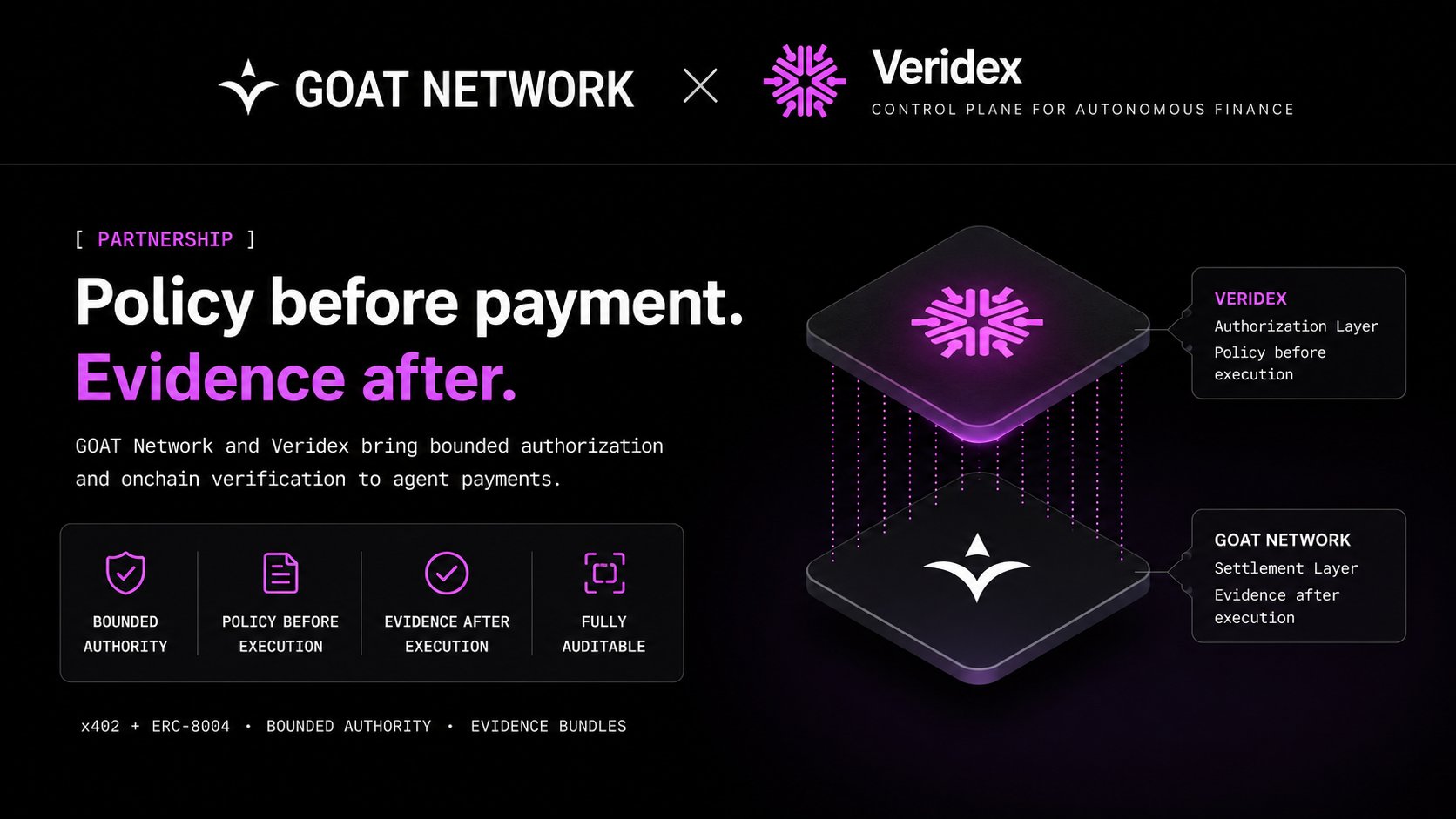
Veridex gives AI agents bounded authority: deterministic policy checks before every payment, ERC-8004 identity, and a tamper-evident evidence bundle for every transaction. The third project in the GOAT AI Builder Grants Program.
Three projects into the GOAT AI Builder Grants Program, a pattern is emerging - and it's the pattern we wrote about before the program began. InFrom Standard Agent to Economic Agent, we argued that agentic commerce creates risk across four layers: reasoning, authorization, trust, and settlement. ThoughtProof, our first project, took the reasoning layer - verifying an agent's thinking before it acts. Today's project takes the next one.
Meet @Veridex_Labs - the authorization layer.
The problem: nobody can safely let an agent spend real money
Agents can call a payment API. That part is solved. What isn't solved is the part that keeps operators up at night: letting an autonomous agent spend real money, continuously, without a human hovering over every transaction.
A spend cap doesn't get you there. A cap doesn't stop a prompt-injected agent from paying an attacker within budget. It doesn't stop a payment to a sanctioned counterparty. It doesn't stop the same invoice being paid twice. Those failures aren't about how much the agent can spend - they're about what it's allowed to do, and today that liability sits entirely on the operator. It's the single biggest blocker between agent demos and real agent transaction volume.
As the Veridex team puts it: agent transaction volume isn't real yet because of risk, not capability.
What Veridex brings to the table
Veridex turns AI agents into safe economic actors. It's two things working together: an agent harness the agent runs inside, and an agentic-payments layer that governs every transaction the agent proposes.
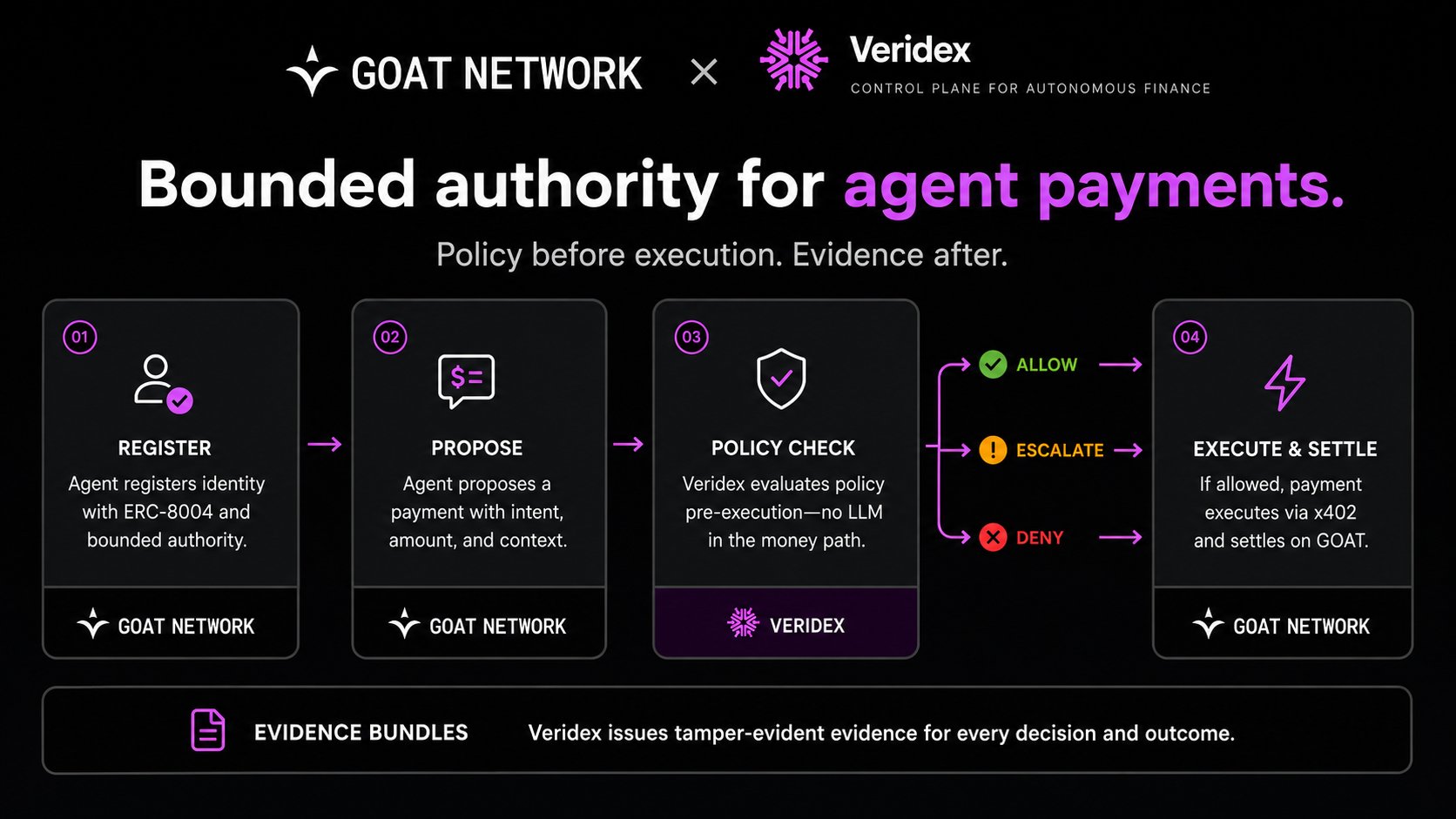
The flow, end to end on GOAT Network:
- A developer registers an agent with an ERC-8004 identity and sets its bounded authority: budget, allowed recipients, payment rails, and policy.
- The agent works - it reasons over a task, plans a workflow, hits a paid service, and proposes a payment.
- Veridex checks the proposal against policy before execution and returns one of three verdicts: allow, escalate for approval, or deny.
- On allow, the agent pays over x402, and settlement is confirmed on GOAT Network.
- Veridex writes a tamper-evident evidence bundle for the transaction - a receipt the operator can audit later.
- The agent repeats this across tasks - continuous transaction volume, fully auditable after the fact.
The result is an inversion of today's trade-off. Operators currently choose between agents that can't touch money and agents they can't fully trust with it. Bounded authority means the agent transacts freely inside the box the operator drew - and can't act outside it.
The design choice that matters: no LLM in the money path
Here's the decision that defines Veridex, and it's worth sitting with: the authorization decision itself is deterministic. There is no LLM in the money path.
The AI does what AI is good at - reasoning over tasks, planning multi-step workflows, deciding what's worth paying for. The guardrails do what guardrails must do - apply the same policy, the same way, every time, in a form that can be audited. Probabilistic intelligence drives the activity; non-probabilistic enforcement bounds it.
If you've followed our builder grants work, you'll notice how cleanly this composes with our first project. @ThoughtProof_ai asks whether an agent's reasoning holds up - a verification problem, answered with independent models. Veridex asks whether an agent's action is within its authority - an enforcement problem, answered with deterministic policy. One checks the thinking; the other bounds the doing. Together they're defense in depth for the agent economy.
Built, open-source, and ready to deploy
Veridex isn't a proposal. The stack is built and open-source - 12 packages with around 1,400 tests - with x402 and ERC-8004 already integrated and the system validated on testnet. The published packages are on npm today, including @veridex/agents (the Agent Fabric - a TypeScript-first agent runtime with native payments, policy, identity, and trust) and @veridex/agentic-payments (a multi-protocol payments SDK supporting x402, UCP, ACP, and AP2 with auto-detection).
And here's the detail we love: all of it was shipped by a two-person team on zero outside capital. That's the resource profile of builders who ship.
Because the GOAT primitives are already integrated, this grant converts fast: the work ahead is deployment, not net-new protocol engineering. Through the program, Veridex will deploy production payment agents on GOAT Network - agents that generate continuous, usage-driven x402 transaction volume with every payment policy-checked before it happens and evidenced after.
Why it belongs on GOAT Network
The agent economy GOAT Network is building runs on exactly the loop Veridex governs: agents discovering services, paying per use over x402, and building reputations through ERC-8004 identity. What's been missing is the layer that lets operators turn that loop on at scale without carrying unbounded risk. Reasoning gets verified. Now authorization gets enforced - deterministically, with receipts.
Two of the four layers, covered. The pattern continues.
Welcome to the ecosystem, Veridex.
Explore Veridex: veridex.network · GitHub · npm
Apply to the GOAT AI Builder Grants Program:goat.network/builder-program
Disclaimer
This article references and links to third-party projects and products, including those built by teams in the GOAT AI Builder Grants Program. These references are provided for information only. A grant, a feature, a mention, or a link does not constitute an endorsement, a recommendation, or a guarantee of any third-party product, and GOAT Network is not responsible for third-party software, services, or websites.
Nothing in this article is financial, investment, legal, or tax advice. Digital assets and onchain applications carry risk, up to and including the loss of funds. Some products described here are early-stage or in active development and may change, pause, or stop working. Always do your own research (DYOR) and assess your own risk before using any product or making any financial decision.