Glad to share another foundational piece of our Physical AI work — TuringViT.
In my previous posts, I've been talking about world models: how they enable Physical AI to predict the future, reason about consequences, and plan before taking action. But all prediction and reasoning rests on perception first.
It starts with a basic question: How does the model actually see the physical world?
The premise from my previous posts still holds: Physical AI cannot be scaled by a single breakthrough model alone. It advances as we improve every component in the pipeline of understanding the physical world.
World models are one critical scaling pillar. Vision encoders are equally fundamental.
Today's vision encoders were largely built for internet-scale VLMs. They work remarkably well for digital content tasks, but Physical AI asks for something different. Intelligent mobility, robotics, and edge deployment all bring high-resolution inputs, multiple cameras, long video streams, dynamic resolutions, and tight latency constraints.
The common solution is to reuse existing ViTs. But that comes with three familiar trade-offs for Physical AI:
- Quadratic self-attention grows prohibitively expensive as input resolution rises
- Scaling raw web data hits rapidly diminishing returns on representation quality
- Fixed-resolution pretraining does not align with how downstream VLMs and VLAs actually operate
Our goal was not to build one more incremental ViT variant. We set out to rethink the full design and training pipeline of a vision encoder, built specifically for Physical AI.
Three core insights shaped our end-to-end design, across architecture, data and training.
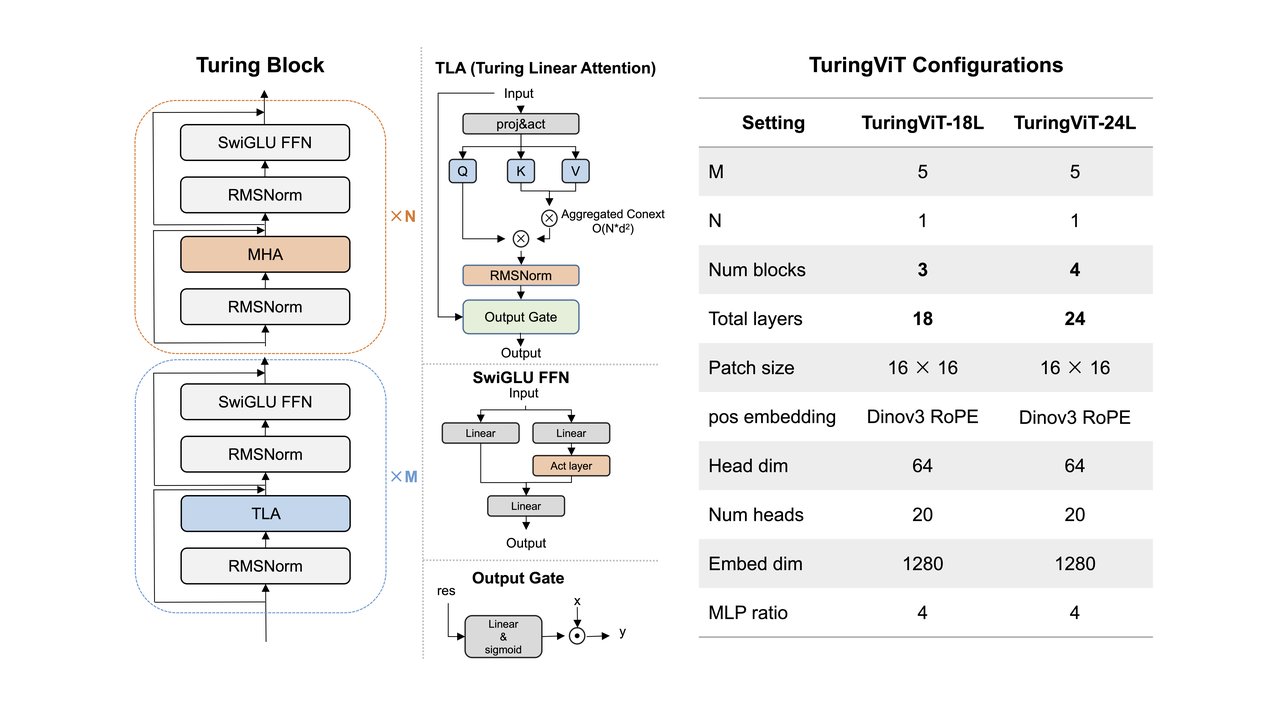
First, efficiency has to scale with resolution. We built Turing Linear Attention (TLA) as the primary computation backbone, with a hybrid structure: 5 layers of TLA for near-linear computational scaling, paired with 1 layer of standard multi-head attention per block to preserve the fine-grained global detail required by Physical AI tasks. The result is nearly flat latency growth as input resolution increases.
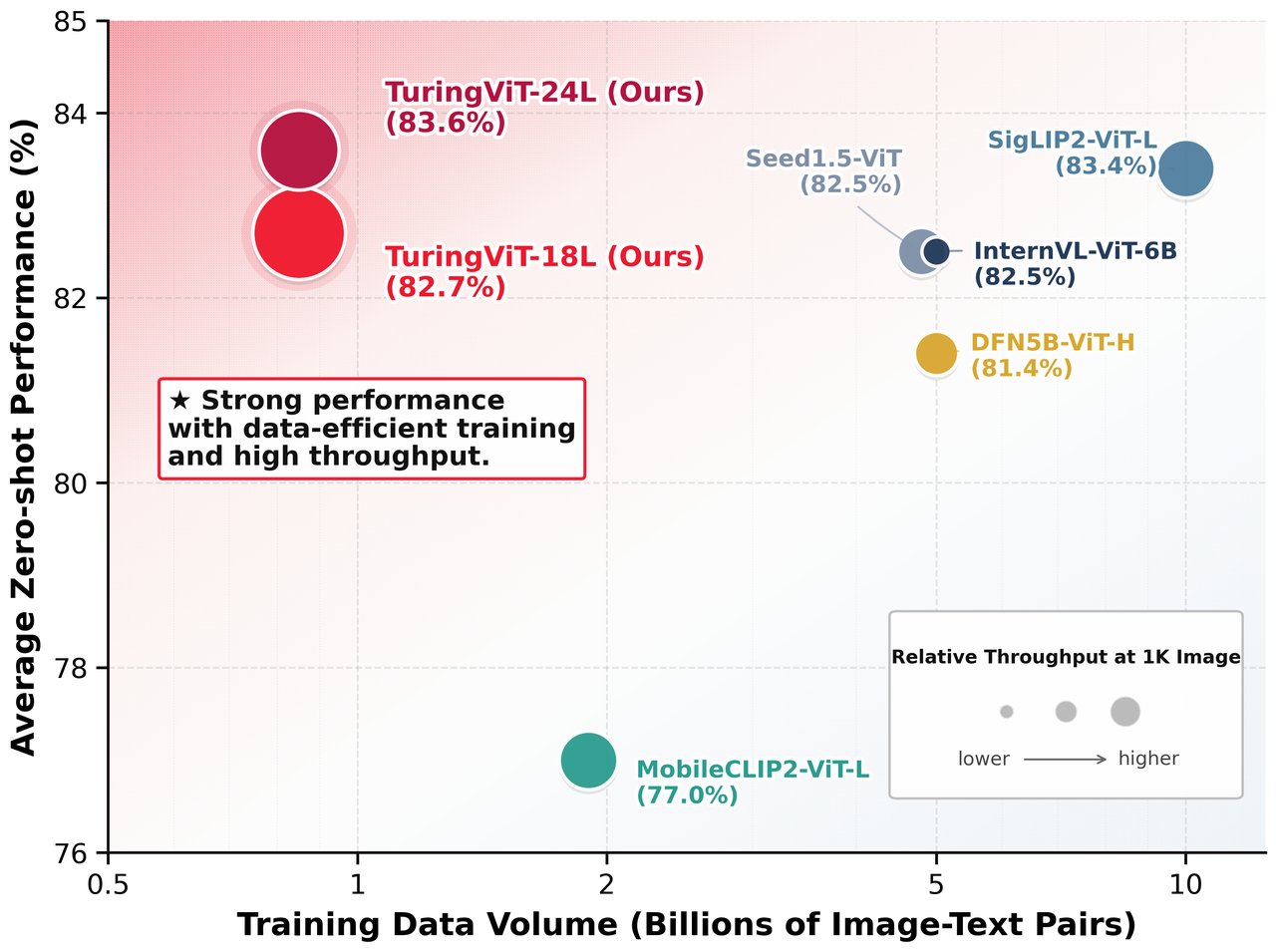
Second, better supervision instead of more supervision. Rather than simply scaling datasets, we built VISTA-Curation to improve the quality of supervision. The result is notable: TuringViT reaches competitive performance using only around 10% as much data as leading open-source ViTs. To us, that's a strong signal that data quality still has plenty of room to scale.
Third, training the way deployment actually looks. Instead of pretraining at fixed resolutions and adapting later, TuringViT learns native dynamic resolutions from day one, bringing pretraining much closer to how downstream VLM and VLA systems are actually deployed.
More importantly, these design principles are not limited to autonomous driving. The same vision encoder now supports intelligent mobility, in-cabin multimodal interaction, and humanoid robotics. Different form factors, different use cases, but the core problem of perceiving and understanding the physical world is the same.
Fore more information: