Today I finally picked up my Tesla, and to be honest, it feels a bit surreal.
In January and February of this year, when news of layoffs from big tech companies was coming one after another, my feed was full of anxiety: "AI is going to replace us," "Programmers are going to lose their jobs."
As for me, I chose to go ALL IN on OpenClaw. I earned a Tesla in one month—forgive the clickbait title, I just paid the down payment.
I was panicked too. But after the panic, I did one thing: I searched for "OpenClaw installation" on Xianyu and Taobao.
And then I saw the most surreal scene of this era.
How Surreal the Market Is
OpenClaw installation services ranged in price from 30 yuan to 5,000 yuan.
That's right, for the same thing, some people charge 30, and others charge 5,000.
I was stunned.
The most ridiculous thing was seeing someone in a group chat take a 16,000 yuan order just to help a company batch-install OpenClaw. A 3,000 yuan deposit had already arrived.
It blew my mind.
I searched carefully on Xianyu and Taobao, and there were all sorts of strange prices. Online installation prices ranged from dozens to hundreds, mostly between 100~200. The cheapest was 30 for deployment. Local on-site installation fees were higher, basically around 500.
Then I thought: Since so many people are doing it, why can't I?
Week 1: Market Testing + First Order
I first posted a few OpenClaw tutorials on Xiaohongshu to test the market reaction.
The titles were very direct: "What OpenClaw can do for you," "AI automation saves 3 employees," "An AI tool you can use without knowing how to code."
Sure enough, people soon sent private messages asking: "Can you help me install it?"
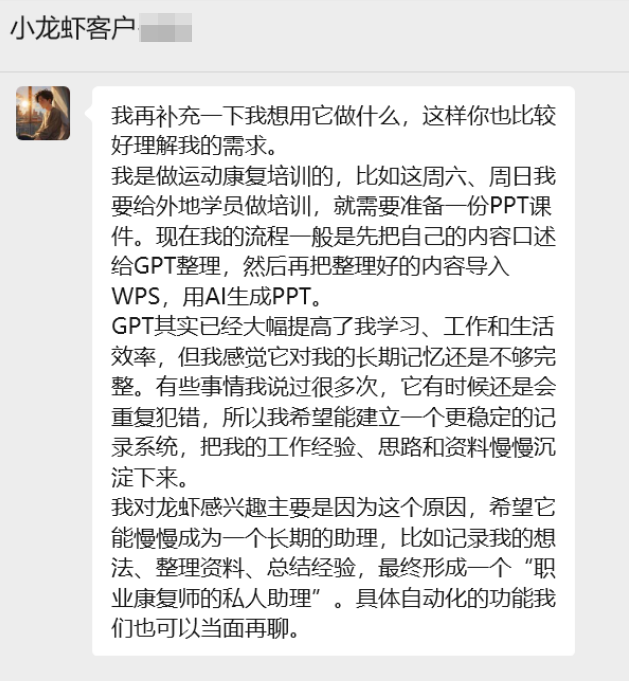
The first client was in sports rehabilitation training, running his own studio and frequently training students from other cities. His pain point was very specific:
Every time he prepared a lesson, he had to dictate the content to GPT for organizing, then import it into WPS to use AI to generate a PPT. Although GPT significantly improved efficiency, its long-term memory wasn't complete. Some things he had said many times, yet GPT would still repeat mistakes.
He hoped to build a more stable recording system to slowly accumulate work experience, ideas, and materials, eventually forming a "private assistant for professional rehabilitation therapists."
I was unsure at the time because it was my first commercial project. But I felt this need was perfect for OpenClaw. I quoted 3,000 yuan, and the other party agreed almost without bargaining.
The actual operation took an afternoon for the entire configuration:
- Remotely helped him install the OpenClaw environment.
- Configured a "Knowledge Management Agent" specifically to record his training content, cases, and experience.
- Set up an automatic organizing function: after he dictated content, the Agent automatically categorized and archived it (e.g., "Shoulder Joint Rehab," "Sports Injury Cases," "Training Plan Templates").
Earning 3,000 in one afternoon, and the client was very satisfied. He said this system was much better than just using GPT because OpenClaw could remember his professional terminology, common cases, and teaching style.
There was a key design here: I set up a "Long-term Memory Bank" for the Agent. Every time he dictated content, the Agent would not only organize the current content but also automatically associate it with historical records. For example, if he talked about "shoulder joint rehab" this time, the Agent would automatically pull up related cases and precautions he had mentioned before, reminding him to supplement or update.
In that moment, I understood: most people don't know about OpenClaw, let alone what it can do. But I know, so I can turn this tool into a service.
Week 2: Content Acquisition + Big Contract
After the success of the first order, I started systematic content output.
My strategy was to push on two platforms simultaneously:
- X (Twitter): Deep technical articles, such as "Detailed Explanation of OpenClaw's Memory Mechanism" and "How to Use Agent Orchestration to Solve Complex Business Processes." The goal was to let people who know the industry see my technical depth.
- Xiaohongshu: Practical tutorials and landing cases, such as "Building an Automated Customer Service System in 3 Hours" and "OpenClaw Helped Me Save 2 Operations Staff." The goal was to let people with needs know what I could do.
This combination worked very well. Within a week, my private messages went from a few scattered ones to over a dozen inquiries a day.
But I soon discovered a problem: most inquiries were ineffective.
Some asked "Can you help me install it for free," some asked "What's the difference between this and GPT," and some wanted to "make an AI that can do everything" right away.
I spent two days filtering and finally locked in 5 reliable potential clients. The screening criteria were simple: clear needs, reasonable budget, and the ability to explain what problem needed solving.
One client's needs really caught my eye.
What truly pushed my income into six figures was an e-commerce automation project.
The client was in cross-border e-commerce with over 20 stores and a team of 10. Their pain points were: low efficiency in manual product selection, high costs for outsourcing images and videos, slow production of detail pages that couldn't keep up with new arrivals, and untimely operation data analysis.
They asked me: Can OpenClaw solve these problems? I said yes, but it requires custom development.
I designed an automation system with 7 Agents for them: product selection analysis, image generation, video generation, copywriting, detail page production, listing management, and data analysis.
The quote for the entire solution was over 100,000 yuan. The client signed the contract almost without hesitation. After signing, I regretted it, feeling I had quoted too low. E-commerce is really profitable, haha.
Week 3-4: Development & Delivery
When I signed the contract, I confidently said, "I'll get it done in a week." It ended up taking two full weeks because I underestimated the complexity of custom development.
Problem 1: API integration was harder than imagined
The client's e-commerce system was custom-developed, and the API documentation was poorly written. It took me 2 days just to understand their data structure.
Problem 2: AI-generated content required extensive debugging
The image generation Agent performed poorly at first; the generated images either had inconsistent styles or detail issues. I repeatedly adjusted prompts and tested hundreds of times before it stabilized.
Problem 3: Client needs kept changing
Initially, they said they only needed 7 Agents, but later they wanted to add inventory alerts, competitor monitoring... Every time a need was added, I had to redesign the workflow.
Problem 4: OpenClaw itself had pitfalls
OpenClaw's documentation wasn't detailed enough, and many advanced features had to be figured out through trial and error. I encountered issues like data transfer errors between Agents, unstable scheduled tasks, and API timeouts.
Here are some hardcore technical details of OpenClaw:
1. Agent Orchestration: Serial or Parallel?
I initially designed the 7 Agents to execute serially: Selection → Image → Copywriting → Detail Page. It turned out to be too slow; it took over 30 minutes for one product from selection to listing.
Later, I changed it to a hybrid of parallel + serial:
- Selection Agent runs first (serial)
- After getting product info, the Image, Video, and Copywriting Agents run in parallel
- Finally, the Detail Page Agent runs after the first three are completed (serial)
This way, a product takes only 10 minutes from selection to listing, an efficiency increase of nearly 4x.
2. Timeout Retry Mechanism
When OpenClaw calls external APIs (like Midjourney), it often encounters timeouts. I added a timeout retry mechanism to each Agent:
- 1st failure: Wait 5 seconds and retry
- 2nd failure: Wait 10 seconds and retry
- 3rd failure: Log the error and skip the task
This mechanism increased the overall success rate from 70% to 95%.
3. Acceptance KPIs: Response Time and Human Intervention Rate
For the customer service Agent's acceptance criteria, I set two KPIs:
- First Response Time: The AI must reply within 3 seconds after a user sends a message. Over 3 seconds counts as a timeout.
- Human Intervention Rate: The proportion of issues the AI cannot solve that are transferred to a human. The goal was to keep it under 15%.
These two KPIs are critical and directly determine client satisfaction.
4. A Failure Case and Fix
Once, the customer service Agent suddenly started talking nonsense. A user asked "Is this product in stock?" and it replied "Our company was founded in 1998."
After troubleshooting for a while, I found it was because I added the company introduction to the system prompt, causing the Agent to mix company info with product info.
Fix: Split the system prompt into two layers: one for global rules (e.g., reply style, forbidden items) and one for contextual information (e.g., product inventory, user history). This way, the Agent won't get confused.
5. Memory Management: Short-term vs. Long-term Memory
OpenClaw's Memory mechanism has a pitfall: if you don't clean it up, Memory keeps accumulating, eventually leading to Token limits being exceeded.
My solution:
- Short-term Memory: Keep only the last 10 rounds of conversation; automatically clear beyond 10 rounds.
- Long-term Memory: Store important information (e.g., user preferences, historical orders) in an external file and call it when needed.
This ensures conversation continuity while avoiding Token explosions.
The most time-consuming part of the whole project wasn't writing code, but understanding what the client actually wanted. The client initially said: "I want an automated e-commerce assistant system." I asked: "Specifically, what do you want to automate?" The client said: "The kind that helps me save manpower."
This kind of demand is too vague. I had to dig bit by bit: Which of your current tasks take the most time? Which tasks are repetitive? To what extent do you want the AI to help you? What error rate can you accept?
After asking around, I finally understood their real pain points. This is why now, before taking an order, I must conduct a needs interview, write a clear requirements document, and have both parties sign and confirm. Otherwise, it's impossible to settle disputes later.
Review: Gains from This Experience
In nearly a month, I took on 3 projects and developed over 20 Agents. Every day after work, I worked until 2 or 3 AM. Why I bought a car immediately is another story.
In addition to big orders, I also took some small ones: remote installation services (500-3,000 yuan/order, done in 2 hours; this is now oversaturated, so I gave it up), simple customization (e.g., automated customer service, content publishing, data scraping, 5,000-10,000 yuan/order), and consulting services (some clients just want to know if OpenClaw can solve their problems; I charge by the hour, 500 yuan/hour).
Although these small orders have low unit prices, they add up. The e-commerce order was a big one converted from a client recommendation.
Looking back at this period, I've summarized a few lessons:
Timeline Review
- Week 1: Tested the market, received the first order, validated the model.
- Week 2: Content acquisition, signed a big contract, set acceptance standards.
- Week 3-4: Development and delivery, fixed pitfalls, client renewed the contract.
Core Experience
- X builds professionalism, Xiaohongshu acquires clients; multiple clients found me proactively.
- Acceptance standards, number of revisions, and responsibility boundaries must be clearly written.
- Learning while doing is the fastest; when I took the first order, my understanding of OpenClaw was only about 60%, but I didn't wait until 100% to start.
Finally, a message for everyone: ordinary people have no choice.
It was the worst of times, it was the best of times.
ALL IN AI, JUST DO IT