Most people install a local model for one reason - to stop paying subscriptions. They download Ollama or LM Studio, run an open model, save twenty dollars a month, and the story ends there. That's fine. But a smaller group looks at the same box and sees something different: not a chatbot, infrastructure.
Here's the honest frame before the list. OpenAI, Anthropic and Google all built businesses on one idea - people pay to use computers they don't own. Every prompt runs on someone else's hardware, and every month you keep paying for access. A local box flips that: you own the thing doing the work. History rewards people who own infrastructure over those who only rent it - the web rewarded platform builders over browsers, the cloud rewarded companies that ran servers over ones that only used them. AI is early in the same pattern.
None of this makes you rich overnight, and installing a model doesn't create income by itself. What it does is unlock work that pays: businesses want lower AI costs, private data, and repetitive tasks automated, and a local model makes all three possible. Here are ten realistic ways people turn that into money - and the honest version of each.
1. AI automation agency
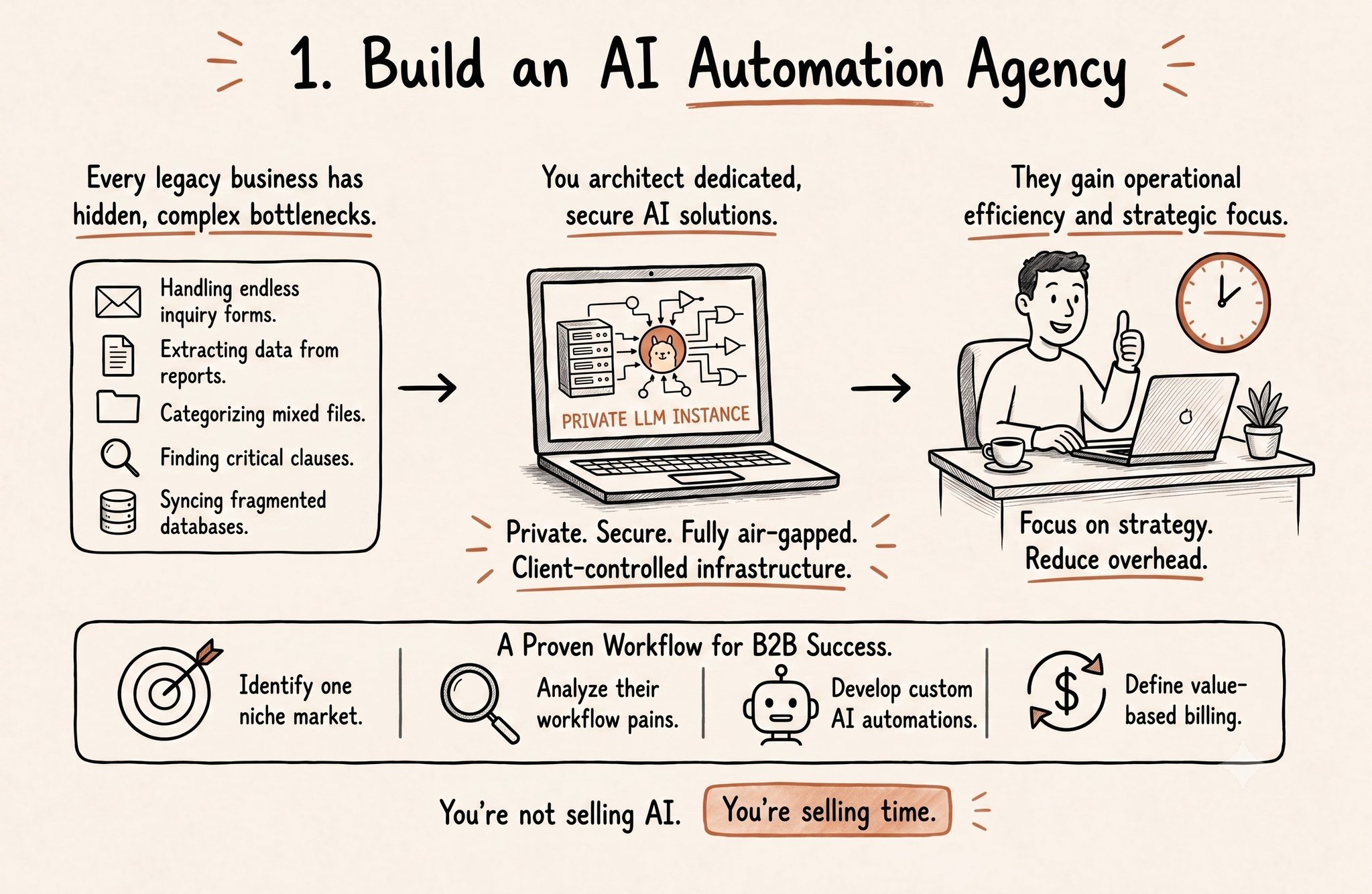
The fastest first client isn't another chatbot - it's solving the repetitive work every company hates: copying data between systems, answering the same emails, summarizing documents, searching hundreds of PDFs. You don't sell "AI," you sell a better workflow, and running it on the client's own box means their confidential data never leaves the building. Pick one industry - accountants, law firms, real estate - and the same problems repeat across dozens of companies. You're selling time back, and businesses always buy that.
2. Private AI infrastructure for businesses
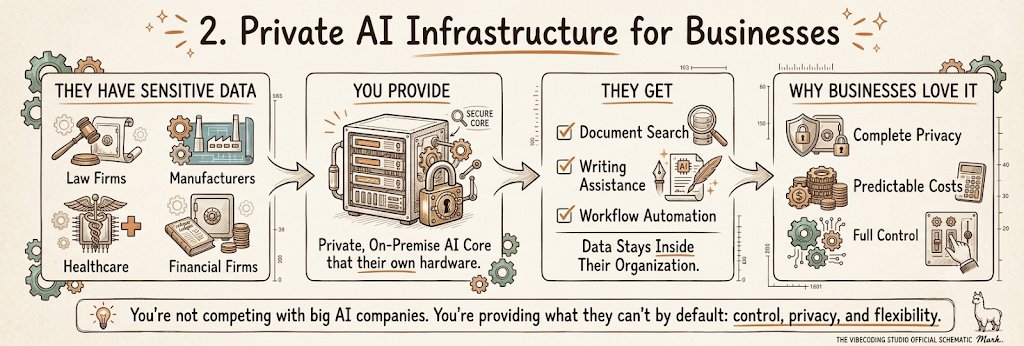
Plenty of companies legally can't send internal documents to public AI - law firms, manufacturers with proprietary designs, healthcare, finance. Instead of telling them to replace ChatGPT, you give them an assistant that runs entirely on hardware they control: document search, writing help, automation, with the data staying inside. Privacy is half the pitch; predictable cost is the other half, since a local server doesn't bill per prompt. You're not competing with the frontier labs - you're offering the one thing they can't always give: full control over where the model runs.
3. Vertical (niche) SaaS
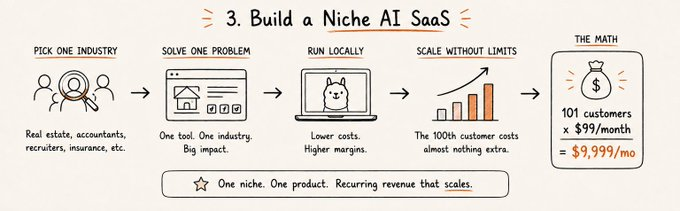
Freelancing has a ceiling: more clients, more meetings, more custom work, until you've built yourself another job. A niche SaaS breaks it - build one product for one industry and sell the same version to everyone in it. A tool for real estate agents that turns property details into a listing, ad copy and captions in one pass; the same shape works for accountants, recruiters screening CVs, or brokers comparing policies. Local inference keeps your cost per customer flat, so margins improve as you scale instead of shrinking under API fees. The math is simple, and it's just math, not a promise: 101 customers at $99/month is $9,999 before a single consulting call - the point is that the model can scale, not that those customers appear on their own.
4. Private AI API service
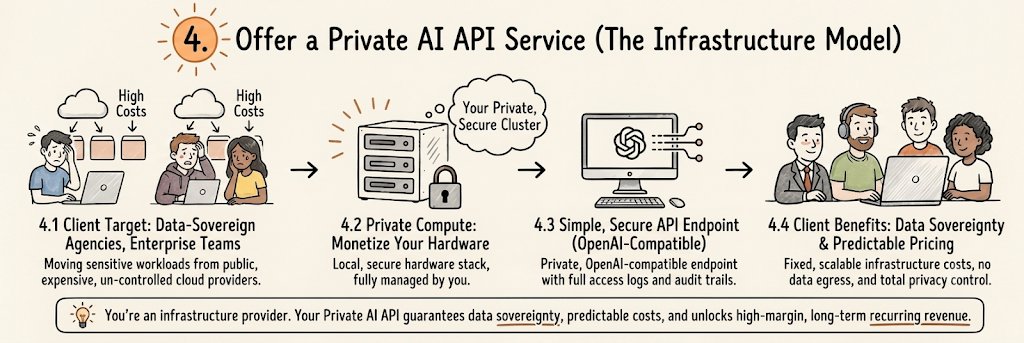
Thousands of developers build on OpenAI-compatible APIs, and every request costs money that grows with usage. You can host open models on your own hardware and hand clients an API endpoint that behaves like a commercial one - simple for them, and it monetizes hardware that would otherwise sit idle most of the day. This wins with teams that want predictable pricing or control over where data is processed. Success here is less about the smartest model and more about reliability: uptime, consistent performance, responsive support. Trust earns recurring revenue.
5. AI content factory
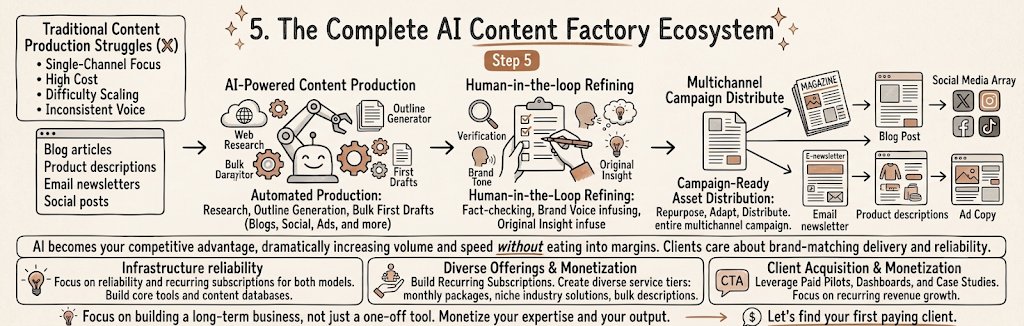
Almost every business needs content, and the old agency model scales badly because more clients mean more writers and editors. Local AI changes the economics - research, outlines, first drafts, translations and repurposing get handled by the model while humans edit, fact-check and add the original insight. One article becomes an X thread, a LinkedIn post, a newsletter and several short posts with a few more prompts. You're not selling AI articles, you're selling a production system - and because the model runs locally, generating volume doesn't eat your margin in token costs.
6. Fine-tuning and RAG as a service
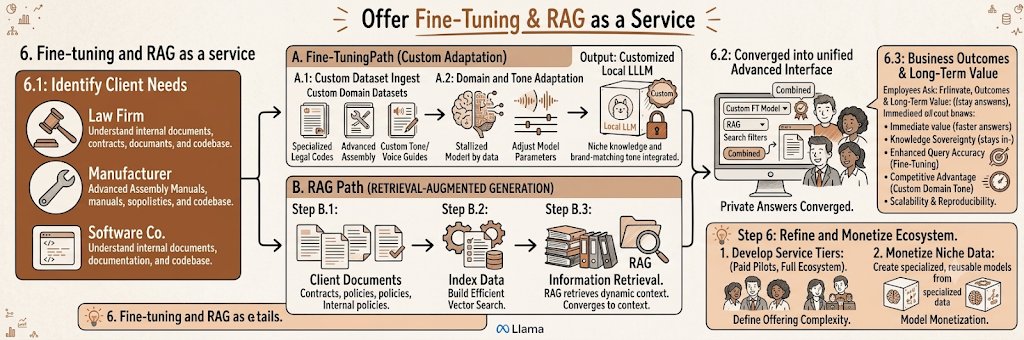
Most companies don't need a custom-trained model - they need AI that understands their business. A firm wants answers from its own contracts, a manufacturer from thousands of pages of technical docs, a software team from its own codebase. Retrieval-augmented generation connects an existing open model to the company's documents so employees ask in plain English and get answers from information they already own. New hires ramp faster, senior staff stop digging through folders, and knowledge stays when someone leaves. It's a premium service because you're selling instant access to years of accumulated knowledge - and once you've built one for an industry, the next is faster.
7. Consulting for local AI adoption
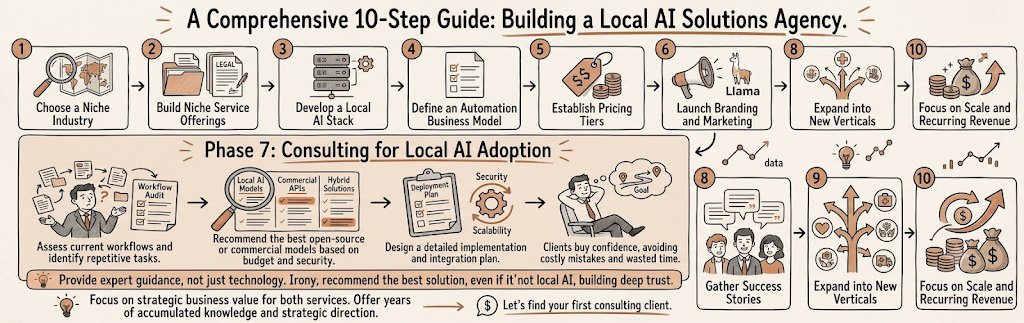
Thousands of companies know they should use AI and have no idea where to start. Your job isn't writing prompts all day - it's helping them decide: assess the workflows, find the repetitive tasks, recommend the right open models, design a plan that fits their budget and security needs. Sometimes the answer is local, sometimes it isn't, and clients trust the consultant who says so instead of forcing local AI into everything. They're not buying technology, they're buying confidence - a wrong AI decision costs months and thousands, and paying to avoid that is cheap.
8. Internal AI knowledge systems
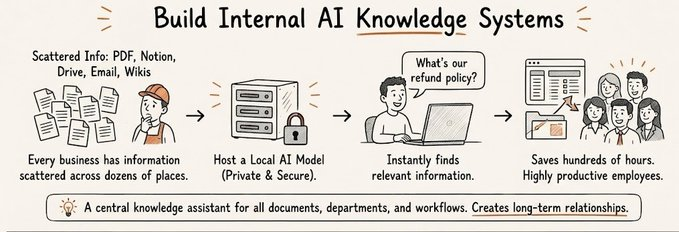
Every company's information is scattered - PDFs, meeting notes, Drive folders, Notion, network drives, wikis, email. Finding the right document takes longer than the work. A local knowledge system lets employees just ask: "what's our refund policy for enterprise customers?" and get the answer in seconds from internal docs. It's one of the easiest services to sell because every owner instantly recognizes the problem, and it grows over time as you connect more departments - which turns a one-off project into a long-term relationship.
9. AI products built for one industry
Your edge as a small builder is speed and focus. While big labs build for everyone, you build for one market, and the narrower it is, the easier you stand out. Software built only for accountants - categorizes invoices, explains tax rules from internal docs, summarizes reports, drafts client emails - beats a general assistant with dozens of features nobody asked for. A niche product is easier to sell (customers get it immediately), easier to onboard, and every new customer teaches you how to improve it for the next. The classic mistake is building for everyone; the fast-growers own one audience first.
10. Turn the hardware itself into the business
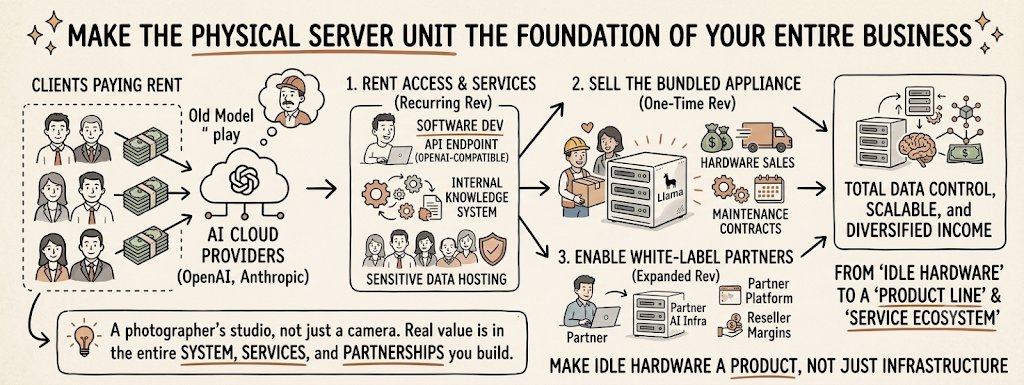
By now the pattern is obvious: most of these aren't really about AI, they're about owning infrastructure. Thousands of businesses pay the labs monthly because they don't own the hardware - they rent intelligence. When you own it, one server can run internal knowledge systems by day, host private APIs for clients, and run automations overnight - the same box earning several ways instead of sitting idle. Stay realistic: one computer won't instantly make a six-figure business. The hardware is the foundation; the value is the services and relationships you build on it. Think of it like a photographer's camera or a contractor's equipment - a professional tool, not the business itself.
The honest close
A few years ago this needed big budgets and ML teams. Now it needs some time to learn. Most people will use local AI to drop a few subscriptions and write emails faster, and there's nothing wrong with that. None of these ten require inventing a new model - they require understanding how businesses create value. As the tech gets easier, the advantage shifts from owning it to knowing how to apply it. Most people install a local model and ask "what can this do for me?" The ones who build something ask a different question: "what can it do for everyone else, and how do I build a business around it?"
I write about Claude, local AI, agents, and the systems that turn them into real work. Follow @88n77n.