The hottest role in tech pays $150K base to $1M a year.
Most people can't even explain what it is.
It's the Forward Deployed Engineer. The person who decides where AI belongs inside a business.
Here's the 30-day playbook to become one.
Start with the shift
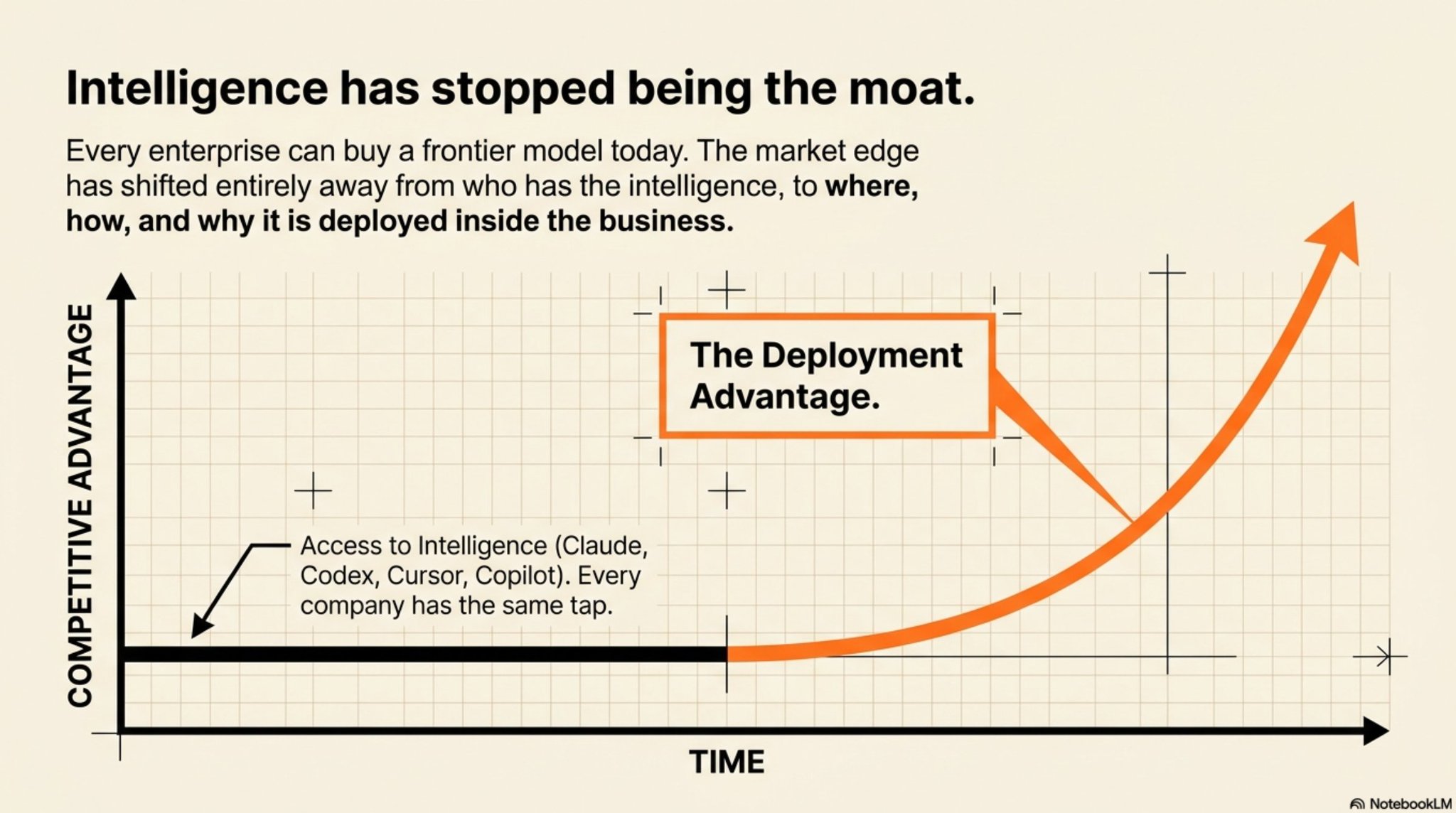
Every company can now buy intelligence. A new frontier model drops almost every day.
Talk to 50 enterprises and they run the same stack: Claude Code, Codex, Cursor, GitHub Copilot.
Same tap. Same tools.
So intelligence stopped being the moat. If everyone can buy it, the edge moves: where, how, and why you deploy it.
That bridge between a company's real processes and the model is the whole job.
Palantir proved it first
They built an ontology, then sent engineers on site to enterprises, the military, government.
Those engineers learned the workflows, then spun up dashboards and agents that solved the real pain.
Consulting, rebuilt from software.
Why the role is exploding
95% of generative AI pilots fail (MIT).
One exec handed AI to everybody and burned a $10M compute budget in 3 months. It was meant to last a year. The needle stayed flat.
Buying intelligence is easy. Placing it is hard.
The rare combination
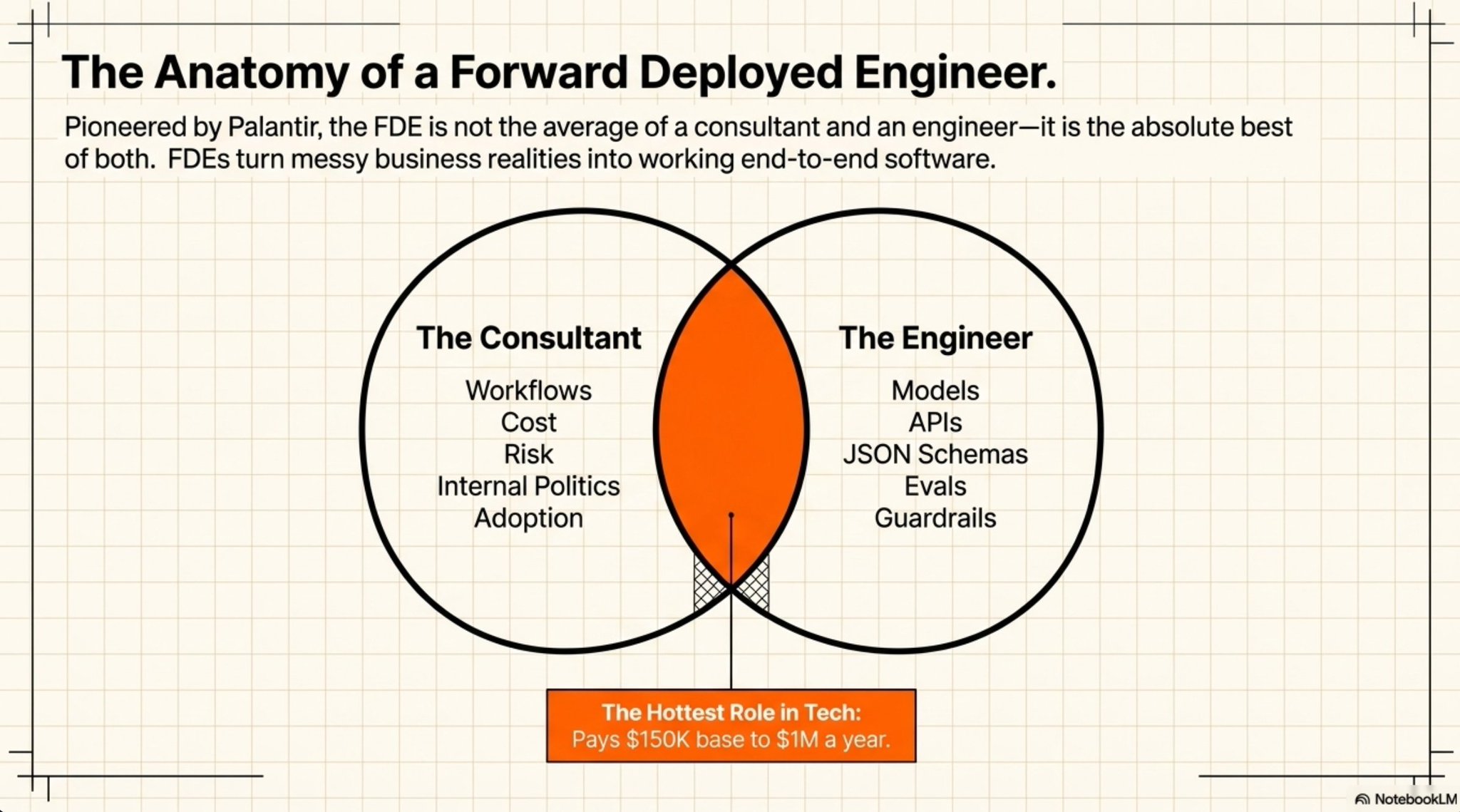
Business side: workflows, cost, risk, adoption, internal politics. Consultants own this.
Technical side: models, APIs, evals, guardrails. Engineers own this.
Best of both, not the average of both. That's the million dollar hire.
Stage 1: Understand how the work really happens
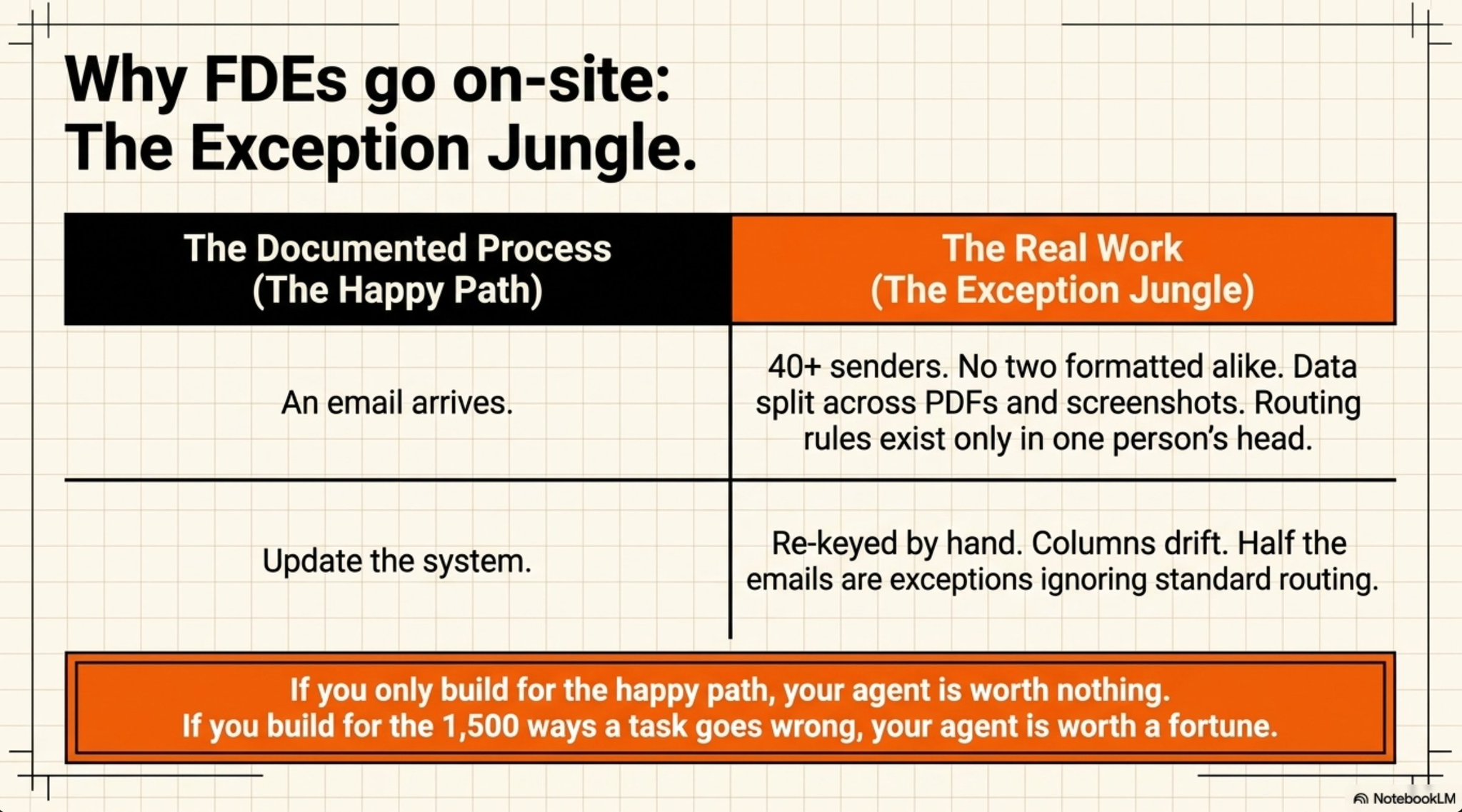
The documented process is rarely the real process.
"An email arrives" sounds clean. Reality: 40+ senders, no two formatted alike, half of them exceptions, and the routing rules live in one person's head.
This is why FDEs go on site.
Book a 1-hour meeting and someone tells you what they think their job is. Sit beside them for 8 hours and you see the real job: the breakages, the workarounds, the exceptions nobody wrote down.
McKinsey sits with miners for the same reason.
Stage 2: Judgment
Where does intelligence belong, and where does it stay out?
The early AI era was "slap a model on everything." That's how you get token maxing and hallucinations.
In a 10-step workflow, maybe 3 steps need an LLM. The rest is if/then and API calls.
Stage 3: Build and deploy
Three parts, in order. Audit → Evals → Deployment.
Audit: map every workflow and exception. Evals: prove the agent behaves, route risky cases to a human. Deployment: monitor KPIs and SLAs so the client trusts you.
Each stage earns the next.
The audit is the wedge. One company said theirs was worth 10x what they paid. Sharper than McKinsey. The word "audit" scares people, so rebrand it a "sprint" and watch them lean in.
Deployment rule: build on top of what already exists. A client spent millions and years moving to NetSuite. Tell them to rip it out and you're gone. Build on top. Integrate it with Salesforce, SAP, Gong, Workday. Shadow mode first, then autonomy, then production.
The real objection is human
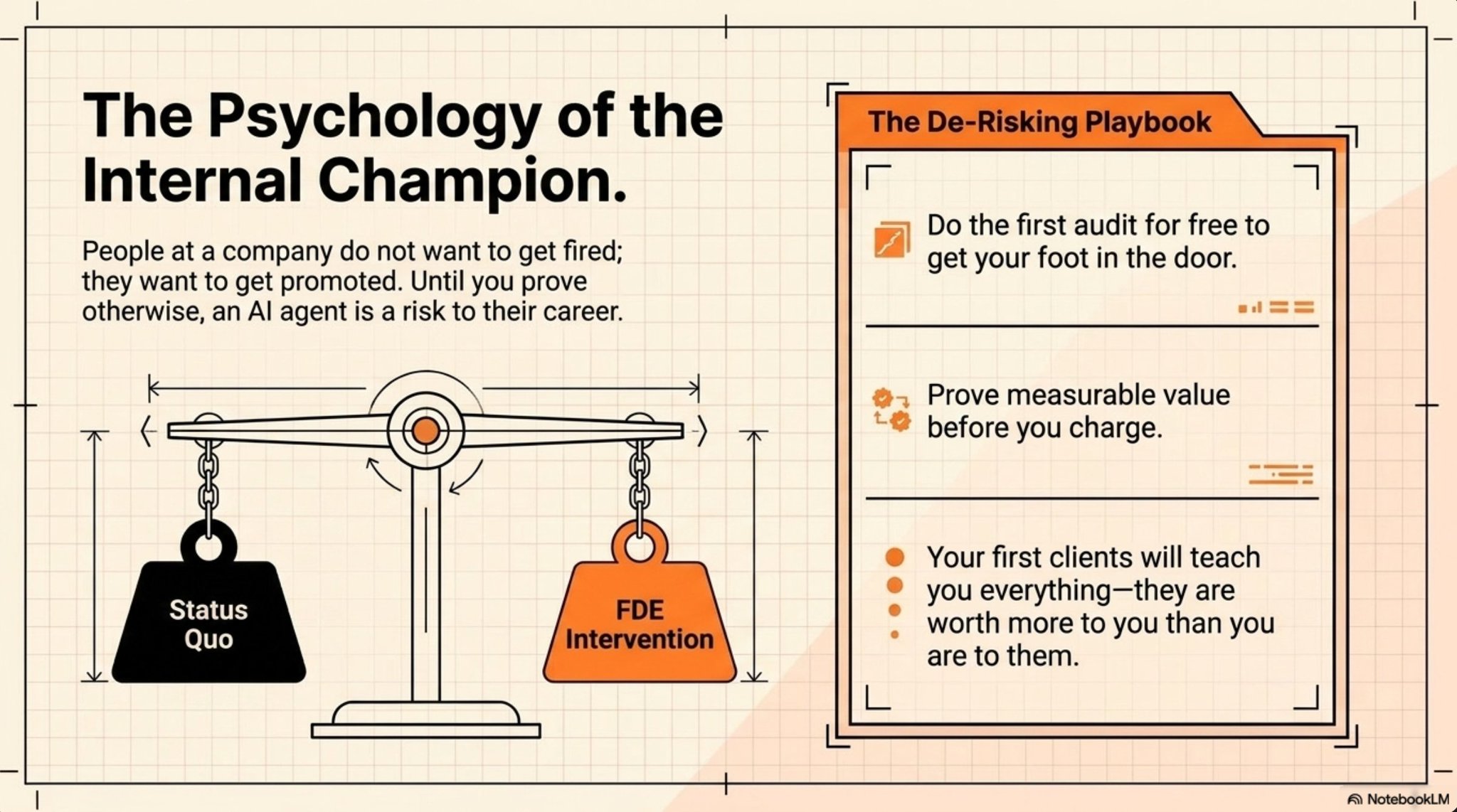
People at a company fear getting fired. They want to get promoted.
You're a risk to them until you prove otherwise.
So de-risk it: do the first audit for free, prove measurable value, get paid after. Your first clients teach you everything.
The 30-day plan
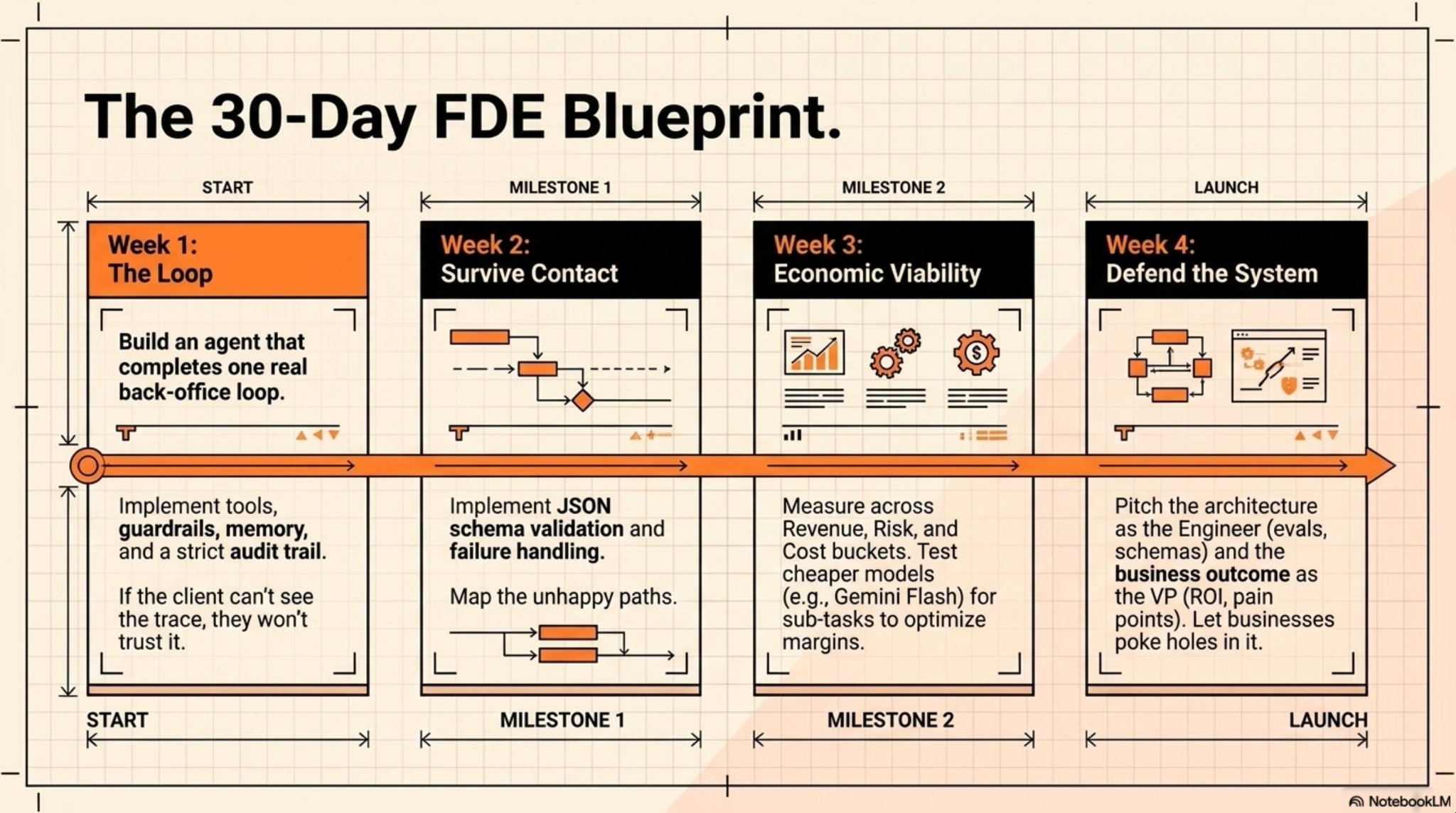
The principle: do the job before you have the title.
Week 1: build an agent that completes one real back-office loop. Agent looping, tools, guardrails, memory, and an audit trail. If the client can't see what it did, they'll never trust it.
Week 2: make it survive contact. JSON schema, validation, exception handling. One way something goes right. A thousand ways it goes wrong. Build only for the right way and you're worth nothing. Solve the exceptions and the agent is worth a fortune.
Week 3: measure it in three buckets. Revenue uplift, risk mitigation, cost savings. Test cheaper models too.
Week 4: defend it. Rehearse as the engineer AND as the VP. Then pitch it to real businesses and let them poke holes.
Day 30
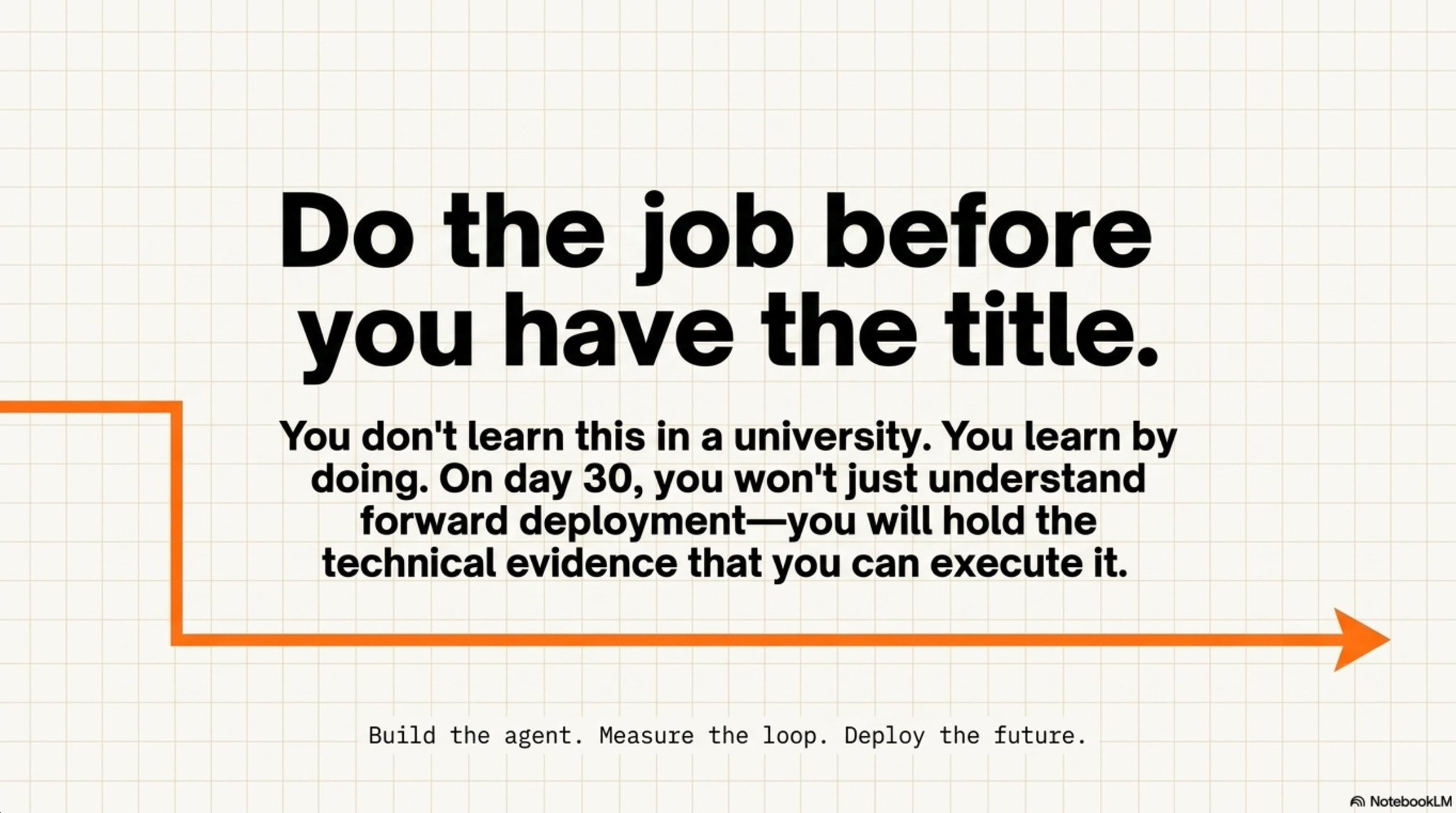
You don't just understand forward deployment. You hold proof you can do it.
Nobody teaches this in school. The whole playbook is free on YouTube and X.
You never learn by reading. You learn by doing.
So go build the agent before anyone hands you the title.
Checkout the full episode:
Apple: https://podcasts.apple.com/us/podcast/the-startup-ideas-podcast/id1593424985
Spotify: https://open.spotify.com/episode/5J0qYg2t5S9IWR0oJ7gWqm?si=5a8aea074a074a91



![[Apology and Gratitude] Redefining the Value of the Office in the AI Era](https://youmind.club/__ym/cms-assets/media/1784654487214_c56a6p_HNr6-znbwAAQJbv.jpg)