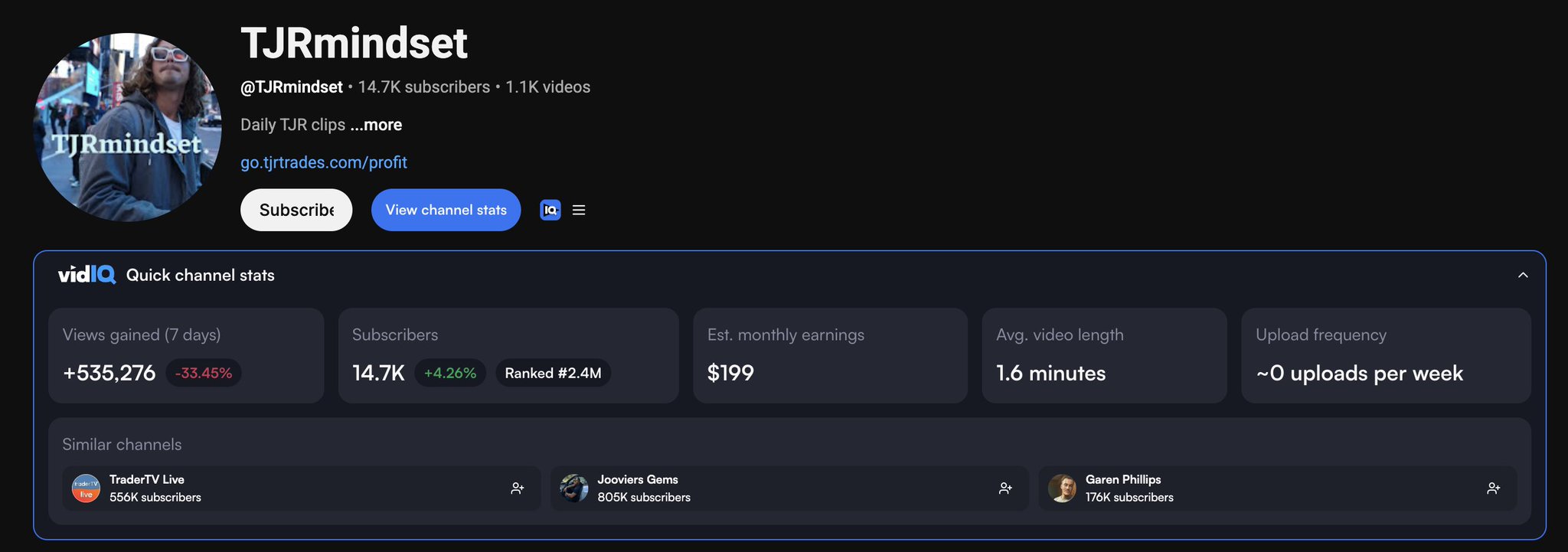
TJRmindset pulled 535,276 views in 7 days.
YouTube estimates the channel makes $199/mo. That sounds terrible until you realize YouTube is not the business.
YouTube automation used to mean faceless videos, cheap voiceovers, stolen Reddit stories, and a dashboard full of channels nobody cared about. That version is dying. The better version is simpler: take one creator who already has attention, clip the best moments, post them everywhere, and attach the traffic to a real offer.
That is what clipping pages are: not content creation. Distribution.
The screenshot everyone reads wrong
TJRmindset is not a massive YouTube channel. It has about 14.7K subscribers and 1.1K videos. The page says it posts daily TJR clips, and it also says it is not TJR and is not impersonating him.
That matters. The page is not trying to be the creator. It is trying to be the distribution layer around the creator.
The vidiQ panel shows the part most people miss: 535,276 views gained in 7 days, estimated monthly YouTube earnings of $199, and an average video length of 1.6 minutes.
If you think the business is YouTube AdSense, that looks like a waste of time. Half a million weekly views for a couple hundred bucks a month is not a business. It is a bad internship.
But the page has a link in bio. That is the point.
The clips are not the product. The clips are the traffic. The backend is the product: a creator program, a paid community, a trading course, an affiliate deal, a clipping campaign, or a client paying for distribution.
This is the first rule of clipping pages: do not build for views. Build for a monetization path behind the views.
The $16,567/mo math
The number is not magic. It is just distribution math.
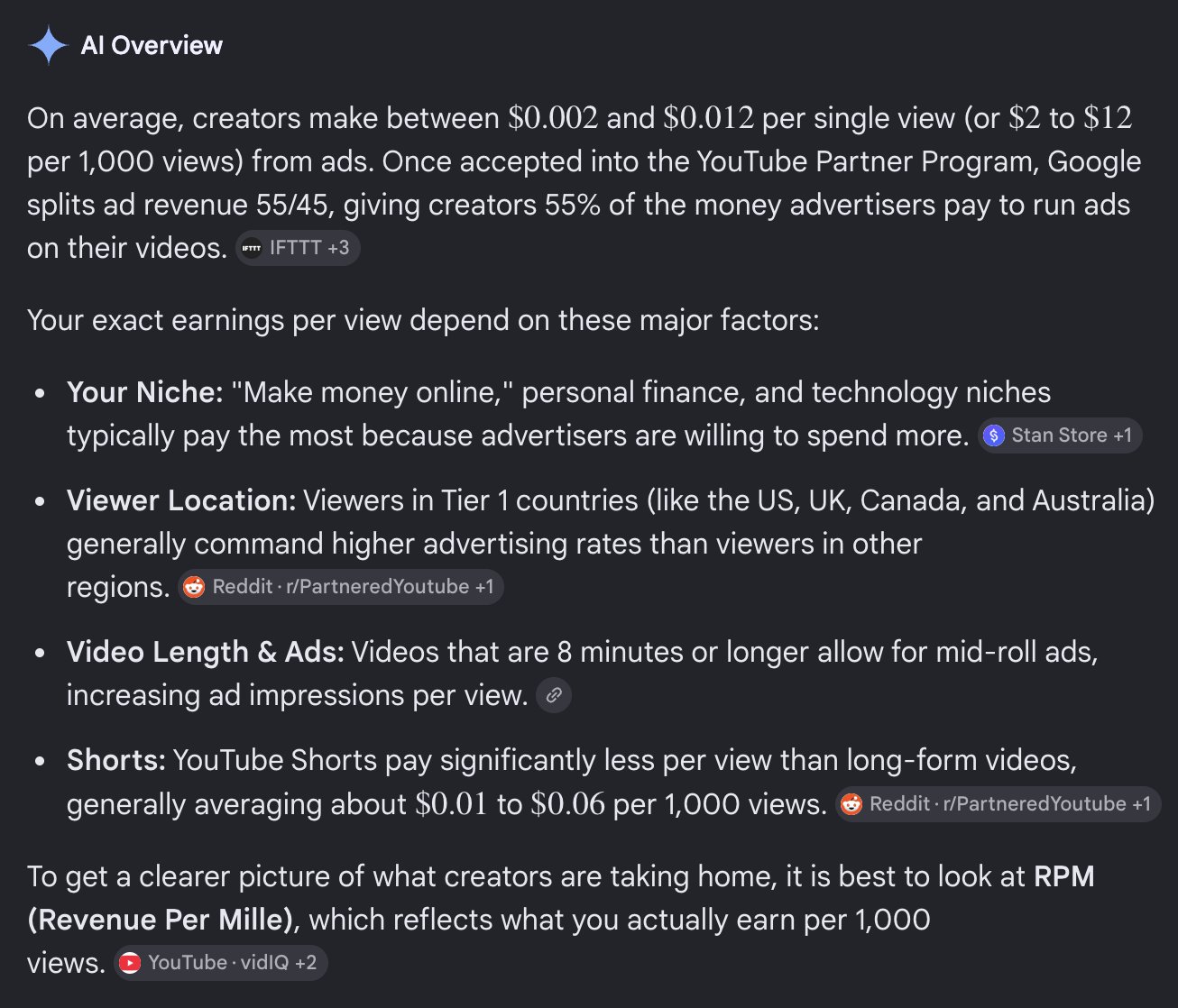
If a clipping page can push toward 4,000,000 tracked views a month and the backend pays around $4.14 per 1,000 views, that lands near $16,567/mo. The exact cents do not matter. The point is the spread: the same attention can look worthless on AdSense and valuable when it feeds the right backend.
That payout can come from a creator campaign, a Whop-style content reward, an affiliate deal, a paid funnel, or a client who cares about booked calls more than AdSense.
Without that backend, the same attention might be worth $199/mo.
Same clips. Same views. Different business model.
This is why most YouTube automation advice is broken. It teaches people to chase the platform payout when the real play is owning the offer, the campaign, or the distribution service.
The money is not in uploading Shorts. The money is in turning Shorts into a pipeline.
Why Claude Opus 4.8 matters
Claude Opus 4.8 is not interesting because it can write captions. That is cheap. It is interesting because it can act like an operator.
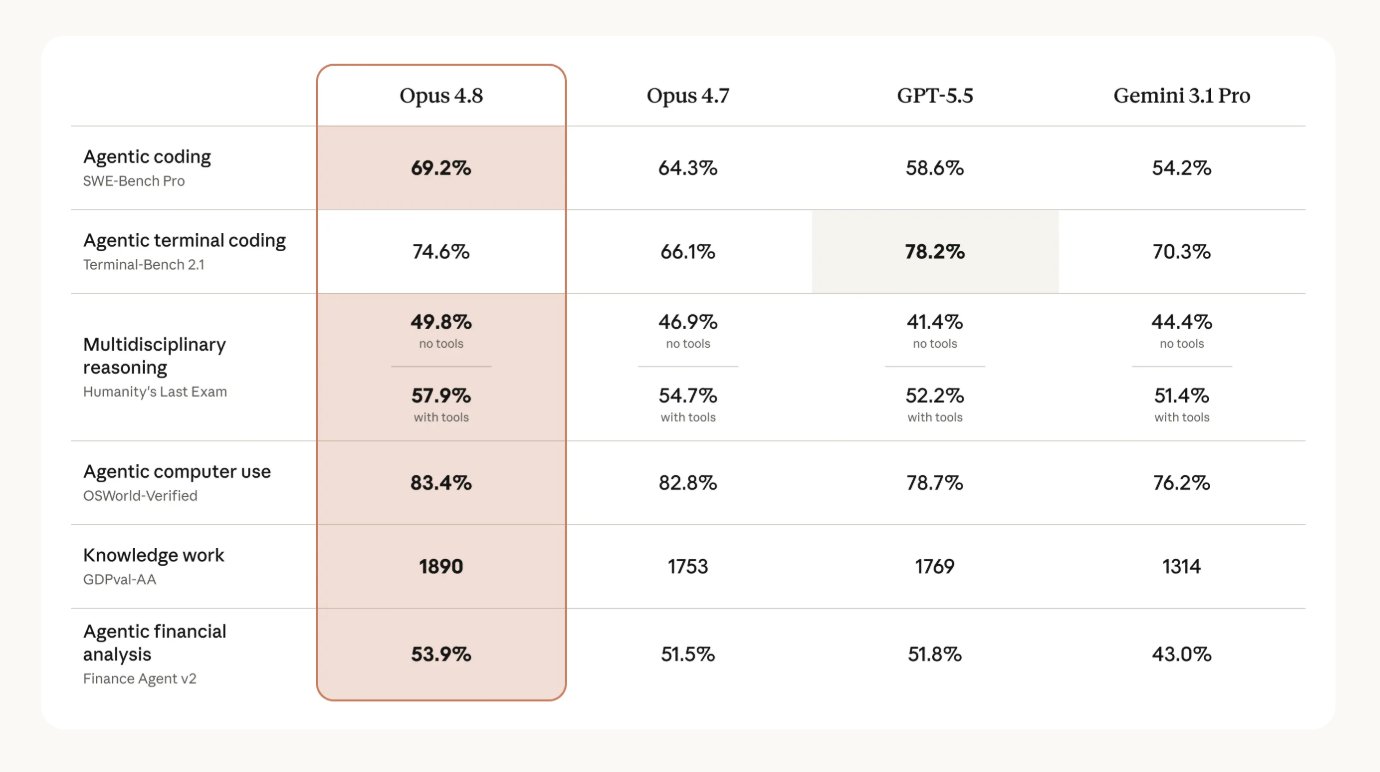
Anthropic says Opus 4.8 is better at agentic tasks, sharper in judgment, stronger at long-horizon work, and built for dynamic workflows inside Claude Code.
The API docs also show 1M context support, 128K max output, adaptive thinking, and fast mode.
Translation for normal people: it can hold more context, follow a bigger plan, use tools, catch more mistakes, and stay on task longer. That is exactly what a clipping page needs.
A human editor does one clip at a time. An operator runs the machine: which creator are we clipping, which videos are in the backlog, which hooks are winning, which platforms need posts today, which clips are already scheduled, which ones failed, which ones should be reposted, which account is getting signal, and which offer is this traffic feeding?
That is not an editing problem. That is an operations problem.
Opus 4.8 is the brain. Vugola is the clipper. Postiz is the distribution engine.
Together, they turn one creator backlog into a posting machine.
The full stack
You need three parts.
First, Claude Opus 4.8 runs the workflow. You tell it the creator, the offer, the content source, the posting rules, and the weekly target. Claude uses MCP servers to do the work instead of giving you a plan you still have to execute.
Second, Vugola MCP turns long videos into short clips. The MCP server lets Claude call Vugola directly: submit a YouTube video, request 9:16 clips, choose a caption style, poll the job, download the finished clips, and check usage.
Third, Postiz MCP turns finished clips into scheduled distribution. Its MCP server lets Claude talk to your social calendar instead of leaving exports in a folder.
Without Postiz, you have inventory. With Postiz, you have distribution.

How to set it up with Claude
Do this once. After that, the workflow runs from prompts. Keep the real keys private, use placeholders in public examples, and do not paste secrets into screenshots, repos, or tweets.
Start by checking Node. Vugola MCP requires Node.js 20 or higher and a paid Vugola account with API access.
node -v
Open the Vugola API docs, then use the API key link in the Quickstart. Keys start with vug_sk_. Sanity-check the key from Terminal before wiring it into Claude.
export VUGOLA_API_KEY="vug_sk_your_key_here"
curl https://www.vugolaai.com/api/v1/status \
-H "Authorization: Bearer $VUGOLA_API_KEY"
For Claude Desktop, Vugola ships a one-command installer. It prompts for the key, writes the Vugola server into Claude Desktop config, and uses a pinned vugola-mcp version. After it finishes, fully quit and reopen Claude Desktop.
npx [email protected] install
For Claude Code, Vugola's official docs show this command:
claude mcp add vugola -- npx -y [email protected]
Then make the key available in the shell where Claude Code launches the MCP server:
export VUGOLA_API_KEY="vug_sk_your_key_here"
If you want Claude Code to store the env var directly on the MCP entry, Claude Code supports this form too:
claude mcp add vugola \
-e VUGOLA_API_KEY="vug_sk_your_key_here" \
-- npx -y [email protected]
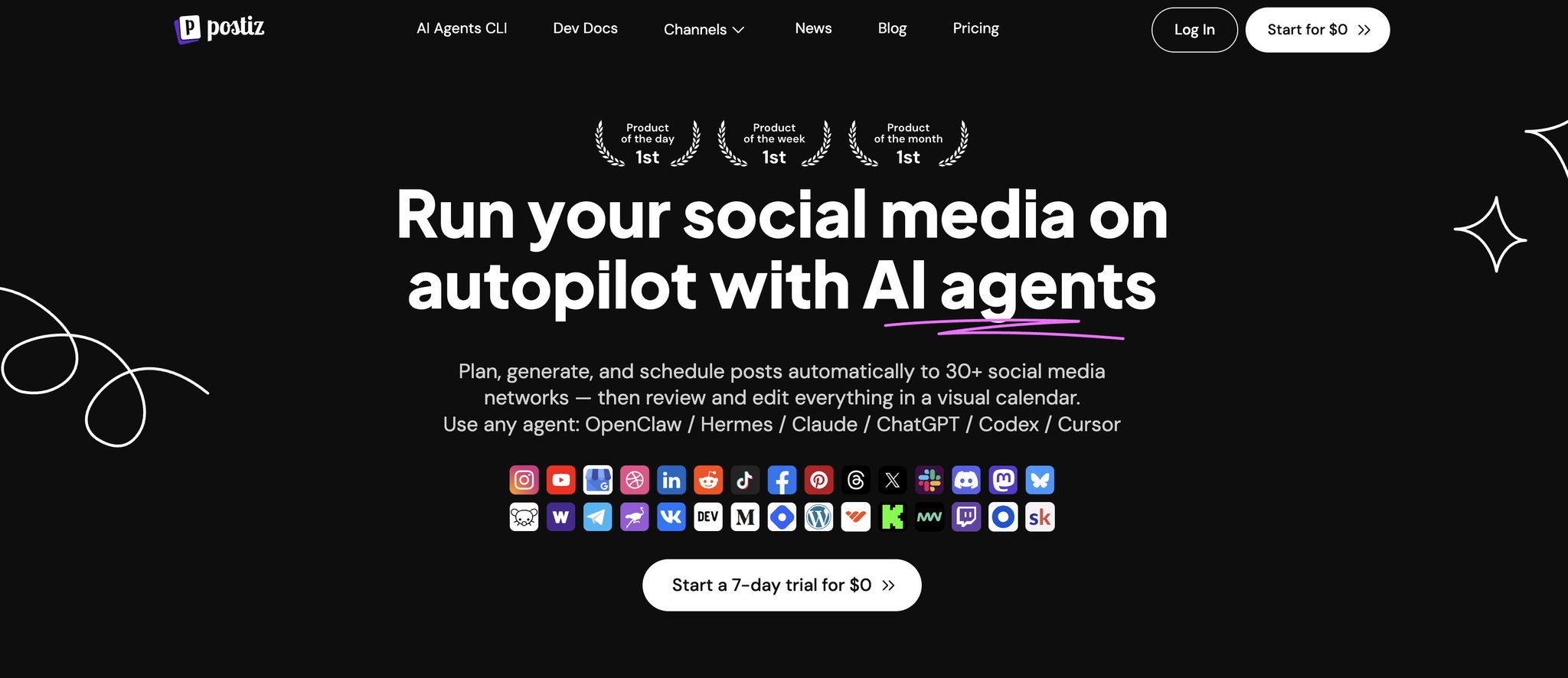
Now connect Postiz. In Postiz, go to Settings, then Developers, then Public API.
Copy the API key. Postiz supports two auth paths: key in the MCP URL or bearer token.
For current Claude Code, Anthropic's documented HTTP syntax is claude mcp add --transport http <name> <url>. Use this:
claude mcp add --transport http postiz \
"https://api.postiz.com/mcp/YOUR_POSTIZ_API_KEY"
Bearer-token auth works too:
claude mcp add --transport http postiz \
"https://api.postiz.com/mcp" \
-H "Authorization: Bearer YOUR_POSTIZ_API_KEY"
For Claude Desktop, add Postiz to the Claude Desktop MCP config. On macOS, the file is ~/Library/Application Support/Claude/claude_desktop_config.json. The Postiz block looks like this:
{
"mcpServers": {
"postiz": {
"url": "https://api.postiz.com/mcp/your-api-key"
}
}
}
Then restart Claude and verify both servers. Postiz should expose integrationList. Vugola should expose get_usage.
Do not move forward until Claude can see your social accounts and your Vugola usage.
claude mcp list
Ask Claude these two checks:
List my connected social media accounts.
Check my Vugola usage and credits.
The one prompt that runs the machine
Once both MCP servers are connected, you can give Claude one operational prompt. The prompt should not ask for ideas. It should ask Claude to use the tools.
You are running a clipping page for [CREATOR].
Goal: publish short clips that drive attention to [OFFER].
Source video:
[PASTE YOUTUBE URL]
Use Vugola to create 10 vertical 9:16 clips with minimalist captions. Prioritize emotional spikes, flex moments, conflict, status, surprise, or strong claims. Do not prioritize calm educational filler.
When clips are ready, download them. Then use Postiz to schedule the best 6 clips across YouTube Shorts, Instagram Reels, TikTok, and X. Schedule 2 clips per day for the next 3 days at 9am and 6pm Central. Write platform-native captions. Return the final calendar with clip title, platform, and scheduled time.
That is the difference between an AI tool and an AI operator. A tool gives you clips. An operator turns clips into distribution.

What Claude should judge
Do not ask Claude to clip everything. That is how you get garbage at scale. Ask it to judge the moments.
The winning TJR clips are not the neat tutorials. They are status moments, flex moments, emotional spikes, arguments, disbelief, cars, money, taxes, lifestyle, pain, and quotable claims.
The titles tell you the game: Car mogged in a Bugatti. TJR rented the Bugatti.
Stock market is better than real estate. Jet mogged. He is only 27.
That is not an education page. That is a status page. Every niche has its own version of this.
Fitness pages clip shame, transformation, discipline, pain, and ego. Business pages clip money, mistakes, status, and opportunity.
Trading pages clip risk, flex, wins, losses, and confidence. Podcast pages clip confession, conflict, taboo, and emotional truth.
Claude Opus 4.8 should not just find the part where someone explains something. It should find the part people cannot scroll past.

The 30-day playbook
Week 1: pick one creator and one monetization path. Not a niche. A creator.
A niche is too vague. A creator has a backlog, voice, audience, offer, and recurring content supply.
Pick someone with long videos and a reason for clips to exist. Ideally, you have permission, a campaign, an affiliate deal, or you are building for the creator directly.
The lazy version is stealing content. The real version is building distribution around a creator or offer that can pay you.
Week 2: clip and post small volume. Use Vugola to generate clips from 3 to 5 long videos.
Use Postiz to schedule 2 to 3 clips per day on the platforms that fit the content. Do not flood a new account with 30 posts on day one.
That looks robotic because it is robotic. You are testing signal.
Week 3: score the winners. Track hook type, topic, creator moment, platform, views, watch time, saves, comments, and clicks.
Then ask Claude to summarize what is working. The goal is not to make the agent creative. The goal is to make the feedback loop impossible to ignore.
Week 4: scale the winning pattern. If status clips win, make more status clips. If educational clips die, stop being sentimental and kill them.
If one platform wins, feed it more. If the backend offer gets clicks, build more content around the objection people ask before buying.
That is how clipping turns into an operation instead of a hobby.
What kills this business
No backend offer. Views with no monetization path are just dopamine.
No permission or campaign. If your whole strategy is ripping creators with no deal, you are building on sand.
No volume. One clip a day is not a media machine. It is a diary entry.
No taste. The agent removes labor. It does not make boring clips interesting.
No scheduler. This is why Postiz matters. The difference between 10 clips in a folder and 10 clips scheduled across four platforms is the difference between inventory and distribution.
No feedback loop. If you do not track what wins, you are just gambling with exports.

The bigger lesson
Claude Opus 4.8 is not making YouTube automation easier. It is changing what YouTube automation means.
The old game was make videos, upload videos, and pray for AdSense. The new game is find attention, clip attention, schedule attention, and route attention into an offer.
Vugola handles the cutting. Postiz handles the posting. Claude handles the loop.
The person running it still needs judgment. You still choose the creator. You still choose the offer.
You still decide what kind of attention is worth chasing.
But once the decision is made, the machine should not need your hands all day. That is the opportunity: not faceless YouTube automation, but agent-run clipping pages.
A 14.7K subscriber page can pull 535K views in a week and still look tiny from the outside. The people who understand the backend will see the asset underneath: a traffic asset, a distribution layer, and a media machine waiting for an operator.
Build the stack
Vugola is the clipper. Drop in a long video, get short-form clips back with captions and virality scores, then let the Vugola MCP server give Claude direct access to the workflow.
Postiz is the distribution engine. Connect your social accounts once, then let Claude schedule through the Postiz MCP server. This is what turns clips into a calendar instead of another folder on your desktop.
Claude Opus 4.8 is the operator. It reads the backlog, calls the tools, checks the schedule, and keeps the loop moving.
If you set this up right, the prompt is not "write me content ideas."
The prompt is: "Here is the source video. Clip it, rank it, schedule it, and show me the calendar."
That is the business.
thanks for reading
- Vadim