My first long-form article; it's a bit long, so I recommend liking and bookmarking it to read later.
Friends who follow me should know that I've been tinkering with AI portraits lately.
This batch is mainly centered around ChatGPT's image-2 / gpt-image-2. It's not the kind of play where you just write 'a beautiful girl portrait' and hope for the best. It's about running them set by set.
Flower fields, orchards, old pavilions, blackboards, studio shoots, direct flash, soft mist, CCD. For the same theme, I repeatedly change actions, lenses, and lighting. Sometimes after a set, the good ones are truly great, and the failures are incredibly absurd.
A few days ago, I was browsing my Eagle portrait folder and felt a bit speechless looking at that pile of images. How should I put it? I felt like I've been acting as a photography assistant for the AI lately.
I'm responsible for writing the scene, the light, the props, the makeup, and the actions; it's responsible for trying to capture the image in my head. Then, as I scrolled, I realized that the prompts that consistently produce stable results aren't the longest ones, nor the ones with the most flowery words. The ones that work best are like a 'photography cheat sheet.'
You don't need to treat AI as a metaphysical wishing well. You can treat it as a photography team. The photographer needs to know the camera position, the makeup artist needs to know the look, the stylist needs to know the clothes, the stage manager needs to know what's on-site, the prop team needs to know what's on the table, and post-production needs to know if the final image is film, direct flash, soft mist, or a mobile snapshot. When a prompt is written to this level, it won't just generate an empty shell of a 'pretty person.' It starts to have a sense of presence.
Let's look at a few first.
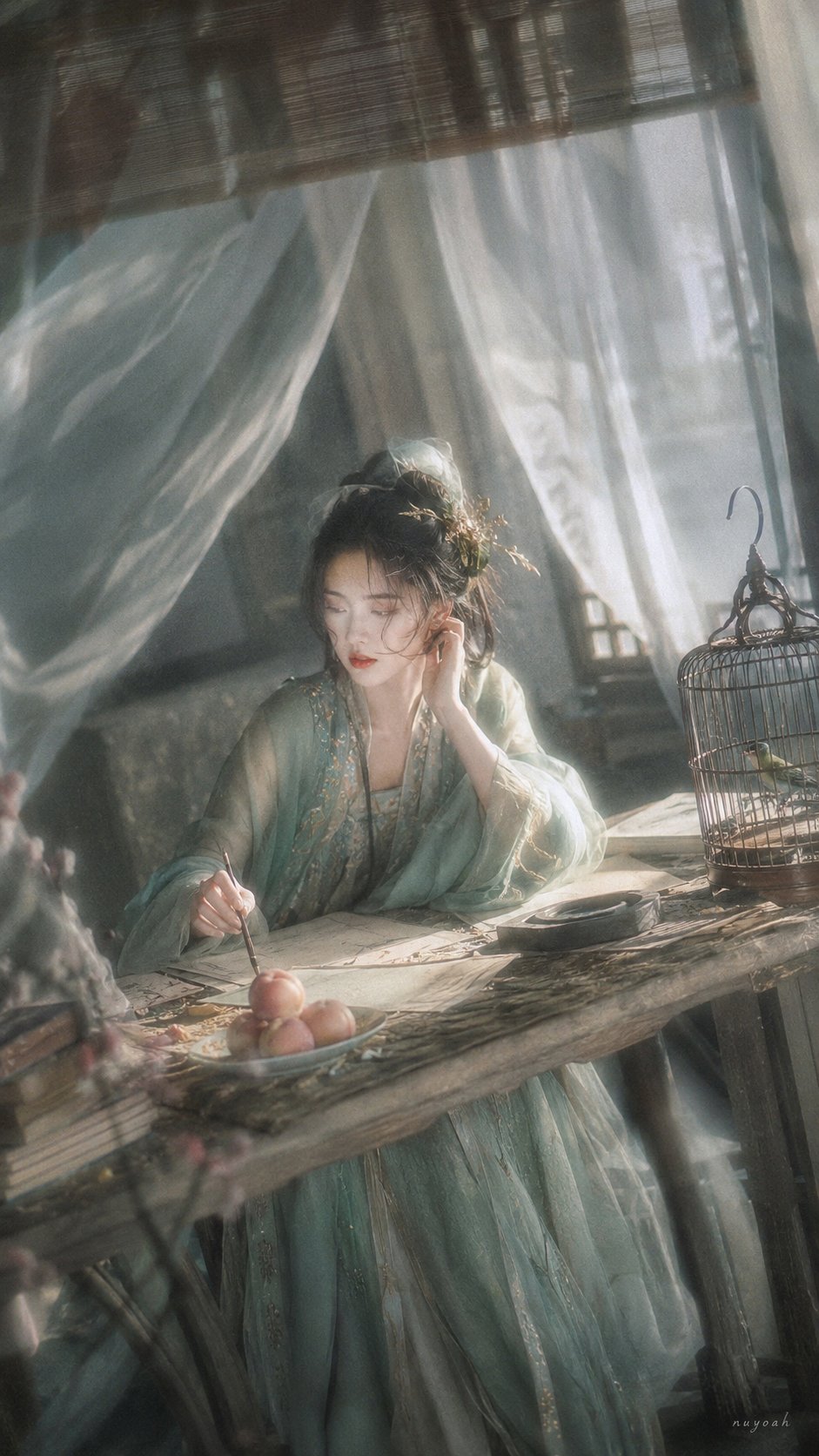
The keyword for this one isn't 'ancient style beauty.' It's: old wooden desk, birdcage, small bird, handmade paper, scrolls, bamboo curtains, window frames, wind-blown gauze curtains, white mist backlight outside the window. You see, the character is just one part of the frame. What really holds the image up is this room.
Look at this one.
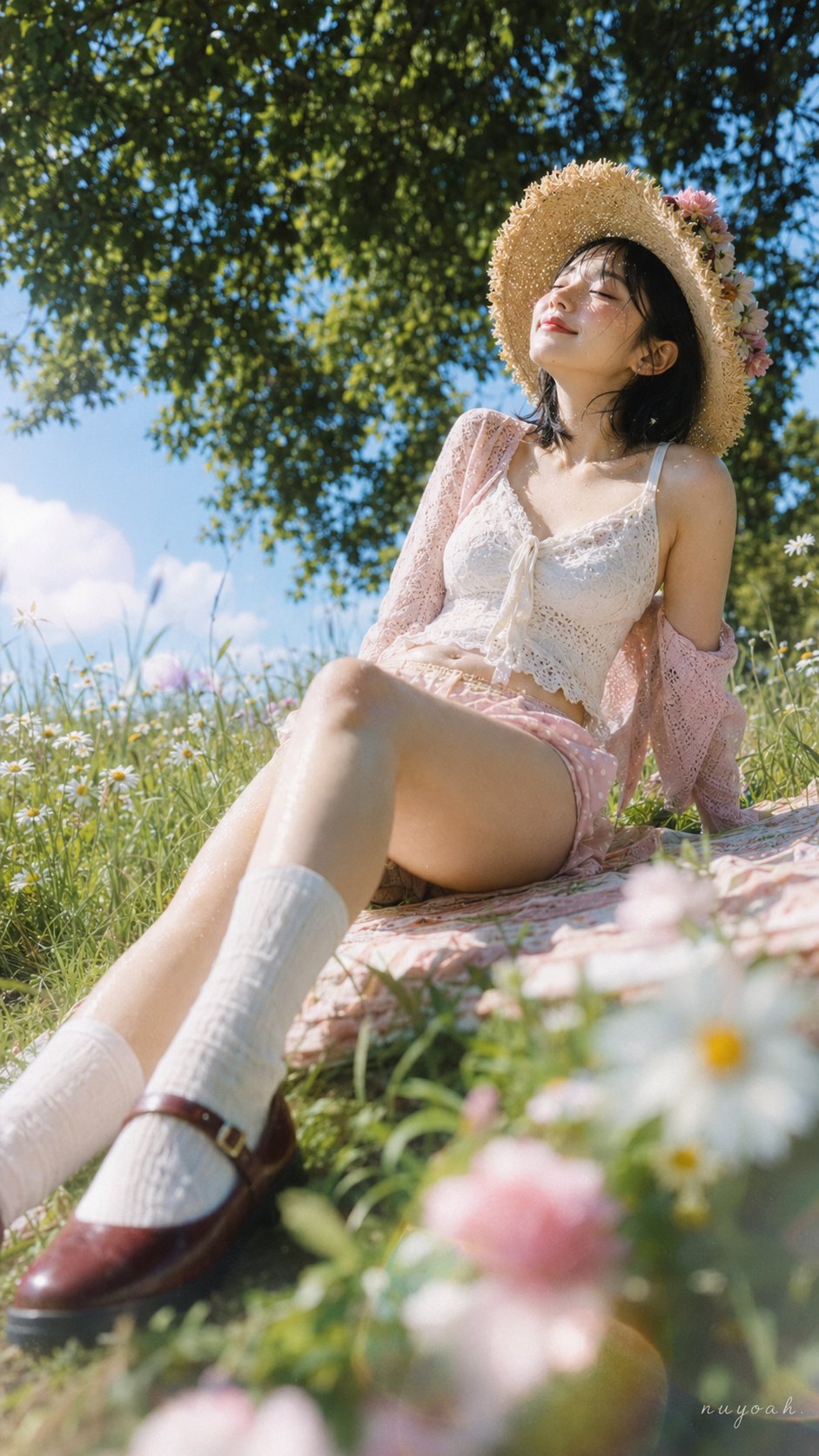
Summer Daisy Field Straw Hat Film Portrait. This one isn't just 'summer girl' either. It has daisies, a straw hat, large white flower foreground, dappled tree shadows, blue sky, cumulus clouds, grass, a picnic blanket, plus a low camera angle and blurred flowers in the foreground.
This is what I want to talk about most this time. Don't start writing portrait prompts from the 'person.' Start from 'why this photo works.'
I Used to Write Nonsense Too
When I first started playing with AI portraits, I easily made a mistake. I would desperately write 'beautiful.' Clear, atmospheric, high-end, cinematic, exquisite, realistic, delicate. Are these words useful? A little. But they are too empty. It's like telling a photographer, 'Help me take a high-end photo.' The photographer will likely look at you and ask: where are we shooting, what's the light, what's the outfit, what's the mood, half-body or full-body, how far is the lens from the person? AI is the same. It's not that it doesn't understand beauty; it's that it doesn't know which kind of beauty you want.
So later, when I wrote portrait prompts, I would first ask myself a question: What is the 'anchor point' of this image? Some images work because of the scene. Some because of the light. Some because of the makeup. Some because of the lens angle. Some because of an action. You grab this thing first, and then the subsequent words have a place to land.
Layer 1: Give It a Scene That Can Stand
Now when I write portraits, I basically don't just write big words like 'indoor,' 'outdoor,' or 'studio shoot.' Too vague. I write it as a specific space. For example, an 'old pavilion study desk' isn't just an 'ancient style room.' It's an old wooden desk, birdcage, yellow-green bird, scattered grains, ancient books, handmade paper, scrolls, inkstone, old porcelain fruit plate, peaches, bamboo curtains, window frames, old bedstead. This string of items looks like a lot, but it's not to make every prop appear. It's to give the AI a 'spatial density.'
I'm telling it that this room isn't empty. Someone has lived here. There's the dampness of old wood, paper, gauze curtains, a birdcage, and a bit of dust. Once the scene is established and the person enters, it becomes natural.
Take the summer orchard set, for example.
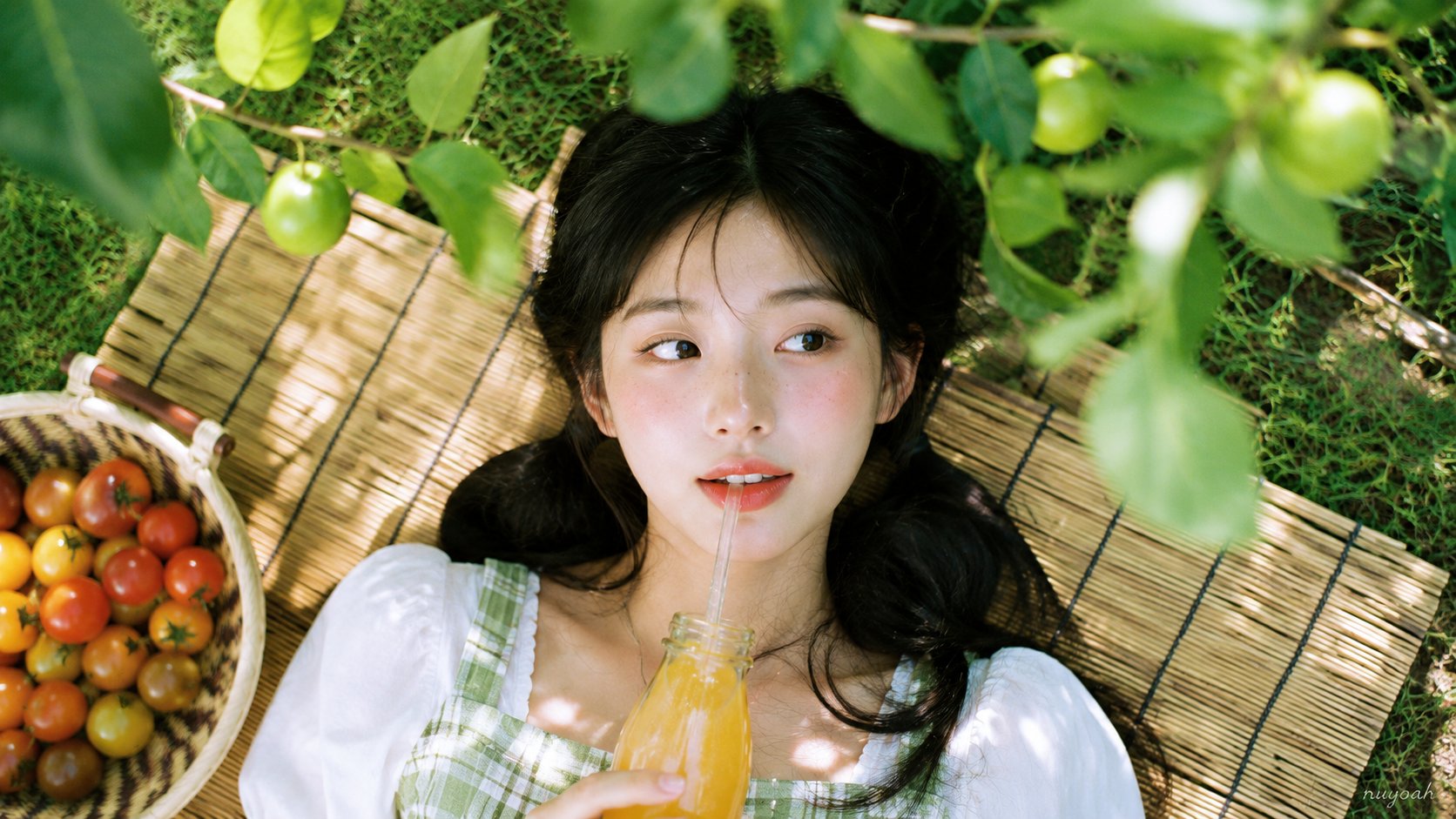
I didn't just write 'orchard portrait.' I wrote leaves, branches, green fruits, vines, bamboo baskets, fruit baskets, straw hats, fruit juice, straws, natural paths, dense vegetation background. More importantly, I wrote one sentence: 'The lens is like it's hidden between the branches and leaves of the fruit trees.' This sentence is very useful. It forces foreground obstruction into the frame. With a foreground, the image isn't flat. With obstruction, the photo looks like it was actually captured by someone, rather than the AI placing the person squarely in front of a backdrop.
I now judge if a scene is well-written by seeing if it has three layers: What's in the foreground? Where is the person? What's in the background? If all three layers are empty, it will likely generate a very flat image.
Layer 2: Don't Just Write Style, Write the Imaging Method
Many people like to write styles: film feel, CCD, cinematic, magazine feel, atmospheric. You can write these, but they aren't enough. I now prefer to write 'what device it looks like it was shot with.' For example: Fujifilm photography, Nikon photography, mobile snapshot, direct flash CCD, high-key creamy soft mist studio light. Behind different devices are different imaging logics.
Fujifilm outdoors tends to bring out high saturation, blue skies, and film grain. Direct flash CCD will have hard shadows, skin reflections, and a sense of presence. Soft mist studio shoots will have low contrast, blurred edges, and creamy highlights. When you write 'high-end,' the AI doesn't know how to be high-end. If you write 'high-key creamy soft mist studio light, large area of soft light wrapping the character from the front and side, overall exposure slightly high, low contrast, like shooting through a Pro-Mist filter,' it knows where to put the effort.
This 'White Orchid Soft Mist' image follows this logic.
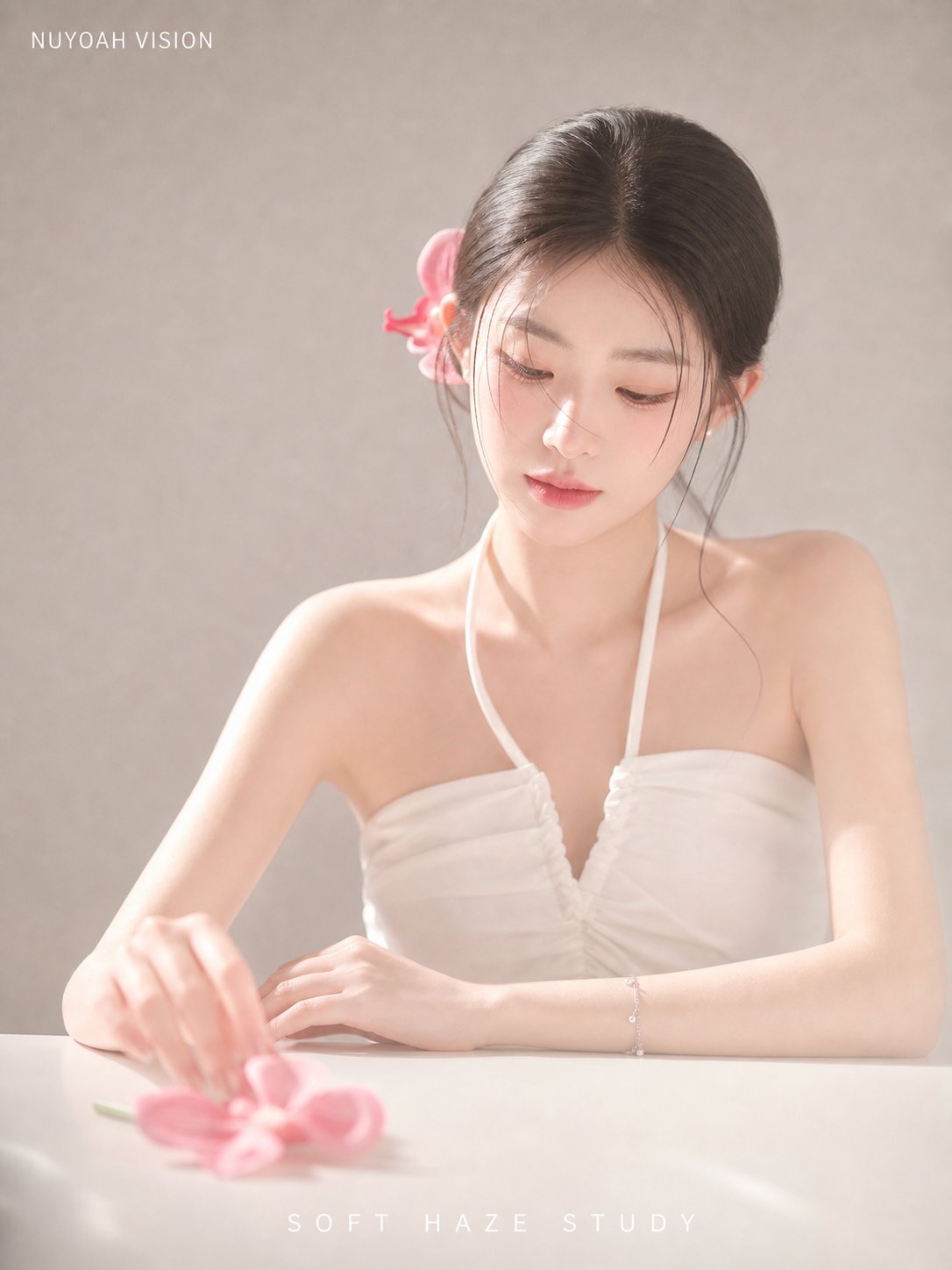
What I'm most satisfied with in this image isn't the face. It's that the light is very soft. The hands, flowers, white tabletop, and background are all softened by the light. What really worked in the prompt was 'high-key,' 'soft mist,' 'low contrast,' 'foreground bokeh,' and 'highlights slightly overflowing but not dead white.'
Here's a small tip: don't just write that the light is beautiful. Write where it comes from, where it lands, and what effect it ultimately creates.
Layer 3: Write Makeup as Anchors, Not a Tutorial
Writing portraits makes it easy to fall into another trap: making the makeup description longer and longer. Eyeshadow, eyelashes, aegyo-sal, lip glaze, nose bridge highlights, cheek blush, skin texture—everything gets stuffed in. I've stepped in this pit too. The result is that some images look like beauty ads, and the faces even start to look fake. Later I found that makeup is best captured by 'minimum recognizable anchors'—the most important identification points for that face.
For example, in the 'Peach Oxygen Portrait,' the makeup anchors are peach-pink sweet makeup, creamy skin, peach blush, under-eye blush, hydrated peach-pink lips, fruit hair accessories, and ribbon hair ornaments.
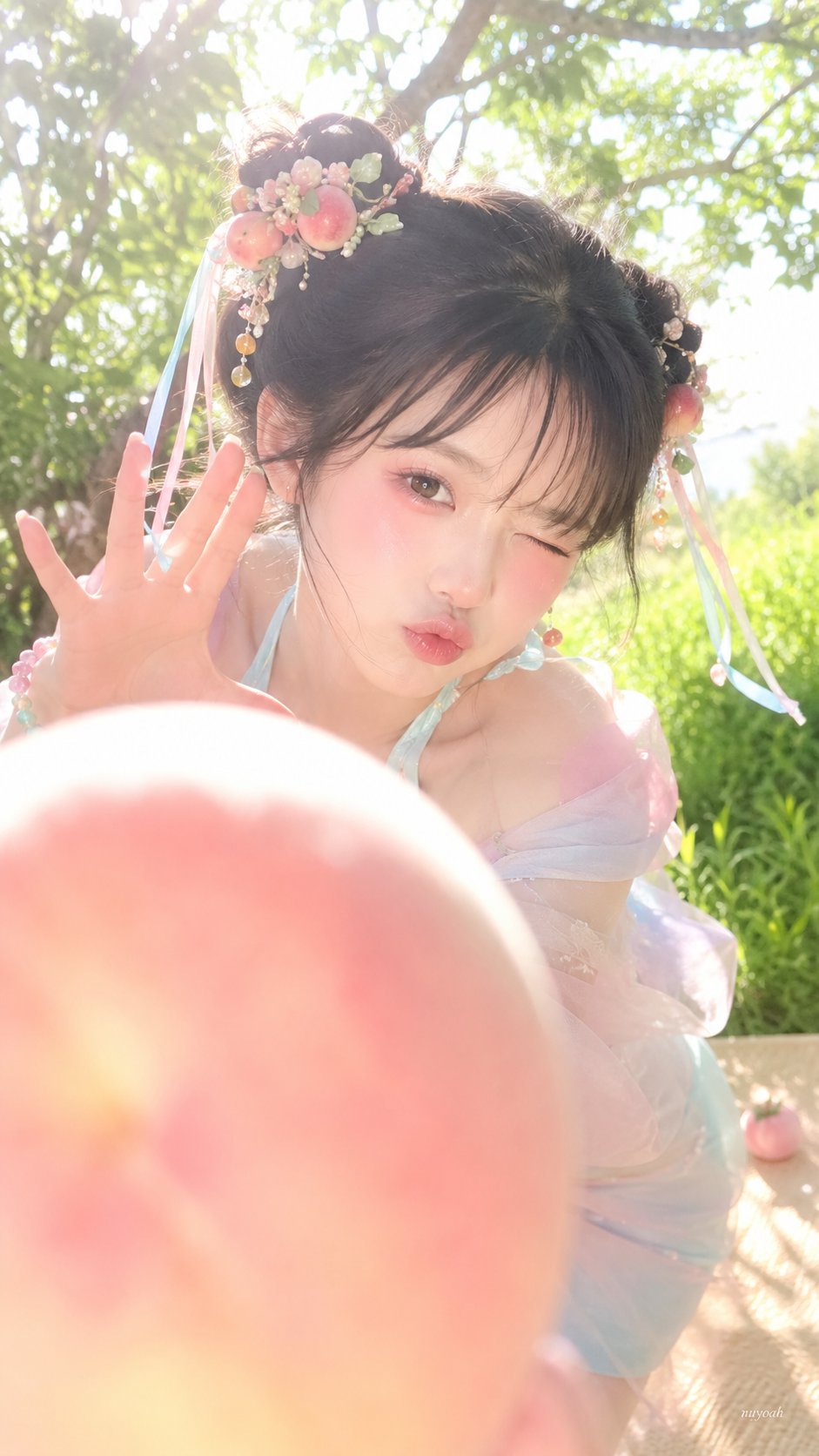
You'll find the focus isn't 'perfect features.' The focus is that the whole face looks like a peach. The blush, lip color, hair accessories, props, and light all serve this feeling. At this point, don't write a bunch of conflicting makeup styles in the prompt. Don't write 'cold and world-weary' while also writing 'sweet and energetic.'
Layer 4: Don't Write Fixed Actions, Write Action Skeletons
This is where many people get stuck because the easiest place for AI portraits to fail is the pose. An extra finger, a neck twisted like it's broken, legs that don't connect. I now avoid poses like 'looking back at the camera' or 'body turned away but head turned back' by default. It's not that they can't produce good images; it's just that the failure rate is too high. Especially the neck and shoulders—they break easily.
So I prefer to write action skeletons. For example: Lowering head and eyes, fingers lightly touching petals on the table. Sitting on the grass basking in the sun, not forced to look at the camera. Running through fruit tree branches, smiling sideways but with head and shoulders in the same direction. Holding a peach near the face, a playful close-up snapshot.
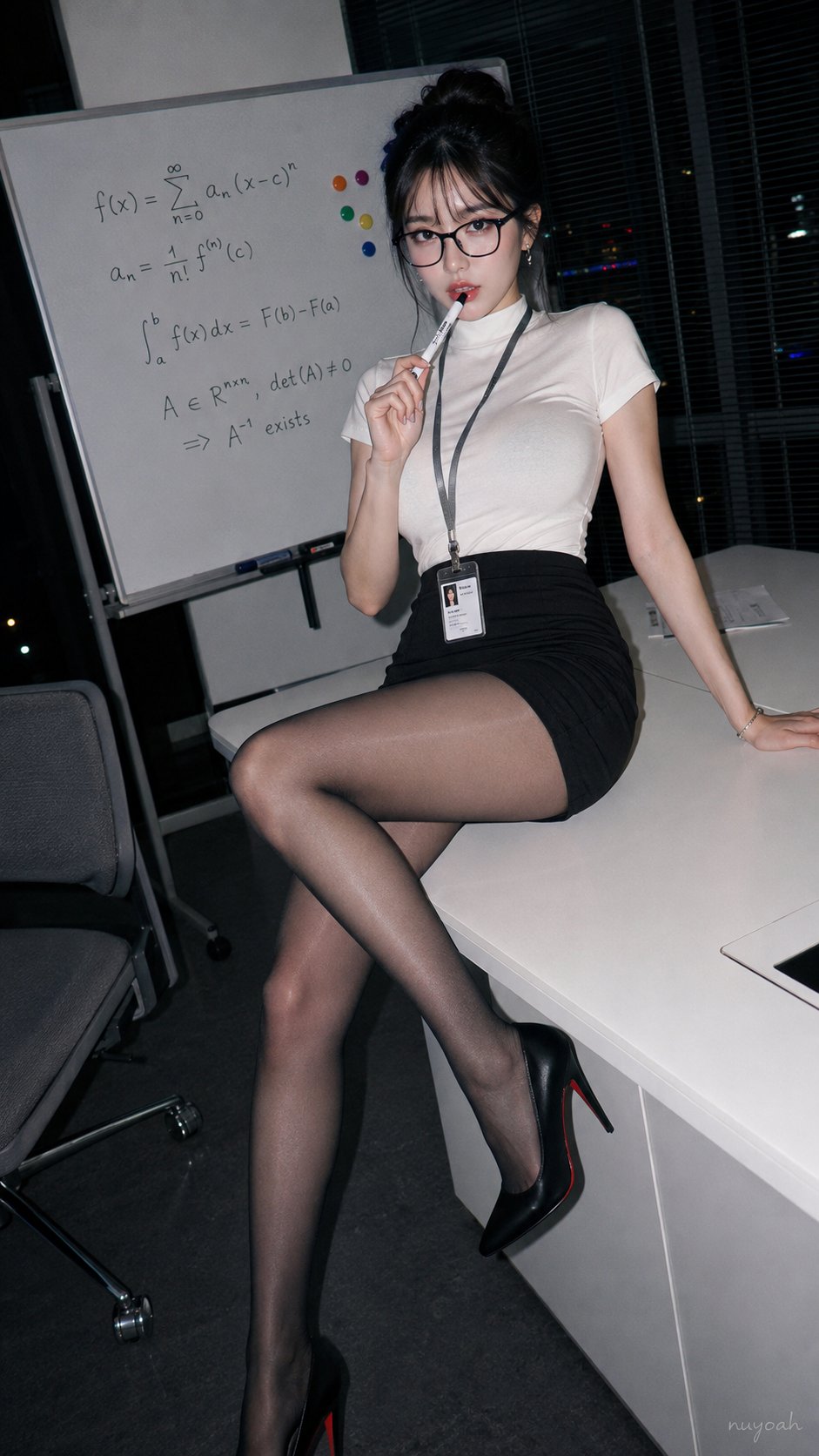
This 'Blackboard Professional' image works because of a few things: blackboard, formulas, ID lanyard, black-rimmed glasses, night office, direct flash. The action isn't a complex dance move; it's just hands supporting the tabletop, body slightly sideways, looking at the camera with direct flash. The more direct the flash, the simpler the action must be, because direct flash exposes body structure very clearly.
Layer 5: Give It Some Randomness, But Don't Randomize the Direction
I used to be afraid of randomness. I thought prompts should be written as strictly as possible. Later I found that's not the case. The worst thing for portraits is for all images to look the same. I now intentionally leave variables in some places. For example: 'Not all props need to appear, select based on composition needs.' Or 'Lens distance varies for each image.' Or 'Actions and expressions are random, no need to look at the camera.'
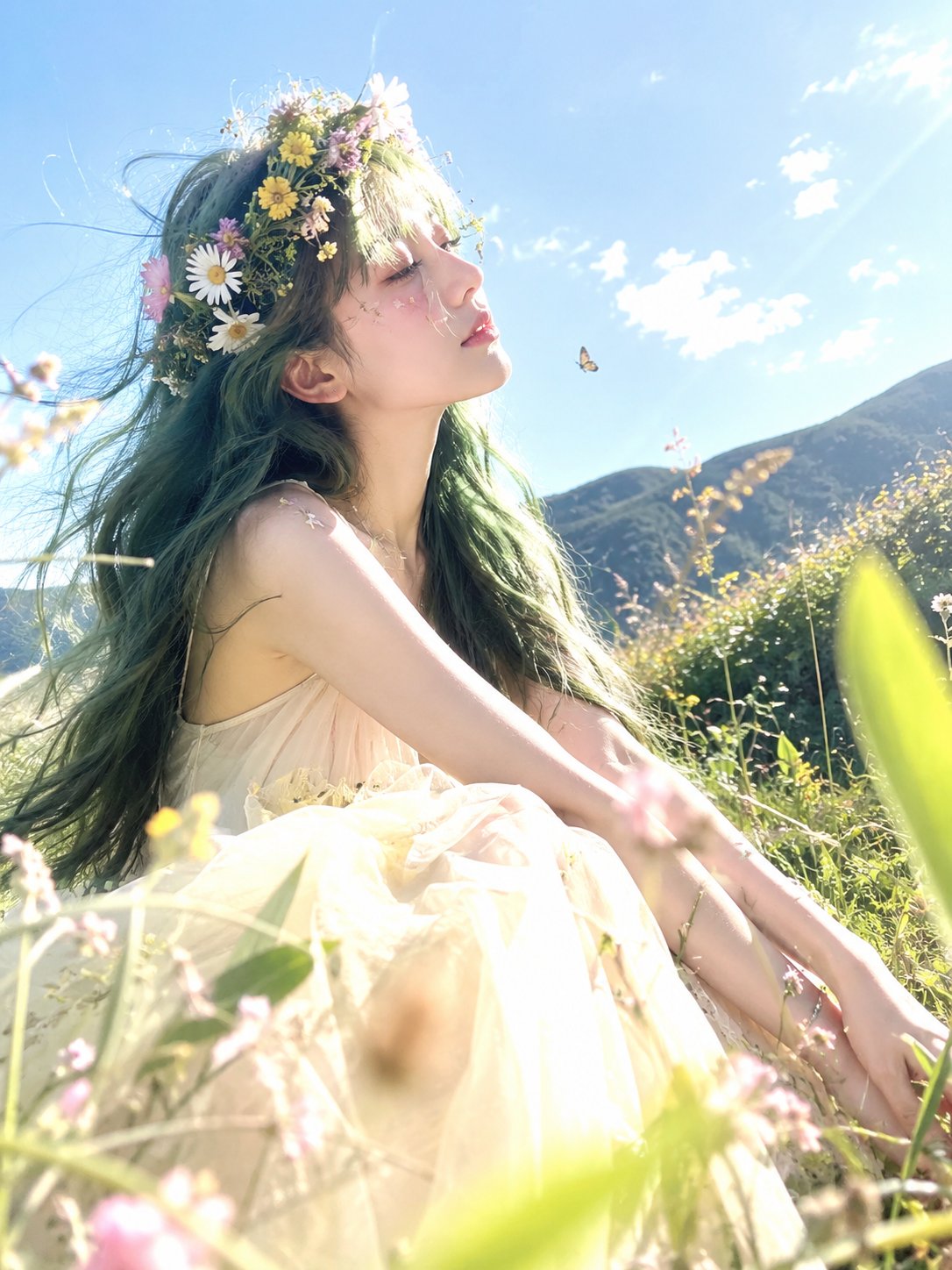
This 'Summer Stream Flower Crown' is a typical example. Its direction is clear: summer, strong light, flower crown, green hair, garden elf vibe. But it doesn't mandate that the character must face the camera directly. Consequently, the image is more natural. My feeling is that the most stable structure isn't 'locking everything down,' but 'locking the style skeleton and letting the frame breathe.'
My Current Common Writing Style
If you want to write AI portraits, I suggest not learning those long 'universal' prompts first. Use a stable structure instead. I roughly write like this:
Aspect ratio, realistic photography, specific portrait theme, specific camera or imaging method
Character base, clearly adult, face shape/temperament, hairstyle, makeup anchors, realistic skin texture
Clothing styling, color, material, realistic wearability, relationship to the theme
Scene, what's in the foreground, where the person is, what's in the background, what props can be there
Lens, long shot or close-up, wide angle or medium-close, low angle or top-down, bold cropping, shallow depth of field
Action/Expression, a clear action skeleton, can avoid looking at camera, natural head/shoulder direction
Lighting, where light comes from, where it hits, what highlights/shadows/glare/grain it produces
Negative constraints, no plastic skin, no deformed fingers, no extra limbs, no sharp head turns
The Real Point is Making Elements Relate
When I browse these images, one feeling is particularly obvious: in good images, the elements 'know' each other. The peaches and the blush know each other. The straw hat and the tree shadows know each other. The blackboard and the ID lanyard know each other. Bad images aren't just ugly; they often feature elements that don't know each other. A person stands in front of a background, but the clothes are from another world, the light is from another world, and the props are just pasted on. This creates that 'AI smell.'
Actually, Writing Prompts is Training Your Own Aesthetics
To be honest, after running so many portraits, I don't think prompts are spells anymore. They are tools that force your aesthetics to improve. You can't write it clearly because the image in your head isn't clear yet. Once you start writing about foregrounds, lighting, lenses, actions, makeup, and prop relationships, you'll find your way of looking at images has changed too.
AI hasn't made aesthetics unimportant; it has made them more specific. All those feelings you couldn't express before now have to become words. When you can explain these things clearly, the AI images finally start to behave.
The Shortest Version
If you only take one thing away today, remember this: The order of writing a portrait prompt can be: Theme, Imaging Method, Character Styling, Scene Relationships, Lens Composition, Action Skeleton, Lighting Texture, Negative Guardrails. Don't start from 'beautiful girl.' Start from 'why the photo works.'