"Start an AI business and create a state where it runs without you working."
When you hear that, it might sound like a story for a few geniuses or influencers.
It's the opposite. You don't need flashy talent or viral hits. You just need to follow a steady, unglamorous sequence, one step at a time.
The only thing that separates those who use the same AI to earn and become free from those who stop at a few tens of thousands of yen a month is one thing.
It's simply "the order in which you do it."
Summarizing text. Generating ideas. Drafting emails.
These are certainly convenient. But those are just common uses where anyone gets the same answer.
The real value lies elsewhere.
It's whether you can turn AI into a "mechanism that earns on your behalf."
This is where a difference as vast as heaven and earth is born.
Individuals Who Fall Behind Will Be Quietly Left Behind
I'll be blunt. Individuals who fall behind in the AI wave will definitely be left behind from now on.
The difference will first appear as a "gap in information" one year from now.
Those who didn't get on board are still treating AI as just a convenient tool. Their work got a little faster, but the content of their income is the same as last year.
Three years later, it turns into a "gap in assets."
Younger people and businesses using AI will quietly steal your unit prices and jobs. Before you know it, you'll be on the side that isn't chosen.
Conversely, those who got on board will have started turning AI into an earning mechanism within a year. In three years, that business will be generating money. That money will turn into real estate and stocks. They will be on the side where wealth increases even without working.
The difference isn't ability. What separated them was the choice of "whether they used it for convenience or turned it into an asset."
And the shortest route to "turning it into an asset" is the 7-step AI entrepreneurship plan I'm about to discuss.
This is a Roadmap, Not a Dream
What I'm introducing here are the 7 steps to steadily head toward FIRE through AI entrepreneurship.
- Start a business with unglamorous AI support work and get your first client.
- Achieve 2 million yen in monthly sales with training for one company.
- Reach 10 million yen in monthly sales through training, implementation support, and advisory services.
- Solidify an annual profit of 100 million yen.
- Sell the company for 500 million yen.
- Invest that 500 million yen in real estate and stocks to obtain a passive income of about 20 million yen per year.
- Then, do what you love. Take risks.
This is not an idealistic theory thought up on a whim.
It's a roadmap reverse-engineered from both the experience of actually running unglamorous AI support work and the fact of seeing people who reached beyond that up close.
That's why I write it as a sequence, not a dream. It has zero flashiness. But that's exactly why it's reproducible.
Step 1: Start an AI Business with Unglamorous Support Work—Enter with Questions and Get Your First Client
The first stumbling block is the proposal. The most common failure in going from 0 to 1 is right here.
Immediately after going independent, I enthusiastically held a paid seminar. I rented a venue, worked through the night on materials, and advertised it. Only two people came. One left halfway through.
I spoke for 90 minutes to the remaining person with a trembling voice. A comment I received afterward still stings today.
"The talk was interesting... but, what exactly is going to change in my company with this?"
My mind went blank. I was only talking about what I wanted to say and hadn't mentioned the benefit to the other party at all.
So I stopped proposing and started entering with questions.
"What is the most tedious repetitive task in your company right now?"
Start with the other party's benefit. With this one sentence, the other party starts talking about their troubles on their own.
The first step in entrepreneurship is not a flashy service. It's listening to the other party's troubles. It starts from here.
What I grasped here was the "pattern of selling by starting with questions."
That seminar for two people is the origin of my current 400,000 yen training. Failures pay off later in embarrassing ways.
Next, I used that pattern to go get the first client.
I was painfully aware of the fact that having good content alone doesn't make it sell. Even if you're confident in the content, if it's not known, it's zero. The most important thing is customer acquisition.
I chose neither sales nor SNS, but a friend's company. I pleaded, "Let me try it at your company first," and was allowed in.
Rather than a beautiful track record, it's about completing the first case. When I did it, they were genuinely happy, and I gained confidence.
What you need to go from 0 to 1 is not technique. It's this confidence.
Growth from there follows two paths:
Referrals: One satisfied company says, "An acquaintance is also in trouble," and it spreads horizontally. Trust brings more trust.
SNS Posting: Continue posting case studies in parallel. This creates a path for customer acquisition that doesn't rely on referrals.
Step 2: Achieve 2 Million Yen Monthly Sales with Training for One Company—Profit from Subsidies
A common mistake is thinking about "how much to take from one company."
Monthly sales of 2 million yen for training is not one large contract. It's an accumulation of 400,000 yen per employee taking the course.
- 2 people → 800,000 yen
- 3 people → 1.2 million yen
- 5 people → 2 million yen
So you can make it with "5 people from 1 company" or "2 people + 3 people from 2 companies." This is why it's easy to reproduce.
The biggest point is subsidies.
Training is eligible for the "Human Resource Development Support Subsidy." Specifically, if you use the "Business Expansion Reskilling Support Course," small and medium-sized enterprises (SMEs) can get 75% of the tuition back from the government.
The breakdown is like this:
- Tuition: 400,000 yen per person
- Subsidy from the government (75%): -300,000 yen
- Actual burden: approx. 100,000 yen per person
This is the basic form.
In some cases, it can be lowered even further.
Since this training is conducted online (Zoom) or in person, it is eligible for wage subsidies.
The wage subsidy amount is 1,000 yen per person per hour for SMEs. It gets added back depending on the training hours.
What's excluded from wage subsidies are e-learning consisting only of video viewing, or training conducted outside working hours or on holidays. Normal face-to-face or online training is eligible.
The trick is to put this sentence at the forefront:
"By using the Business Expansion Reskilling Support Course, you can train AI talent for an actual cost of about 100,000 yen per employee."
With this one sentence, the other party's wall of "it seems expensive" disappears instantly. A sales pitch turns into a profitable proposal.
*Note: Subsidy rates, wage subsidy amounts, and limits change based on the course, company size, and system changes. In particular, this course is scheduled to end at the end of FY2026 (March 31, 2027). Notification of the plan must be submitted at least one month before the start of training. Always check the latest official information for figures.
Step 3: Reach 10 Million Yen Monthly Sales Through Training, Implementation, and Advisory—Create a Stock Box
Monthly sales of 10 million yen is not a single large project. It's an accumulation of three pillars:
- Training: 4 million yen/month (approx. 10 people/month at 400k each, split across multiple companies)
- Implementation Support: 3.5 million yen/month (Project-based to deliver working systems. 500k–1.5M per project x 2–4 projects/month)
- Advisory: 2.5 million yen/month (approx. 10 companies at 200k–300k/month. Fixed income coming in every month)
Furthermore, implementation costs are subsidized under the "Digitalization/AI Introduction Subsidy 2026" (formerly IT Introduction Subsidy) normal framework. The subsidy rate is 1/2. If certain minimum wage conditions are met, it's 2/3, up to a limit of 4.5 million yen. Therefore, clients can significantly reduce the burden of both education and implementation through government systems.
*Note: Subsidy rates, limits, and frameworks may change, so please check the latest application guidelines.
The design philosophy is this single line:
Create an entry point with training
↓
Deepen trust with implementation
↓
Turn it into a stock foundation with advisory services
A business that keeps chasing new clients will collapse if it doesn't keep running. That's why you prepare a box to turn one-time profits into "stock" that continues to come in every month.
The moment this "stock box" started spinning was the true starting point for FIRE.
Step 4: Solidify 100 Million Yen Annual Profit—Stop Selling Your Time
From here, the numbers you look at change from "sales" to "profit."
I decided this one night.
I was handling client implementation projects alone until 2 AM. Sales were at an all-time high. Yet, I wasn't happy at all.
I suddenly realized: "This all becomes zero the moment I stop my hands."
A little before that, I had been bedridden for a few days due to overwork. While I couldn't move, the business stopped completely. "If I collapse, nothing will be left tomorrow." That fear connected all at once at my desk late at night.
So I decided: "I'm getting off the life of selling my time right here."
There are two things to do. First, remove yourself from the field. From the next day, I turned training into a system and cut out the parts of implementation that relied on one person.
Next, change the destination of the profit. I started moving the profit left on hand into "capital" like real estate and stocks.
From a form where you become less free the more you earn, to a form where wealth increases even if you don't earn. This is the fork in the road.
An annual profit of 100 million yen is not a number you reach by continuing to run. It's a number you solidify with a system.
Step 5: Sell the Company for 500 Million Yen—Turn the Business into an Asset
This is the most difficult step to reproduce among the seven. That's why I'll write it clearly to avoid misunderstanding.
There's one difference between a company that sells and one that doesn't.
A company that doesn't run without you won't find a buyer. It's the opposite. A company where the system and customers remain sells for a high price.
That's why the patterns created in Steps 3 and 4 work. The training system. The advisory stock box. The implementation flow that doesn't rely on one person.
The guideline for the sale price is simple. A multiple of about 3 to 5 times is applied to the annual operating profit. For a business with an annual profit of 100 million yen, 500 million yen is within range if things go well. This is just a guideline.
Life changes here. What you've earned through monthly labor turns into a lump sum of assets through a single sale.
*Note: Sale multiples and conditions vary greatly depending on the industry and buyer. Figures are guidelines. Please design with an expert.
Step 6: Obtain 20 Million Yen Annual Passive Income Through Real Estate and Stocks—Let Assets Work for You
Here, you turn the 500 million yen from the sale into real estate and stocks.
Split the 500 million yen between real estate and stocks. Leave the real estate to a management company and get rent. Increase stocks through dividends and price appreciation. With this two-pronged approach, aim for a passive income of about 20 million yen per year. This is just a guideline.
Once you reach this point, life goes on even with zero labor. You're on the side where wealth increases without earning. FIRE is complete.
The order is important:
- Earn through business
- Turn it into a system
- Turn it into an asset through a sale
- Turn the asset into rent and dividends
If you skip this order and start with real estate or stocks from the beginning, you'll fail. Because there's no underlying business.
Step 7: Do What You Love, Take Risks—This is Where the Real Work Begins
FIRE is not the goal. This is where the real work begins.
Once you're free from labor, next you do what you love.
The challenges you've been putting off. The fields you gave up on to earn money. The risks you were too scared to take during your salaryman days.
Rent and dividends support your life. That's why you can take a bold gamble.
Interestingly, the risks taken here can sometimes give birth to the next business. Assets earned to protect yourself turn into a foundation for offense.
To be honest, each of these 7 steps is unglamorous. But if you stack them in order, you will definitely reach FIRE. And finally, the freedom to do what you love awaits.
To Those Who Thought, "This is a Story for Talented People"
It's the opposite.
You don't need talent or viral hits. All you need is the accumulation of unglamorous, serious work.
Grabbing AI information faster than anyone else. Breaking it down and communicating it clearly. Starting with the other party's benefit.
What I did was simple. Zero flashiness. That's why it's reproducible.
Is this really okay? You feel that way and can't move forward. That's common, isn't it?
To be honest, this "unglamorous accumulation" is the least noticeable and the most effective.
Summary
"Start an AI business and create a state where it runs without you working." When you hear that, it might sound like a story for a few geniuses or influencers. It's the opposite. The only thing that separates those who use the same AI to earn and become free from those who stop at a few tens of thousands of yen a month is one thing: "the order in which you do it."
These 7 steps are that order summarized into a single line. What separates those who end up just using it for convenience and those who turn it into an asset is which step they start with in the correct order. That's all.
Individuals who fall behind in AI will be left behind. But if you move from today, you can get on the side that's on board.
The 7 steps introduced this time can be started with just a smartphone from today.
First, try asking, "If you were my AI support business consultant, how would you get the first client?"
Finally, just one thing.
To ensure that you don't just "read and finish" the way to use AI as written in this article,
I am currently giving away a super luxurious set of 32 major benefits for free for a limited time.
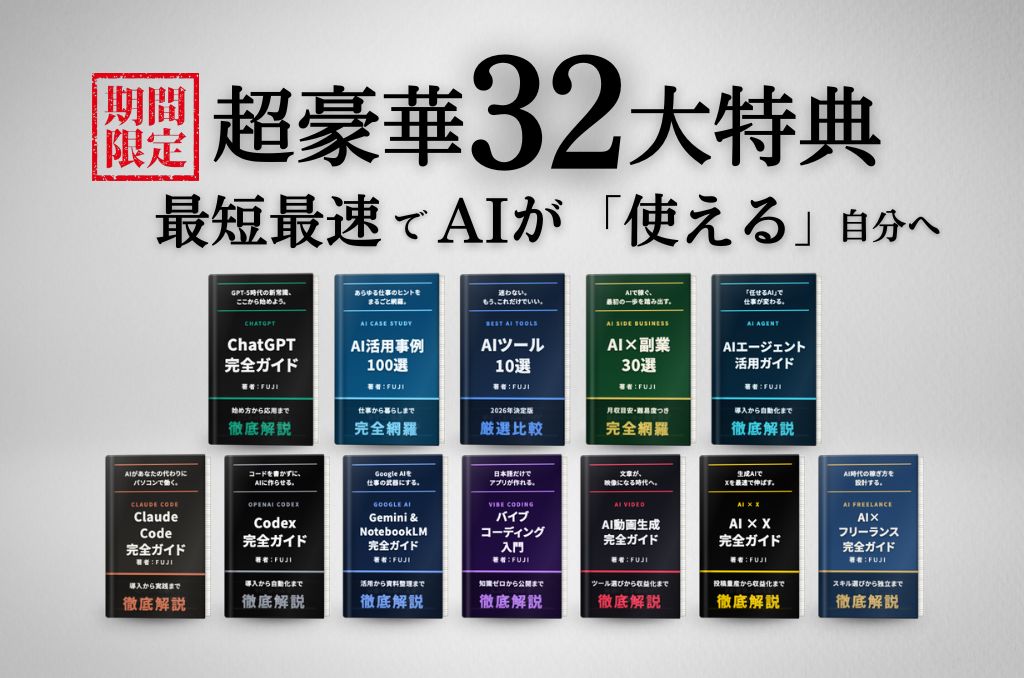
The contents of the benefits are as follows:
- ChatGPT / Claude Code / Codex / Gemini Complete Guide
- AI Side Hustle Roadmap to earn 1M yen/month, Profitable Genre Map, Unit Price List, Market Data
- Practical guides for AI Video Generation, AI Agents, Vibe Coding, etc.
- 100 AI Use Case Examples, etc.
A total of 32 items, over 860 pages in total. And it's all free.
You can get everything without participating in seminars or free individual consultations.
It sounds like a lie, doesn't it? But it's true.
How to receive it is simple.
It starts by joining the LINE Open Chat below.
You can enter from here.
However, these super luxurious 32 benefits are for a limited time only.
I haven't decided on a deadline, but when it ends, it will end without notice.
Almost everyone forgets "I'll do it tomorrow." Please receive it while you can.
Let me say it just one more time.
I'll be honest.
These 7 steps weren't reached in one go.
I failed many times. That's why I can say for sure.
Whether you can earn with AI is not determined by talent.
It's whether you know the correct order.
That order is all in these 32 benefits.
Why not end the exhaustion of selling your time today?



![Yusuke Narita's Genius AI Utilization Techniques [Preservation Edition]](https://youmind.club/__ym/cms-assets/media/1784137658627_u4bwry_HNMS89bbsAAUPJI.jpg)