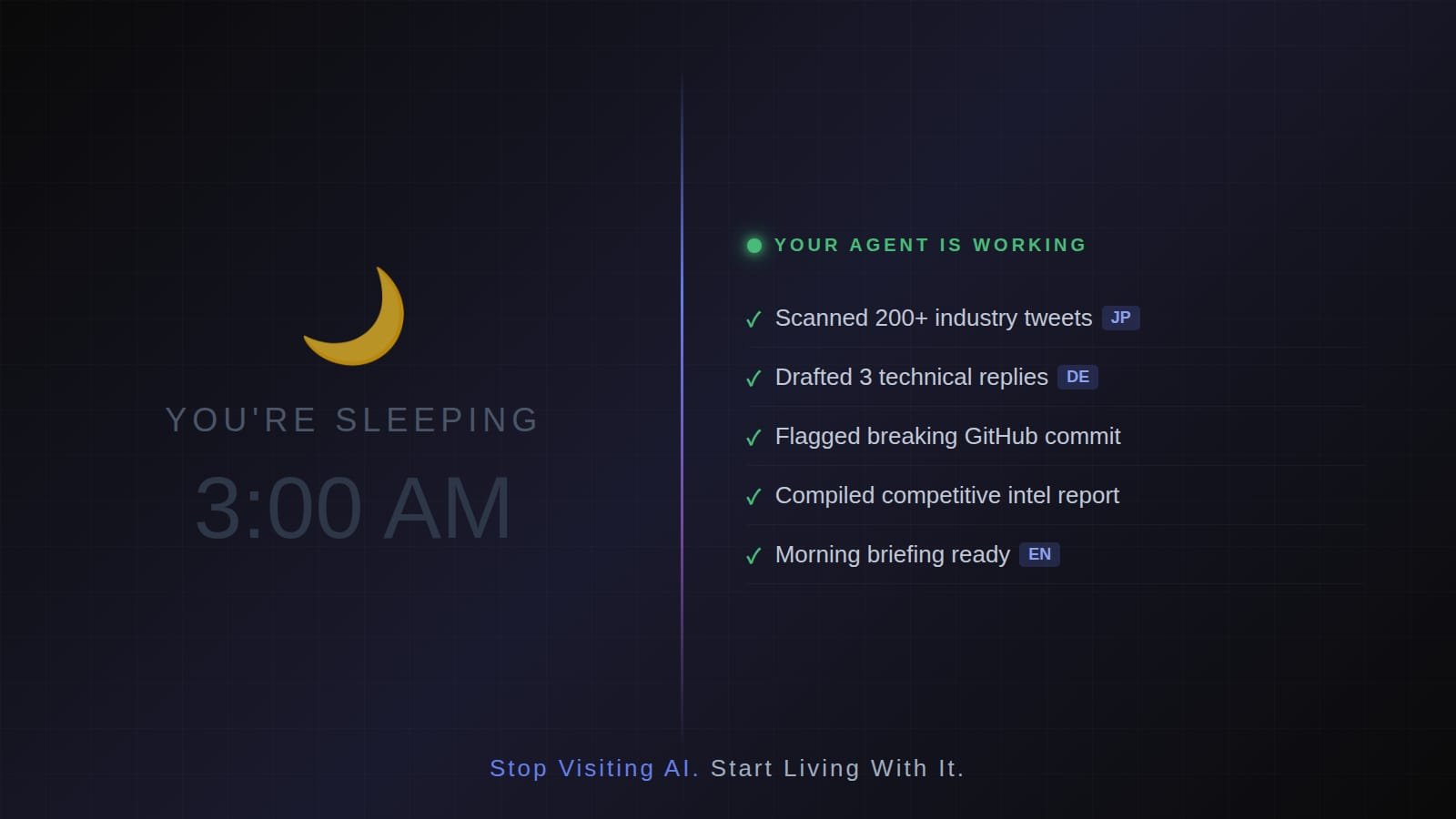
When I am sleeping, My claw is working.
I used to think I was "good at AI."
Open ChatGPT. Type a question. Get an answer. Close it.
That was my entire relationship with artificial intelligence. And honestly? I thought I was ahead of the curve.
Then I set up an AI agent on MyClaw.ai that runs 24 hours a day, 7 days a week — on a cloud server, connected to my Telegram — and I realized something uncomfortable:
I hadn't been using AI. I'd been visiting it.
Like a tourist who thinks they know a city because they spent an afternoon there.
This is the story of what happened when I stopped visiting — and started living with AI.
3 AM. I Was Asleep. My Agent Was Not.
It was a Tuesday night. I went to bed at 11.
While I slept, my AI agent:
- Scanned 200+ tweets in Japanese about a breaking change in the AI framework I use
- Identified 3 users in Tokyo struggling with a configuration error I'd solved last week
- Drafted personalized replies — in Japanese — with step-by-step fix instructions
- Compiled a morning briefing with the top 10 developments in my industry overnight
- Flagged a GitHub commit in a repo I follow that introduced a breaking API change
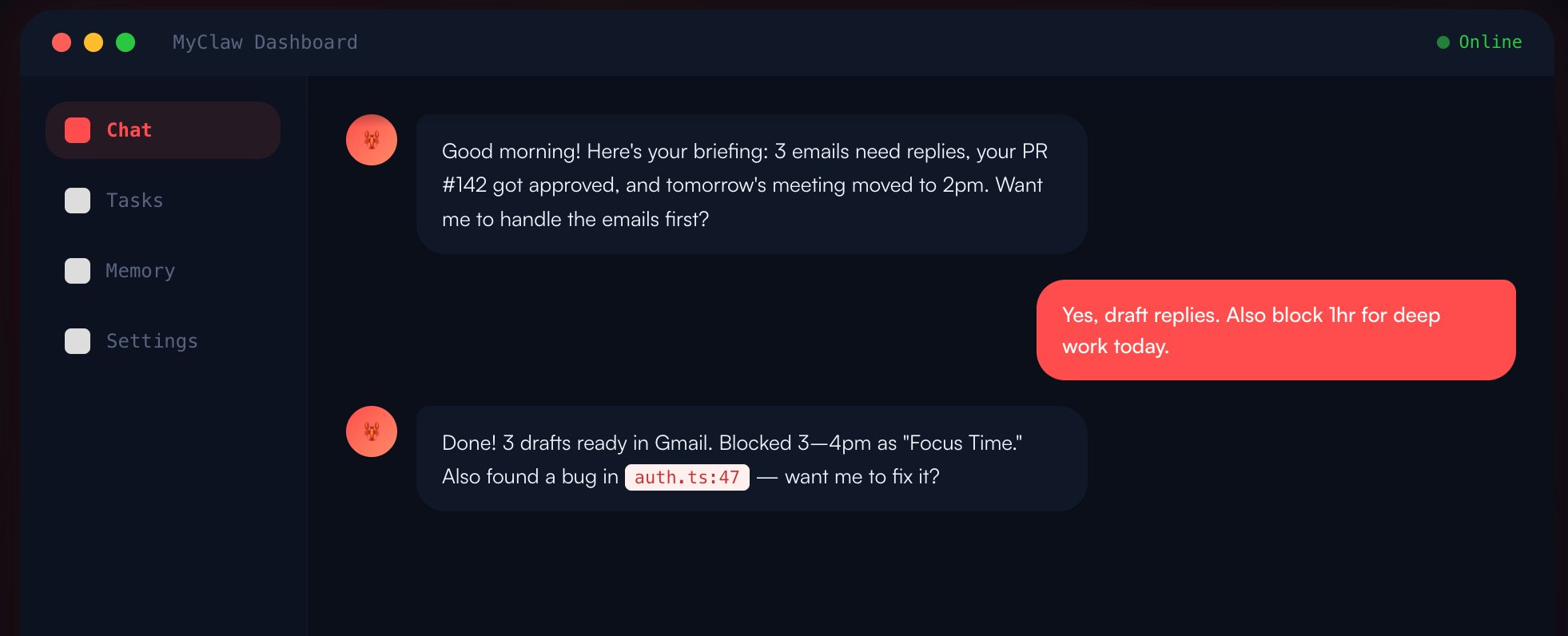
When I woke up at 7 AM, I had a clean summary waiting in my Telegram.
I was the first person in my network to comment on the news — with depth, with links, with context. People thought I pulled an all-nighter.
I slept 8 hours.
The Calculator vs. The Employee
That morning changed everything for me.
I realized the gap between "AI tool" and "AI agent" isn't incremental.
It's categorical.
A chatbot is a calculator. You punch in a question, it gives you an answer, it waits for the next input.
An agent is an employee. It shows up, looks around, identifies what needs to be done, and does it — whether you're there or not.
GPT-4 was impressive. Claude was impressive. Gemini was impressive.
But they were all reactive. You talk, they respond. You stop, they stop.
2026 changed that. AI agents became:
- Persistent — they run whether you're awake or not
- Proactive — they act on triggers, not just prompts
- Personal — they learn your context, your style, your priorities
- Connected — they read your emails, check your feeds, monitor your world
If you're still using AI the old way — open app, type question, close app — you're bringing a library card to a war fought with drones.
"Cool Story. What Does It Actually Do?"
Fair. Let me give you one real week from my life.
Monday:
My agent scanned German-speaking Twitter at 6 AM and found a developer in Munich complaining about Docker permission errors on his home server setup. My agent drafted a reply — in fluent German — with a step-by-step fix and a link to the relevant docs.
By 9 AM, the developer had replied: "Danke, das hat funktioniert!" (Thanks, that worked!)
I didn't even know this conversation existed until I saw it in my evening report.
Wednesday:
A new product launched in my space at 2 PM EST. My agent:
- Detected the announcement within 12 minutes 2. Read their blog post and changelog 3. Summarized the strategic implications 4. Compared it against our roadmap 5. Dropped the analysis in my Telegram with a recommended response
Time I spent on competitive intelligence that day: 0 minutes.
Friday:
My agent compiled a weekly briefing:
- 47 community mentions across 3 languages (EN, JP, DE)
- 5 GitHub issues that might affect our users
- 3 potential partnership leads from Twitter conversations
- Market sentiment analysis with supporting quotes and links
I reviewed it in 6 minutes over coffee.
People like Charles are already running multiple agents around the clock:
https://x.com/CharlesLeft/status/2019915224875458973
"But I'm Not a Founder. Why Would I Need This?"
This is the objection I hear most. And it's based on a wrong assumption.
You don't need to run a company to benefit from a 24/7 agent. You just need to be a person with more to do than hours in the day.
If you have a job: Your agent monitors industry news while you sleep. Preps meeting briefs before you wake up. Drafts email responses in your writing style. Flags messages that actually need your attention.
If you have a side project: Your agent tracks the landscape, engages with your community, identifies collaboration opportunities, and posts content on your schedule — not when you remember to.
If you have a social media presence: Your agent curates content, drafts posts in your voice, schedules across time zones, and responds to messages within minutes — even at 3 AM.
If you just have a life: Your agent tracks package deliveries, monitors price drops on things you want, reminds you about birthdays with gift suggestions, and keeps your digital world organized while you live in the real one.
The question isn't "Do I need a 24/7 AI agent?"
The question is: "Can I afford to be the only one in my field who doesn't have one?"
Even the savviest users are discovering how much more their agent could be doing:
https://x.com/evilcassieroll/status/2022341416446288368
The Engine Under the Hood: OpenClaw
Everything I just described runs on an open-source framework called OpenClaw.
OpenClaw is the engine. It's the raw power — a fully open-source AI agent framework that lets you run persistent, proactive, personal agents on your own hardware or cloud server.
It's extraordinary. It connects to any LLM (Claude, GPT, Gemini, Grok — your choice), integrates with Telegram, WhatsApp, Discord, and Slack, and supports a growing ecosystem of community-built skills through ClawHub. Developers around the world are building incredible things with it:
Running multi-agent systems. Automating entire workflows. Building personal CRMs, knowledge bases, content pipelines, competitive intelligence engines — all on infrastructure they own and control.
The community is thriving. Thousands of developers are pushing the boundaries of what a personal AI agent can do.
Here's what an advanced setup looks like in the hands of a power user:
https://x.com/MatthewBerman/status/2021669868366598632
But here's the thing about raw power:
It requires a driver's license.
**
The Brutal Truth About Running Your Own Agent
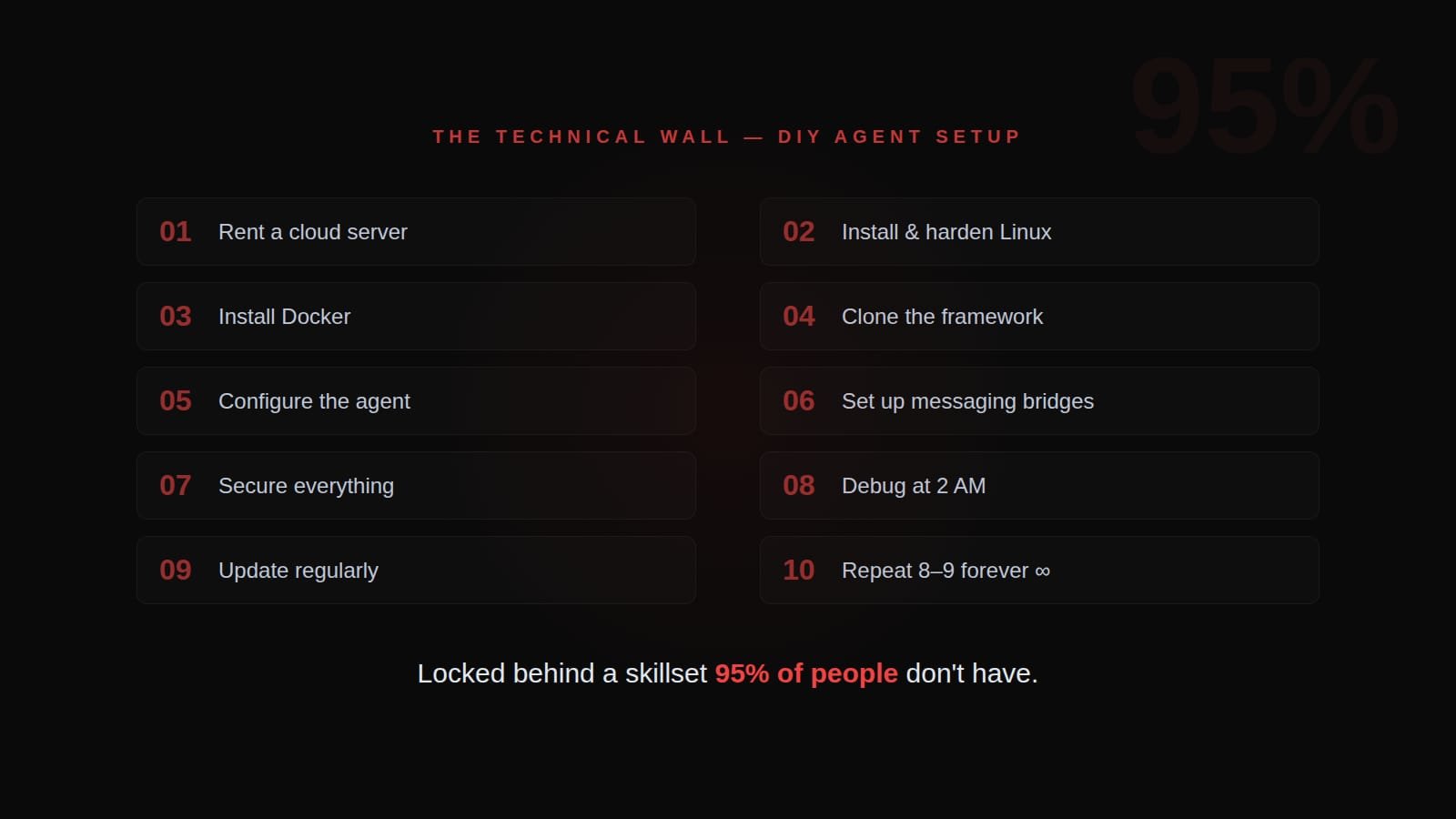
Setting up OpenClaw yourself looks like this:
- Rent a cloud server — which provider? Which region? Which OS?
- Install Linux — SSH keys, firewall rules, security hardening
- Install Docker — because nothing runs without containers anymore
- Clone the framework — git, npm, dependencies, version conflicts
- Configure the agent — API keys, model selection, personality files, memory systems
- Set up messaging — bot tokens, webhook URLs, bridge configurations
- Secure everything — HTTPS certs, port restrictions, rate limits
- Debug at 2 AM — because something will break. It always breaks.
- Update regularly — new versions, breaking changes, migration scripts
- Repeat steps 8-9 forever
For engineers? This is a fun weekend project. Some of the most impressive AI setups I've ever seen came from people who love this process.
For the other 95% of humanity? It's a wall.
And here's what keeps me up at night:
The most transformative personal technology of our generation is locked behind a skillset that almost nobody has.
OpenClaw made AI agents open-source. That was revolutionary.
But open-source alone doesn't mean accessible. Linux is open-source too — and most people use macOS or Windows.
**
OpenClaw Is the Engine. MyClaw Is the Car.
This is why we built MyClaw.ai.
Think of it this way:
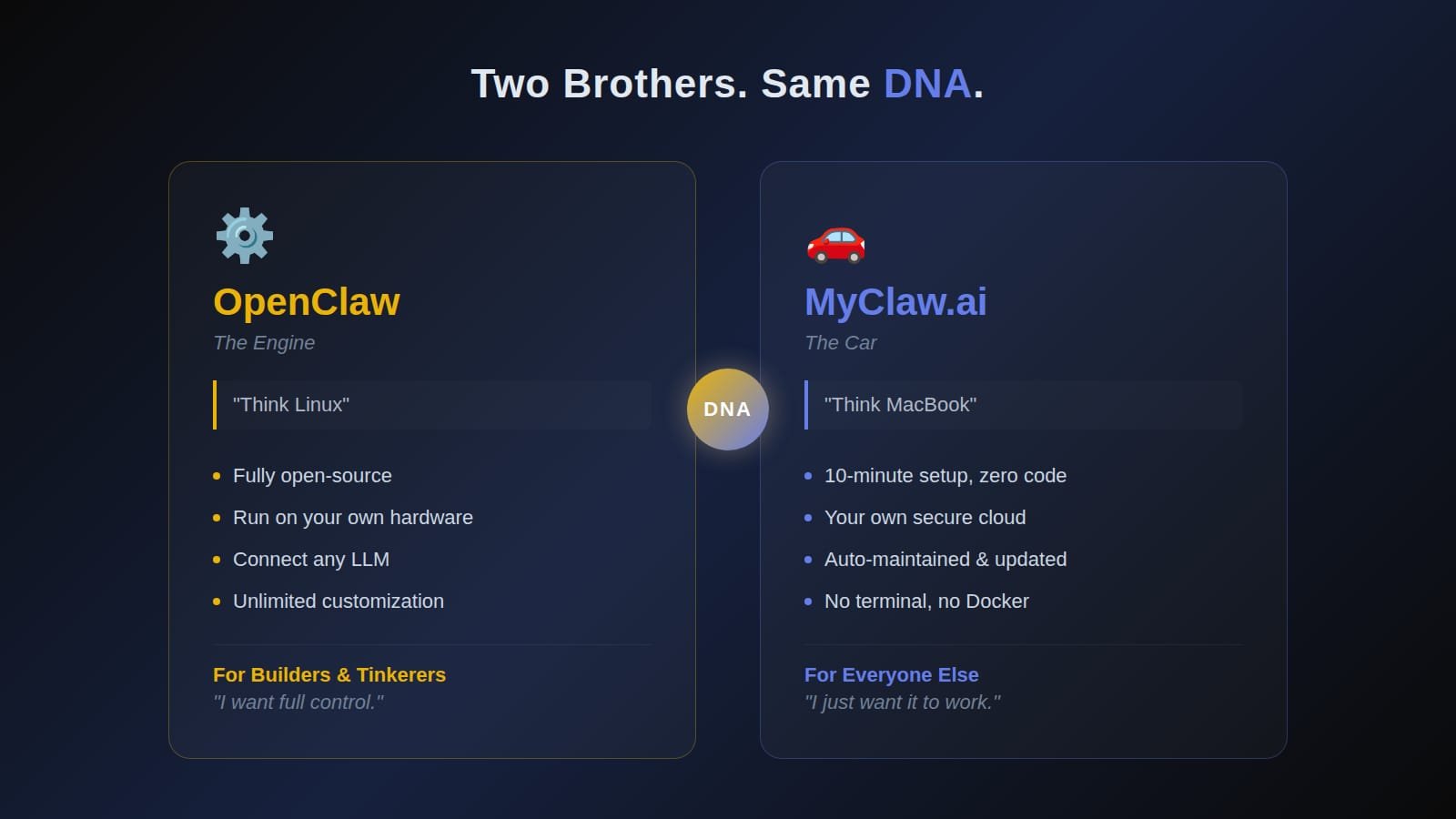
OpenClaw is like Linux — powerful, open, endlessly customizable, built by and for developers who want full control.
MyClaw is like a MacBook — the same core technology, wrapped in an experience that anyone can use in minutes.
Here's what it looks like:
- You sign up on MyClaw.ai
- You choose your agent's name and personality
- You connect your Telegram (or WhatsApp, or Discord)
- You pick what you want it to do
- 10 minutes later, you have a 24/7 personal AI agent — running on a secure cloud instance, maintained and updated automatically
No terminal. No Docker. No SSH. No debugging at 2 AM.
Your own cloud instance. Your own data. Your agent, your personality, your rules. Zero maintenance.
And because MyClaw runs on OpenClaw under the hood, you're not locked into a walled garden. You're getting the same battle-tested framework that power users run — just without the battle.
Two brothers. Same DNA. Different missions.
OpenClaw opens the door for builders. MyClaw.ai opens the door for everyone else.
The Future Is Already Here. It's Just Not Evenly Distributed.
William Gibson said that decades ago. It's never been more true than right now.
The people who adopt 24/7 AI agents in 2026 will have an unfair advantage for years — not because the technology is secret (it's literally open source), but because most people won't bother until it's too late.
Think about it:
- Early adopters of email had an edge for a decade
- Early adopters of social media built audiences that latecomers never caught
- Early adopters of smartphones restructured their lives years before everyone else
Every major technology shift has a window where early movers gain a disproportionate advantage. That window is open right now for personal AI agents.
And it won't stay open forever.
The question isn't whether everyone will have a personal AI agent. They will.
The question is whether you'll be early — or late.
What I'd Tell Myself 30 Days Ago
If I could go back to the version of me that thought "using ChatGPT" was "using AI," I'd say this:
You're not behind. But you're not ahead either. And the gap is about to widen fast.
Stop visiting AI. Start living with it.
Give yourself an agent that works while you sleep, thinks while you're in meetings, and organizes while you're living your life.
The 30 days I just had weren't impressive because of any single thing my agent did.
They were impressive because of the compound effect of having a tireless, context-aware, multilingual digital teammate working for me — every hour of every day.
That's not the future.
That's today. And it's available to everyone — not just engineers.
I'm Leo. I'm building MyClaw.ai because I believe everyone deserves a 24/7 AI personal agent — not just the people who can configure Linux servers.
The engine is open-source: OpenClaw. The car is ready to drive: MyClaw.ai.
If this changed how you think about AI, repost it. Someone in your network needs to read this.
Stop visiting. Start living. 🚀