Prompt engineering was the training wheel.
Loop engineering is the operating system.
A prompt gives you an answer.
A loop gives you a machine.
That’s the shift.
For the last few years, the big AI skill was prompt engineering. Learn how to ask better questions. Add context. Define the role. Set constraints. Ask for a format. Give examples. Refine the answer.
That still matters.
But it’s no longer the main edge.
Models are getting better at understanding messy prompts. You can give ChatGPT, Claude, Gemini, Perplexity, or Cursor a rough request and still get a useful answer.
The advantage is moving somewhere else.
Away from clever wording.
Toward better systems.
Prompt engineering is about better input.
Loop engineering is about a better system.
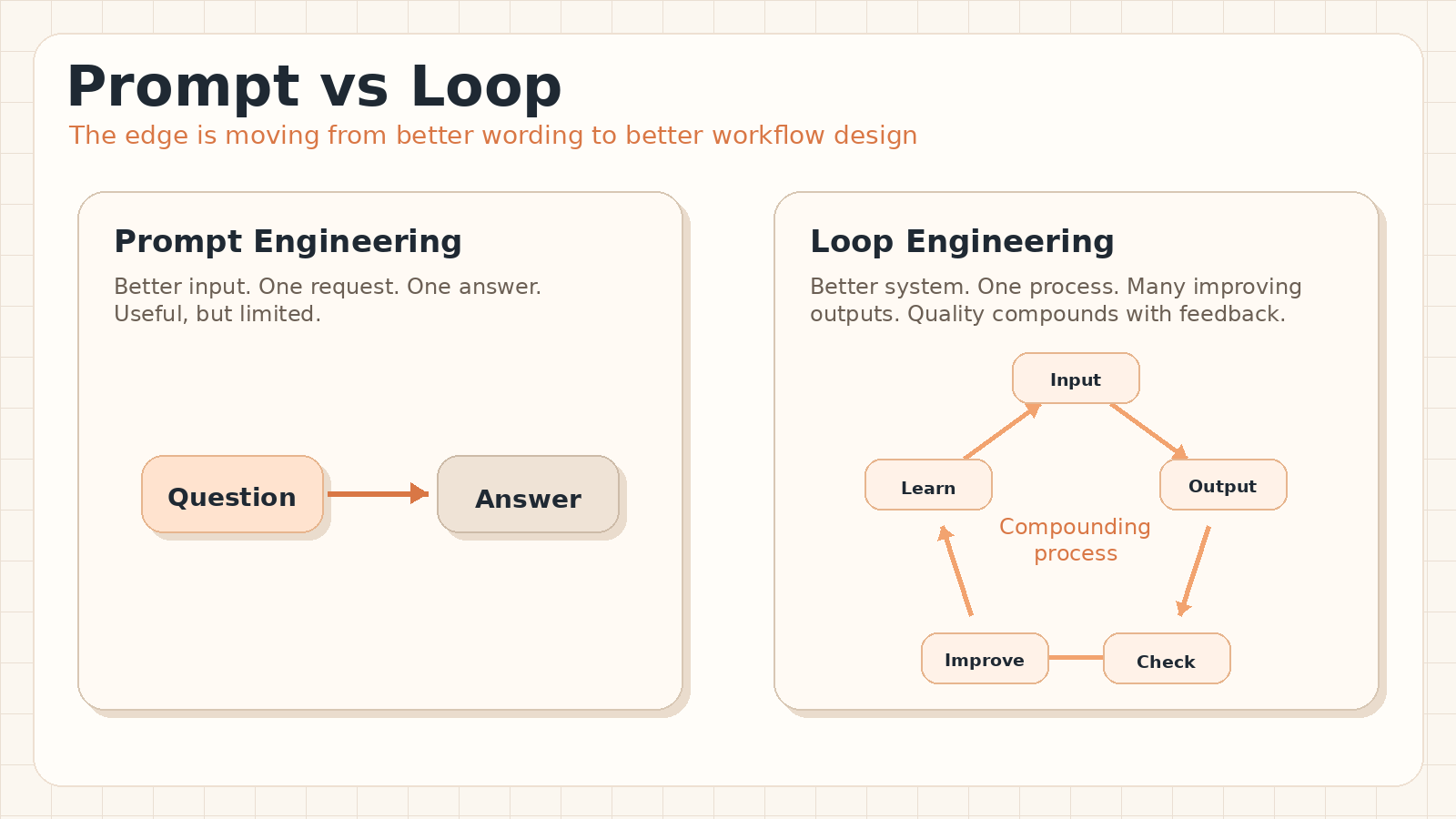
A prompt is a single instruction.
A loop is a repeatable process where AI creates an output, that output gets checked, improved, tested, used, measured, and fed back into the next run.
Prompt engineering says:
“Write me 10 ad ideas.”
Loop engineering says:
Generate 50 ad ideas. Score them against a buyer persona. Rewrite the weak ones. Turn the best 10 into variants. Test them. Analyze clicks and conversions. Feed the winning data into the next batch.
That’s not one prompt.
That’s a performance engine.
Simple Definition
Loop engineering is the skill of designing AI-powered feedback cycles that improve outputs over time.
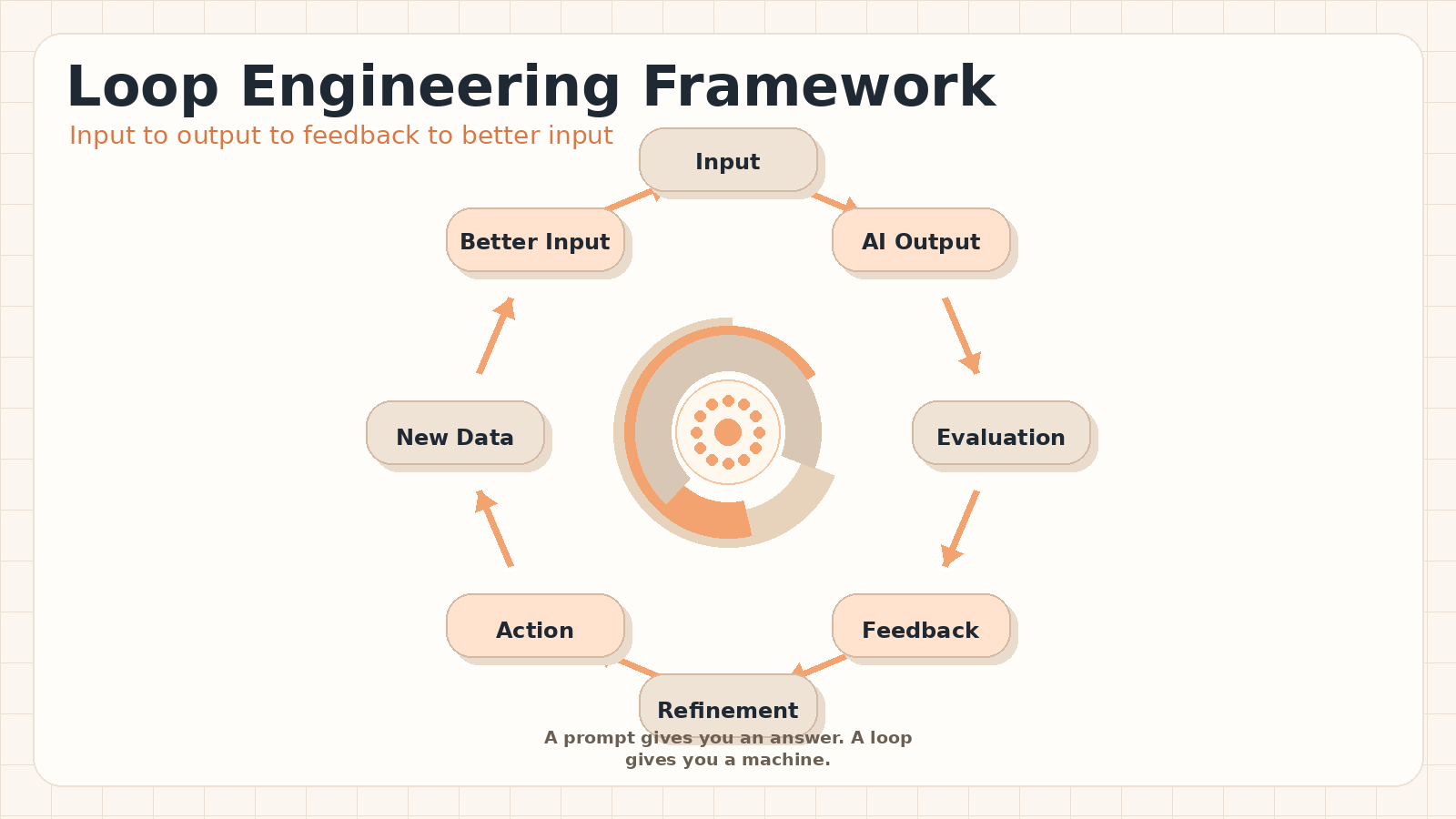
The key word is feedback.
Most people still use AI like a vending machine.
They type a prompt.
They get an answer.
They copy it.
They move on.
That’s useful, but limited.
Better AI users treat AI like part of a workshop.
Input goes in.
The model creates something.
A human or system checks it.
Feedback improves it.
The output gets used.
The result creates new data.
That new data improves the next cycle.
That’s where the compounding starts.
The question is no longer:
“What should I ask AI?”
The better question is:
“What process should AI improve every day?”
The Loop Engineering Framework
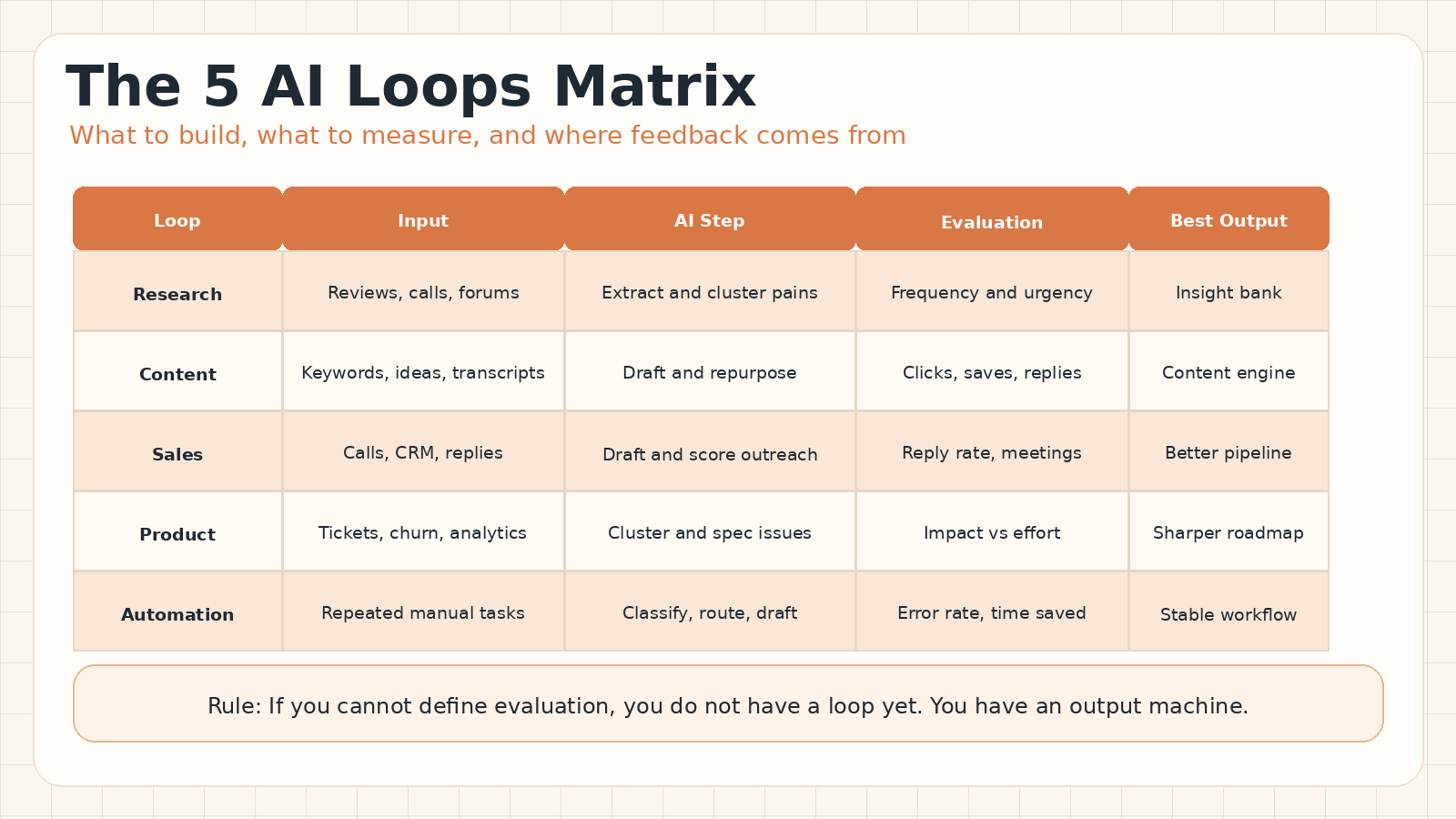
Input → AI Output → Evaluation → Feedback → Refinement → Action → New Data → Better Input
- Input
This is the raw material. A sales call, customer review, keyword list, meeting transcript, product idea, support ticket, analytics report, codebase, or messy note.
- AI Output
The model turns that input into something useful. A summary, draft, score, plan, script, email, brief, workflow, ticket, or code suggestion.
- Evaluation
This is the step most people skip. A loop needs a quality check. That check can be human judgment, a rubric, customer behavior, analytics, a second model, or a test.
- Feedback
The system identifies what worked, what failed, and what needs to change. Maybe the hook was weak. Maybe the email was too generic. Maybe the code fixed one bug and created another.
- Refinement
The AI improves the output based on the feedback. Rewrite, re-score, re-rank, simplify, expand, test again.
- Action
The output gets used in the real world. Published, shipped, sent, scheduled, assigned, posted, tested, or sold.
- New Data
The real world responds. Clicks, replies, purchases, bugs, comments, churn, saves, signups, objections, watch time.
- Better Input
That data becomes better context for the next run.
This is why loop engineering matters.
A prompt can create one decent answer.
A loop can create a system that gets sharper every time it runs.
The 5 Loops Every AI Builder Should Learn
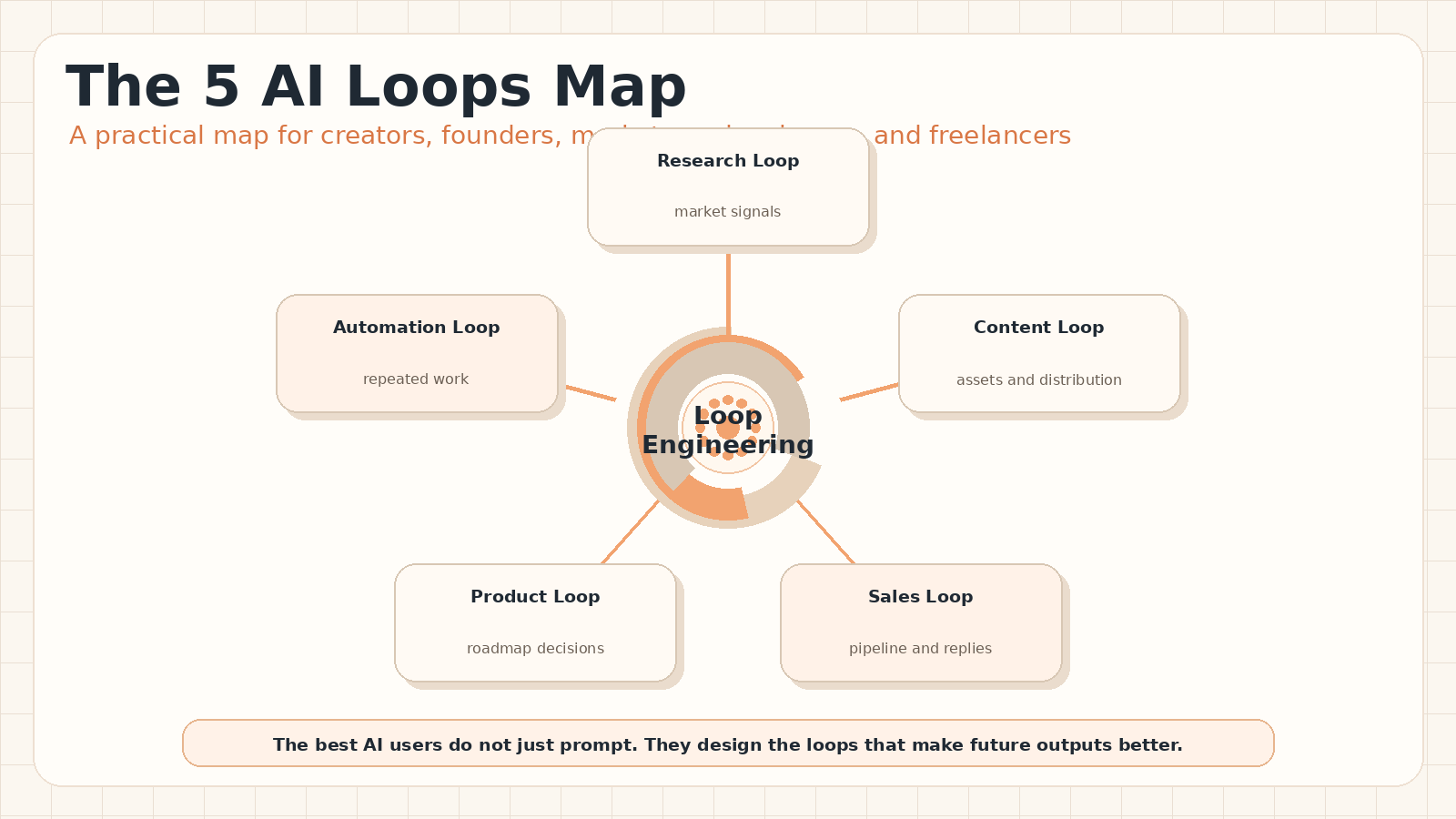
1. The Research Loop
Use this when you need to understand a market, audience, competitor, or problem.
Example:
Collect Reddit threads, G2 reviews, Amazon reviews, support tickets, YouTube comments, or customer calls.
Ask AI to extract pain points.
Cluster them by theme.
Score them by frequency, urgency, and buying intent.
Turn the best insights into content ideas, product angles, landing page copy, or sales messages.
Then track what performs and feed the results back into the next research cycle.
That beats generic “market research” because it keeps learning from real signals.
2. The Content Loop
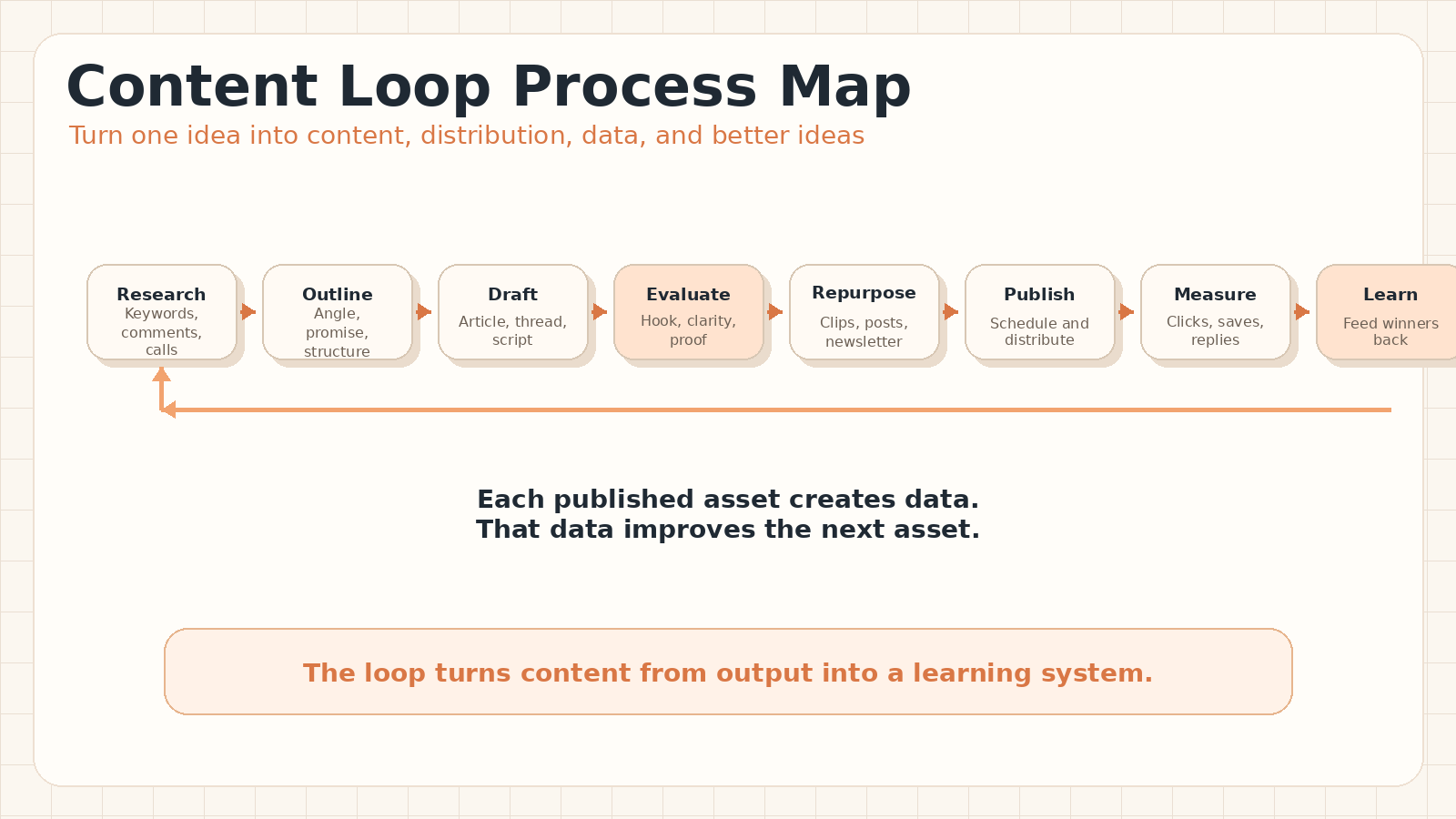
This is where creators, marketers, and solopreneurs can get a serious edge.
A basic prompt says:
“Write a blog post about productivity.”
A content loop does this:
Find search intent. Create an outline. Draft the article. Check weak sections. Add examples. Turn the article into tweets, a newsletter, LinkedIn posts, and short video scripts. Publish. Track clicks, saves, replies, and conversions. Use the data to improve the next piece.
Now content is not just output.
It’s a learning system.
Each post teaches the next post what the audience cares about.
3. The Sales Loop
Most teams use AI to write cold emails.
That’s the shallow version.
A sales loop can analyze won deals, lost deals, call transcripts, objections, reply rates, and CRM notes.
Then it can:
- Identify the strongest buyer pains
- Draft better outreach
- Personalize by segment
- Score messages before sending
- Improve follow-ups
- Build an objection library
- Update the CRM
The win is not “AI wrote an email.”
The win is “every sales conversation improves the next one.”
That’s a real loop.
4. The Product Loop
Founders and indie hackers can use loops to build closer to reality.
Example:
Collect feature requests, churn notes, support tickets, onboarding drop-offs, user interviews, and product analytics.
Ask AI to cluster problems.
Score them by user pain, revenue impact, and build effort.
Turn the top problems into product specs.
Build a small fix.
Collect feedback.
Repeat.
This protects you from building based on excitement instead of evidence.
AI helps you see patterns faster, but human judgment still matters.
A loop should not blindly turn every complaint into a feature.
It should make the decision process sharper.
5. The Automation Loop
This is where tools like Make, Zapier, n8n, Airtable, Notion AI, Slack, and Gmail become useful.
But be careful.
Bad automation creates more bad output faster.
A bad loop can spam weak content, send lazy emails, create messy tasks, and fill your workspace with noise.
The best loop is not fully automated at first.
Start manual.
Run the process yourself.
Watch where the repeated work happens.
Add AI to one step.
Add evaluation.
Then automate the stable parts.
Manual first. Automated later.
That rule saves time, money, and reputation.
Three Practical Examples
Creator Example
A YouTuber records one 30-minute video.
The loop:
Transcribe the video. Extract the strongest ideas. Turn them into 10 short clips, 5 tweets, 1 newsletter, and 3 thumbnail concepts. Score each asset against past winners. Publish. Track retention, clicks, comments, and saves. Feed the best topics into the next video plan.
That creator is building a content learning engine.
Business Example
A small agency wants better leads.
The loop:
Build a list of target companies. Research each company. Generate a custom problem hypothesis. Draft an outreach email. Score it against a checklist. Send a small batch. Track replies. Analyze which angles worked. Improve the next batch.
That’s stronger than asking AI for “a good cold email.”
Developer or No-Code Builder Example
A solo founder is building a micro-SaaS.
The loop:
Collect bug reports and user requests. Ask AI to group issues. Turn high-priority issues into tickets. Use Cursor or Claude to draft a fix. Review the code. Ship to staging. Test. Track errors. Feed the result into the next sprint.
AI is part of the system.
Not the whole system.
That’s the point.
Prompt engineering made people better at getting answers.
Loop engineering makes people better at producing outcomes.
More sales.
Better content.
Cleaner code.
Faster research.
Sharper decisions.
Less repeated work.
The future belongs to people who can design feedback loops.
Not because AI is perfect.
Because AI is fast, cheap, and good enough to run many cycles.
That creates a new kind of operator.
Someone who can spot repeated work, break it into steps, add AI at the right point, define what “good” means, create a feedback mechanism, and improve the process after every run.
That person beats the person who only knows how to write fancy prompts.
How to Start Today
- Pick one repeated task
Choose something you do every week. Writing newsletters, replying to leads, summarizing meetings, researching competitors, reviewing copy, creating reports.
- Map the current process
Write down every step. Even the ugly ones. Especially the ugly ones.
- Add AI to one step
Do not automate the whole thing yet. Let AI summarize, draft, score, classify, rewrite, or suggest.
- Add evaluation
Create a simple rubric.
For content, score:
- Clarity
- Usefulness
- Specificity
- Hook strength
- Audience fit
For sales, score:
- Personalization
- Pain relevance
- Proof
- Brevity
- Clear next step
- Feed the result back into the next run
Keep what worked. Study what failed. Improve the input. Run the loop again.
That’s loop engineering.
The smartest AI users are moving from:
“One prompt, one answer.”
To:
“One process, many improving outputs.”
Prompt engineering helped people talk to AI.
Loop engineering helps people build with AI.
The next edge won’t come from the person with the cleverest prompt.
It will come from the person who builds the loop that gets smarter every time it runs.