「Women who make you never want to leave them.」
Many think the reason is sex appeal or charm.
But looking around, the strongest type is different. You're in the same meeting, excited about the same topic, but when you look back, every word they said was precise, and you find yourself wanting to talk to them again. Such women exist in every workplace and community.
The secret isn't a technique. It's the speed of brain rotation.
Laszlo Bock, who served as the head of HR at Google (the man who oversaw hiring during the era when talent flooded Google from all over the world), asserted this in a New York Times interview:
「GPA as a hiring criterion is worthless. What we value most is the ability to learn.」
A company where geniuses from all over the world gather looks at 「learning ability」 rather than academic background or innate intelligence. And if you follow cognitive science research, you'll find that this difference in 「learning ability」 comes not from a difference in brain performance, but from a difference in daily usage.
In other words, the greatest characteristic of a 「woman who makes men obsessed」 is likely not innate charm, but the difference in how they use their brains daily.
If you think about it, it's obvious. The brain is an organ. Even if there's an innate difference in cardiopulmonary function, the difference between someone who runs and someone who doesn't is far greater. It's unnatural to think that only the brain is an exception and its performance is fixed regardless of how it's used.
I've narrowed it down to five habits that 「smart women」 do unconsciously and others don't, backed by research data.
By the time you finish reading, your perception of the phrase 「capable woman」 should change.
1. Recall before searching
Smart women put a buffer before searching.
When they think, 「Wait, what was that?」, they don't open their smartphones immediately; they first try to remember on their own. This few seconds of persistence makes a decisive difference in the brain.
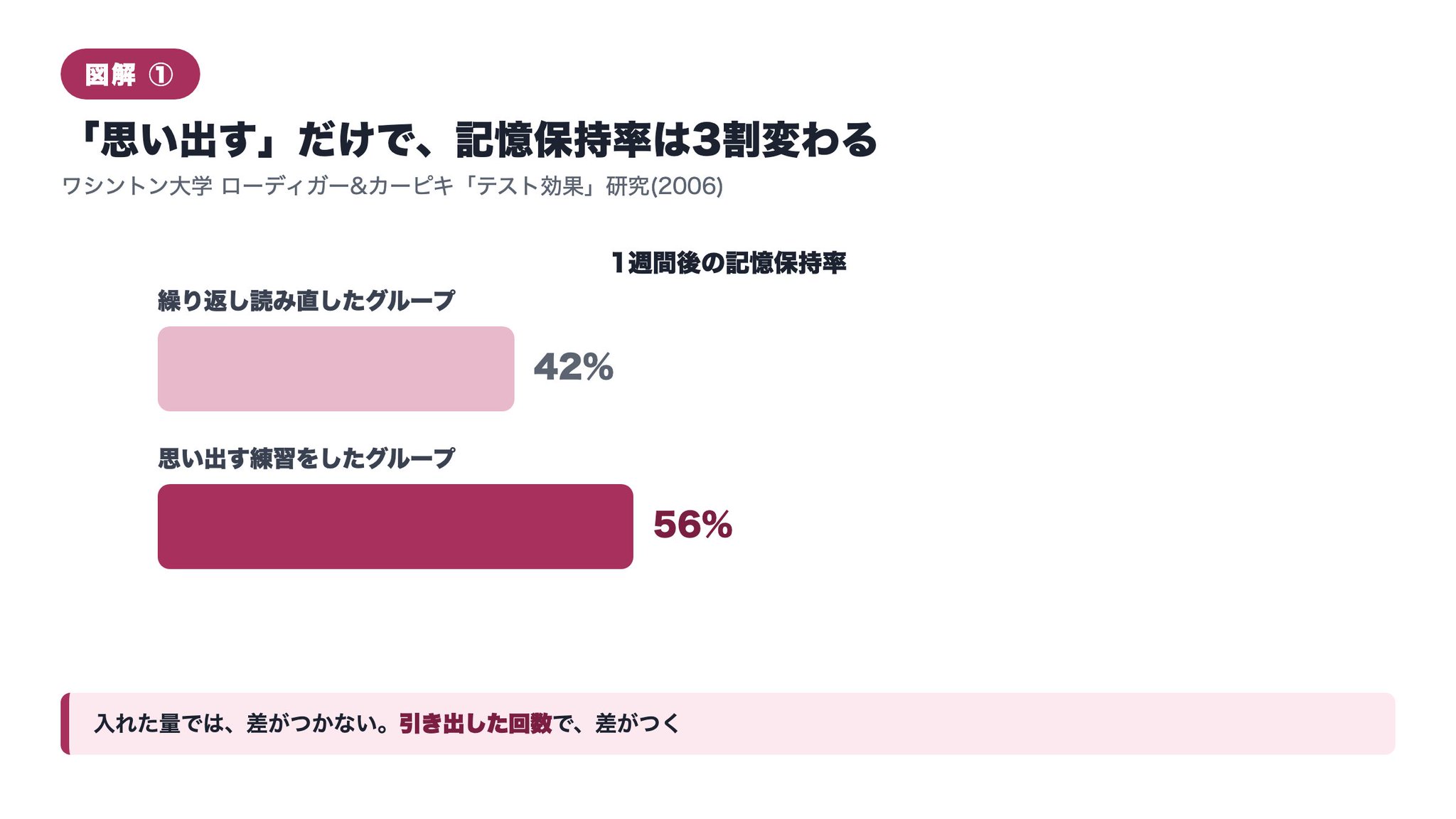
In an experiment (2006) by Roediger and Karpicke of Washington University (a leading duo in memory research), students who studied a text were divided into a 「repeated reading group」 and a 「recall test group.」
Immediately after, the reading group performed better. However, when measured a week later, the results were reversed: the recall group's memory retention was 56%, while the reading group's was 42%. Those who recalled remembered over 30% more.
Memory is strengthened not when you 「put it in」, but when you 「pull it out.」 This is one of the most reproducible laws of learning, called the testing effect in psychology.
This is the secret behind the 「quick retrieval」 of people with fast brain rotation.
The amount you put in doesn't make a difference. The number of times you pull it out does.
Practice:
- Before searching, spend 10 seconds trying to recall it yourself. It's okay to be wrong. The moment you try to remember, your memory is strengthened.
- After reading a book or article, close it and reproduce 「what was written」 in three lines.
- Before a meeting, recall the decisions from the previous meeting without looking at the materials.
2. Walk instead of sitting when thinking
Smart women leave their desks when they get stuck.
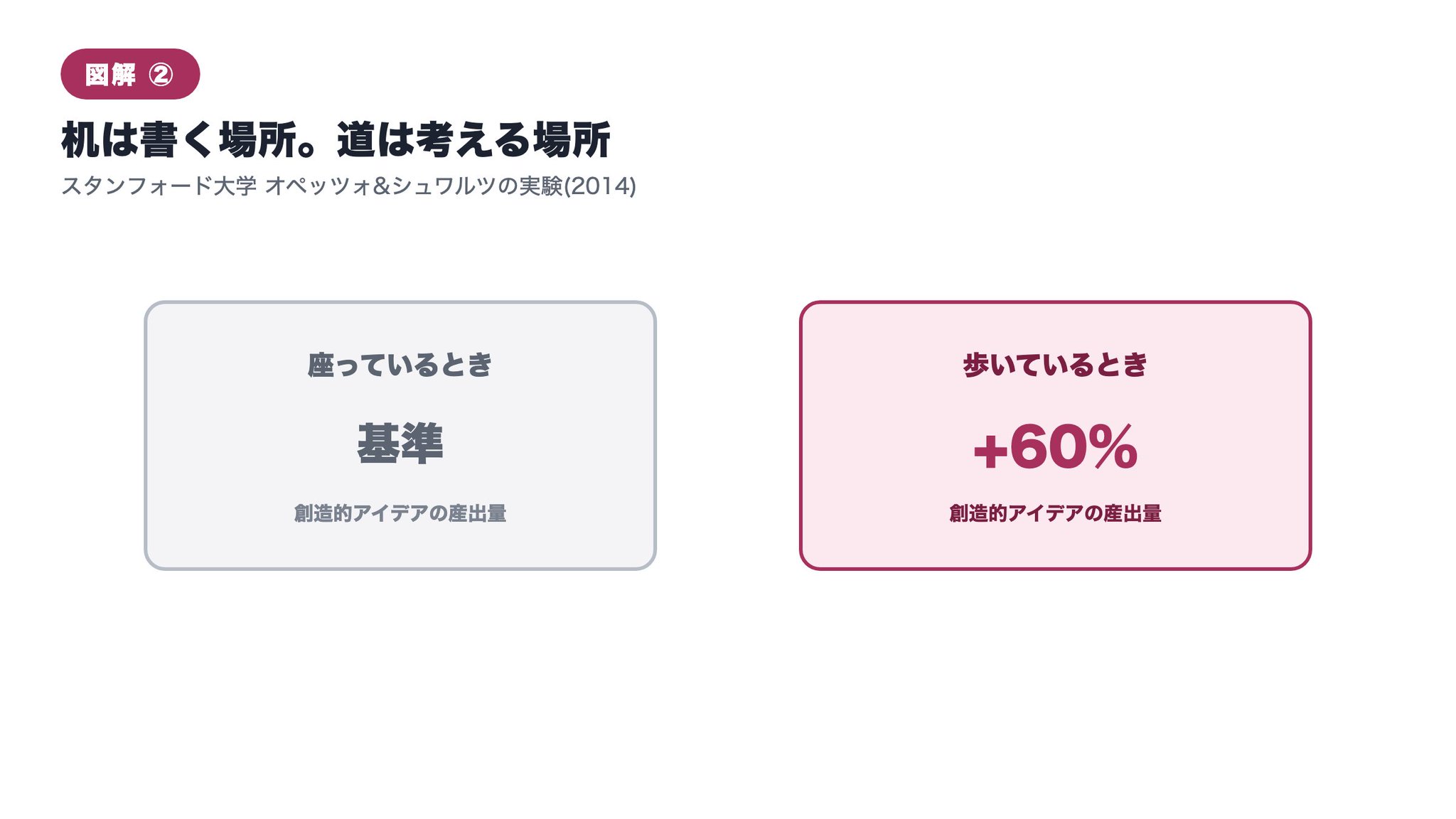
In an experiment (2014) by Oppezzo and Schwartz at Stanford University, they compared the creative power of 176 people while sitting and while walking.
As a result, the production of creative ideas increased by an average of 60% when walking compared to when sitting. Moreover, it didn't need to be outdoors; an indoor treadmill was also effective. It wasn't the scenery, but the act of 「walking」 itself that switched the brain.
Research from the University of Tsukuba also shows that 10 minutes of light exercise activates the hippocampus, which controls memory.
「An idea came to me while walking」 is not a coincidence, but a reproducible phenomenon.
The desk is a place to write. The road is a place to think.
Practice:
- Separate the 「thinking」 task from the 「writing」 task. Think while walking, write at the desk.
- If you get stuck, walk for 15 minutes. The effect disappears if you walk while looking at your smartphone. The goal is to give the brain a blank space.
- If possible, try doing one-on-one consultations or small decision-making while walking.
3. Say 「I don't know」 first
It might be surprising, but smart women are quicker to say 「I don't know」 or 「I don't understand.」
Laszlo Bock of Google mentioned 「intellectual humility」 as the next most important thing after learning ability in hiring.
「Someone who fights fiercely for their point but can say 'then you're right' the moment new facts emerge. Talented people who can't do that learn nothing from failure.」
Actress Mana Ashida has often been a topic of conversation for her wise remarks beyond her years since she was a child, and it's said that the foundation of this is her humble attitude of 「not pretending to know.」 The strength to admit what she doesn't know is the foundation of her ability to keep learning.
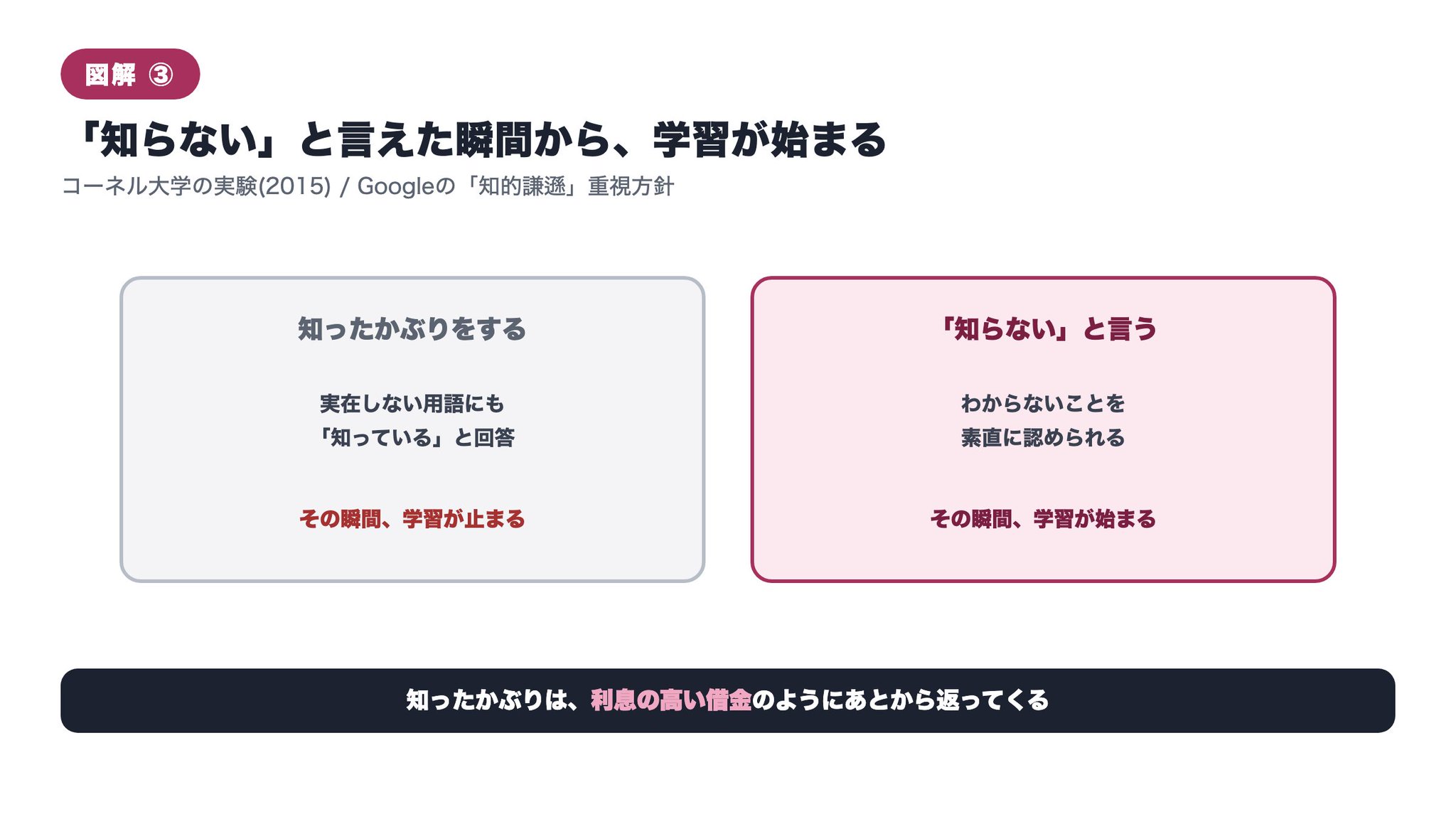
There is also data to the contrary. In a Cornell University experiment (2015, published in the journal Psychological Science), people who were more confident in their financial knowledge were more likely to answer that they 「knew」 non-existent financial terms like 「fixed-rate deduction.」 Confidence had broken the function of detecting what they didn't know.
The reason is simple.
The moment you say 「I don't know」, learning begins. The moment you pretend to know, learning stops.
The difference in innate intelligence is not the difference in comprehension on that day, but the difference in the 「number of years learning didn't stop.」 Pretending to know is like a high-interest loan; it comes back later as shallow thinking.
Furthermore, people who can say they don't know can ask questions. Questioning is the lowest-cost learning method to transfer the other person's knowledge to yourself. The proverb 「To ask is a moment's shame」 was correct from a cognitive science perspective.
Practice:
- If an unknown word comes up in conversation, ask on the spot, 「What does that mean?」 Once a day is enough.
- If you detect a 「sort of understood」 feeling, it's a danger signal. If you can't explain it to others, you don't understand it.
- When your opinion changes, say 「I've changed my mind」 out loud. A reputation as someone who can change their opinion becomes trust in the long run.
4. Don't think of sleep as 「disposable time」
I'll be blunt. No matter how much you learn about thinking methods, a brain that hasn't slept won't work.
The experiment (2003) by Van Dongen and others at the University of Pennsylvania is shocking. They monitored 48 healthy adults for 14 days and measured cognitive function for each sleep duration.
The cognitive function of the group that continued with 6 hours of sleep for two weeks dropped to the same level as someone who stayed awake for two full days.
And here is the most terrifying part: the subjects themselves reported being 「only a little sleepy.」 In other words, only the individuals themselves didn't notice the decline in their abilities.
The suggestion of this research is that most people who say 「I'm fine because I'm a short sleeper」 are just operating in a degraded state as their normal mode.
Michelle Obama has publicly stated in multiple interviews that she 「protects 7 to 8 hours of sleep every night.」 One of the busiest people in the world treats sleep not as something 「disposable」, but as the 「foundation of performance.」
Smart people handle difficult judgments with a cool face because, before talent, they simply start every morning with a 「full performance」 brain. People fighting with 6 hours of sleep might be lamenting a 「difference in innate intelligence」 while standing on the same ground as someone who hasn't slept for two days.
Sacrificed sleep is deducted from the next day's judgment.
Practice:
- Don't decide 「what time to go to bed」, but fix it by calculating backward: 「I'll wake up at this time, so I'll go to bed at this time.」
- Don't place important decisions on days when you lack sleep. Postponing only the judgment until the next morning is a fine intellectual strategy.
- Try 7 hours of sleep for just two weeks and record the lightness of your head in the morning. You can feel it through data.
5. Summarize and write instead of copying
The last is the habit of how to write.
In a study (2014) by Mueller and Oppenheimer at Princeton University, they compared students who 「took notes on a laptop」 and students who 「took notes by hand」 during a lecture.
There was no difference in factual memorization questions. However, the handwriting students clearly outperformed in questions asking whether they understood the concepts.
The cause was not the PC itself. Because typing is fast, the PC group 「copied the lecture as it was.」 On the other hand, the handwriting group couldn't keep up with the speed of writing, so they were forced to summarize the content.
In other words, it wasn't the handwriting that was effective, but the process of 「converting it into your own words.」
Copying is recording. Summarizing is thinking.
Even in the same act of taking notes, different tasks are running in the brain.
The reason smart people's notes are strangely short is not because they are slacking off, but because they have finished the abstraction on the spot.
Practice:
- If you're not the minute-taker, stop copying what's said and just write 「what it is in short.」
- Write reading notes in one line as 「how to use it in your work or life」 instead of quotes.
- If you take notes on a PC, don't type while listening; summarize and type at each break in the conversation.
5 patterns common to 「people often misunderstood as having good innate intelligence」
① They immediately look up what they don't know on their smartphone and don't try to remember it with their own head.
② When they get stuck, they keep sticking to their desk and don't have the option to stand up and walk.
③ They can't say 「I don't know」 to things they don't know and get through the situation by pretending to know.
④ They sacrifice sleep time first and believe the degraded state is their 「usual self.」
⑤ They are satisfied just by copying what people say or what's in books.
「Smart Person」 Self-Check 10
□ Even if there's something I don't know, I try to remember it on my own once before searching.
□ After reading a book or article, I can summarize the content in three lines in my own words.
□ When I get stuck, I make time to leave my desk and walk.
□ I can say 「I don't know」 or 「I don't understand」 on the spot.
□ I can recognize that knowledge I can't explain to others is 「not understood.」
□ I don't make sleep time the first thing to cut.
□ I try not to carry over important decisions to days when I lack sleep.
□ My notes on conversations and lectures are focused on summaries rather than copying.
□ When my opinion changes, I can honestly say, 「I've changed my mind.」
□ I am aware that I can handle difficult judgments with a cool face.
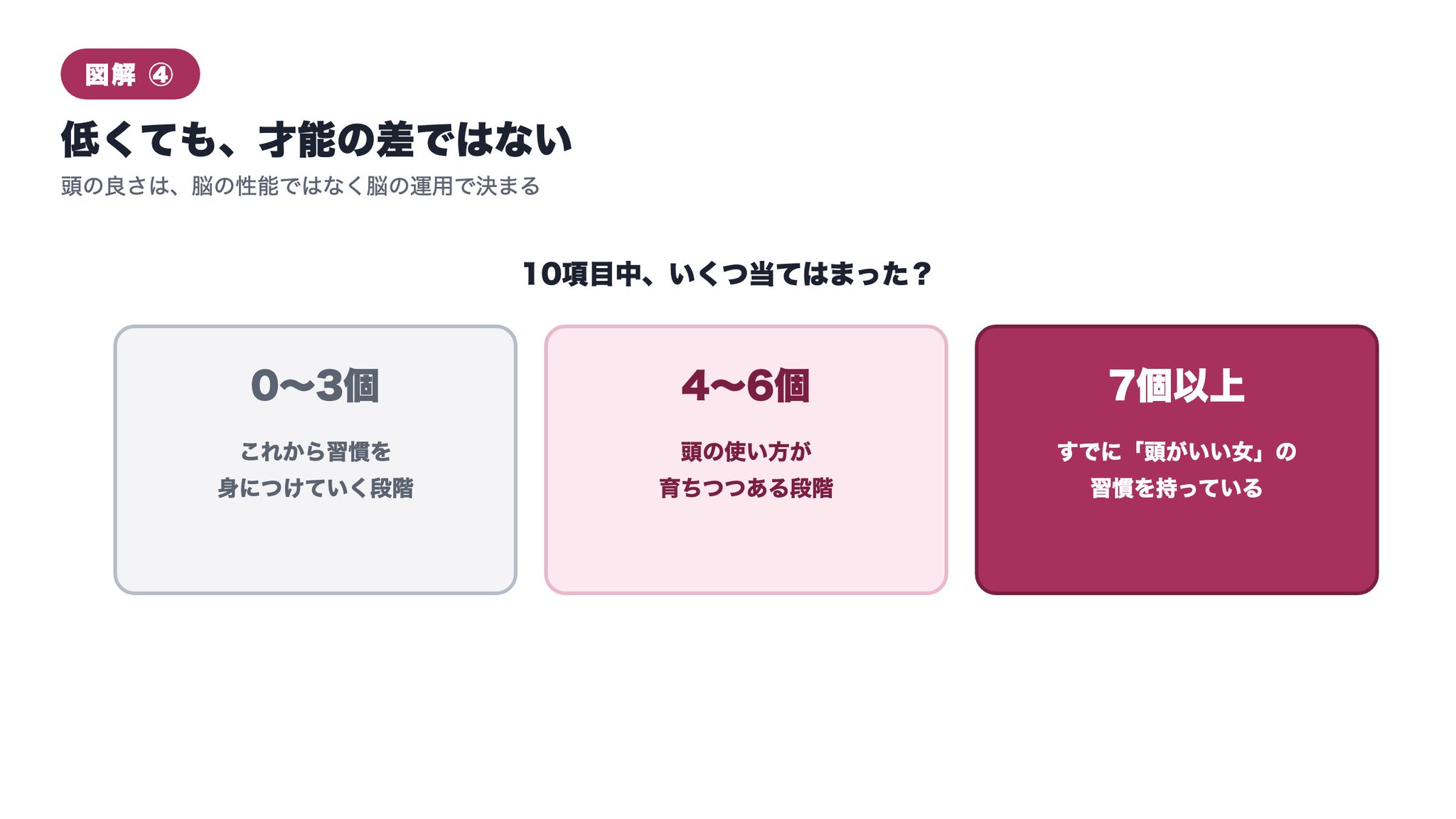
If 7 or more apply, you already naturally have the habits of a 「smart person.」 Even if it's 3 or less, there's no problem. This is not a talent, but a skill you can acquire from now on.
Summary: What makes people obsessed is not sex appeal, but the operation of the brain.
- Recall before searching — Memory gets stronger every time you pull it out.
- Think while walking — Creative output increases by an average of 60%.
- Say 「I don't know」 first — Learning doesn't stop.
- Don't cut sleep — 6 hours of sleep for 2 weeks is the same as a brain that hasn't slept for two days.
- Summarize and write instead of copying — Think instead of recording.
Did you notice? Not one of these five requires talent. You don't need special teaching materials or expensive seminars.
In fact, you can do all of them for free starting today.
Things you can do starting tomorrow:
- Spend 10 seconds trying to recall on your own before searching.
- If you get stuck, leave your desk and walk for 15 minutes.
Things to do within a month:
- Consciously increase the number of times you say 「I don't know」 on the spot.
- Record the lightness of your head on days you secured 7 hours of sleep and days you didn't.
Things to do in the long term:
- Switch reading notes and meeting notes from copying to summarizing.
- Make a life rhythm that accumulates 「years when learning didn't stop」 your standard.
「Innate intelligence is born」 is very convenient as a reason not to do something. But data consistently shows that the true nature of what is called innate intelligence is not 「brain performance」 but 「brain operation.」
Intelligence resides not inside the skull, but in how you use your 24 hours.
Talent cannot be changed. Habits can be rewritten starting today.
Finally
I will introduce the methods for making spiritualism a business only to those who register from the profile link. I recommend registering now.