In the overseas AI / semiconductor supply chain investment circle, Serenity is a name that cannot be avoided recently.
His X account is @aleabitoreddit. His avatar is an image of a white-haired woman, so he is known in the Chinese circle as the "White-haired Stock God." His follower base is approaching one million, and his subscription numbers are also at a very high level. He is currently one of the most influential individual researchers on X discussing AI / Semi supply chains, photonics, CPO, InP, neocloud, and other directions.
What has attracted more market attention is that he has hit a group of highly elastic AI supply chain targets in the past period. Whether it is AXTI in the InP substrate direction, SIVE and AAOI in the laser and optical communication chain, or NBIS in the AI cloud direction, what he truly made the market remember is not simply calling for more AI, but continuing to break down AI demand upstream to find those niche chokepoints with small market capitalization, low coverage, tight supply, and verification earlier than revenue realization.
Recently, Serenity followed my X.

I personally admire his thinking and professionalism in analyzing the upstream and downstream of the AI industry. He represents a very recognizable method in the past round of US stock AI trading: not starting from the most popular stocks, but deducing supply chain bottlenecks from AI demand.
But before breaking down the method, the risks must be clearly stated.
Many of the targets Serenity mentioned in the past often have characteristics of small market capitalization, high volatility, high elasticity, and high thematic nature. Once they are repriced by the market, the gains can be very amazing; but similarly, once orders, qualification verification, revenue realization, or financing structures fall short of expectations, the volatility will also be very intense. Especially after social media dissemination, such small-cap stocks can easily turn from "non-consensus research" into "crowded trades." If ordinary investors only learn stock codes and not the verification framework, they can easily become high-level bag holders.
Therefore, this article is not about leading everyone to copy Serenity's homework.
More accurately, Serenity is a transactional supply chain analysis sample worth studying. His true value is not in predicting whether AI demand will continue to grow, but in breaking down AI demand into layers of supply chain constraints and then looking for the chokepoints that are most easily overlooked by the market but could be rapidly revalued once verified.
1. The divergence in AI investment is shifting from the demand side to the supply side
In the past two years, the easiest stage to make money in AI investment was when the demand side was repriced. Model capabilities improved, GPUs were in short supply, cloud vendors' capital expenditures continued to expand, and NVIDIA, Microsoft, Broadcom, TSMC, storage, and optical modules all entered the market main line successively. The core question at this stage was: who benefits most directly from AI demand?
But when demand has become a consensus, new excess returns often no longer come from the question of "will AI continue to grow," but from another more specific question: in the process of AI growth, which link has the tightest supply? Which link is the hardest to expand production? Which link has the longest certification cycle? Which link, once it fails, will slow down the entire system?
Serenity's research path is precisely centered around this change. AI demand expansion brings hyperscaler capital expenditure; capital expenditure falls on GPUs, ASICs, switching architectures, and optical interconnects; optical interconnects continue to deduce upstream, and you will see 800G, 1.6T, CPO, lasers, InP substrates, epitaxial wafers, and more upstream materials. The further upstream, the less familiar the market is, the less coverage there is, and the less prominent the short-term financials are, but once a certain link really becomes a bottleneck, the elasticity may be even greater.
This is the basic starting point of Serenity-style trading: not looking for certainty in the most crowded places, but looking for odds in bottlenecks that have not yet been fully named.
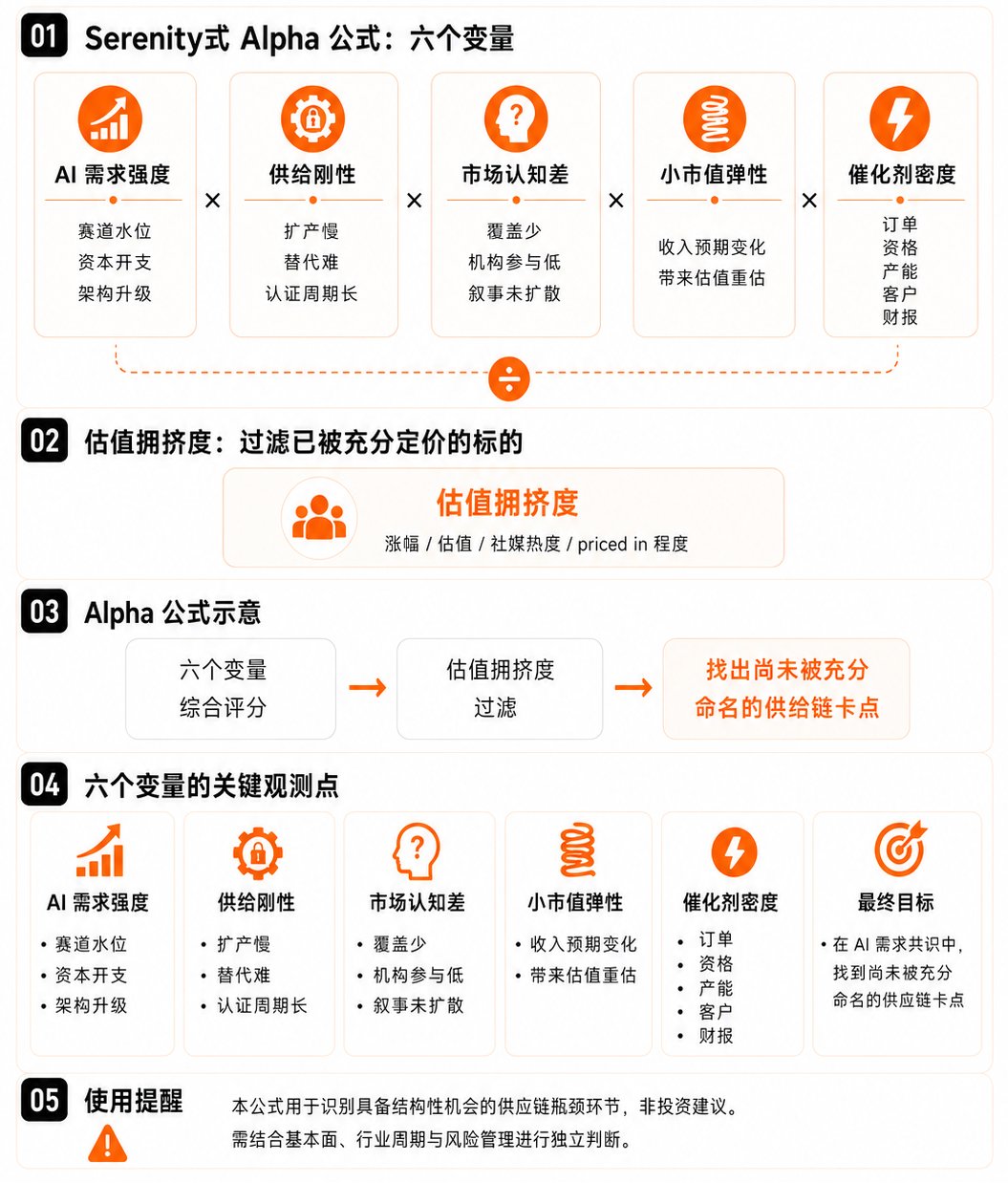
His framework can be compressed into a formula: Serenity-style Alpha = AI Demand Intensity × Supply Rigidity × Market Cognitive Gap × Small Cap Elasticity × Catalyst Density ÷ Valuation Crowding.
In this formula, AI demand intensity is not the scarcest variable. Because strong AI demand is already a market consensus. What truly determines Alpha are the following items: whether supply is rigid, whether the market has not yet fully understood it, whether the target is small enough, whether catalysts are dense enough, and whether the price is already overly crowded.
2. Deducing physical bottlenecks from terminal demand
One of Serenity's most typical cases is AXTI.
AXTI is not an AI company on the surface. It makes compound semiconductor substrates, of which InP substrates are upstream of optical communications, silicon photonics, lasers, and other links. If you only start from the company's revenue scale, profit level, or traditional valuation, it is difficult to include it in the AI main line at the first opportunity.
But Serenity's deduction path is completely different. AI data centers need higher bandwidth and lower power consumption, driving optical interconnect demand; optical interconnect upgrades drive demand for optical modules, CPO, and lasers; lasers and related photonic devices are further broken down upstream, and you will see InP substrates.
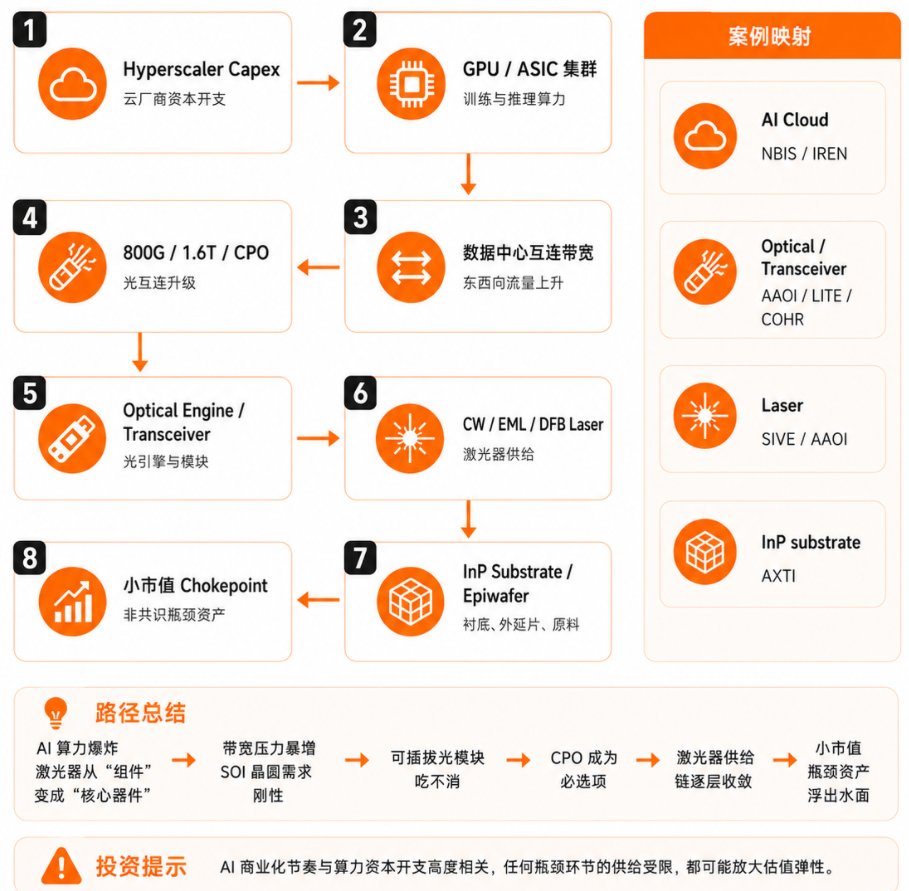
The problem is that InP substrates are not an ordinary material that can be expanded or replaced at any time. If global supply is concentrated, the expansion cycle is long, and customer certification is difficult, then it may become the "bottleneck of bottlenecks" in the entire AI optical interconnect chain.
The significance of AXTI is here. It is not the most conspicuous AI asset, but it is stuck in the upstream material link that AI optical interconnect expansion depends on. The market is initially prone to underestimating such companies because they are not direct takers of terminal demand, nor are they the companies whose revenue explodes first. But when the industry chain begins to realize that an upstream material may affect the expansion of the entire chain, the pricing method will change.
From "a small material company" to "a bottleneck asset renamed by AI demand."
AXTI was later repriced by the market, verifying not the myth of a single stock, but the effectiveness of a research path: after the AI main line is already crowded, Alpha may come from more upstream, more niche, and more physical supply constraints. More importantly, the improvement in revenue and gross margin in subsequent financial reports also shows that upstream material bottlenecks have begun to be partially verified.
But this case also serves as a reminder: once a bottleneck is fully discussed by the market, its nature changes. After turning from non-consensus research into consensus trading, the follow-up must rely on financial realization. The elasticity brought by early cognitive gaps cannot extend indefinitely.
3. Qualification verification often precedes revenue realization
If AXTI embodies "upstream bottlenecks," then SIVE embodies a more important layer in Serenity's methodology: qualification verification precedes revenue realization.
Many investors are used to waiting for financial reports to prove everything. But in the AI supply chain, especially for small-cap device companies, true revaluation often occurs before financial revenue is fully released. Because the earliest signal to appear is not revenue, but qualification.
Who entered customer verification? Who might become a key supplier? Who is embedded in the next generation architecture? Who has established mass production preparations with manufacturing partners? Whose products correspond to the volume ramp in 2027 or 2028? These signals are usually not directly reflected in the current quarter's profit, but they can change the market's imagination of the company's future revenue ceiling.
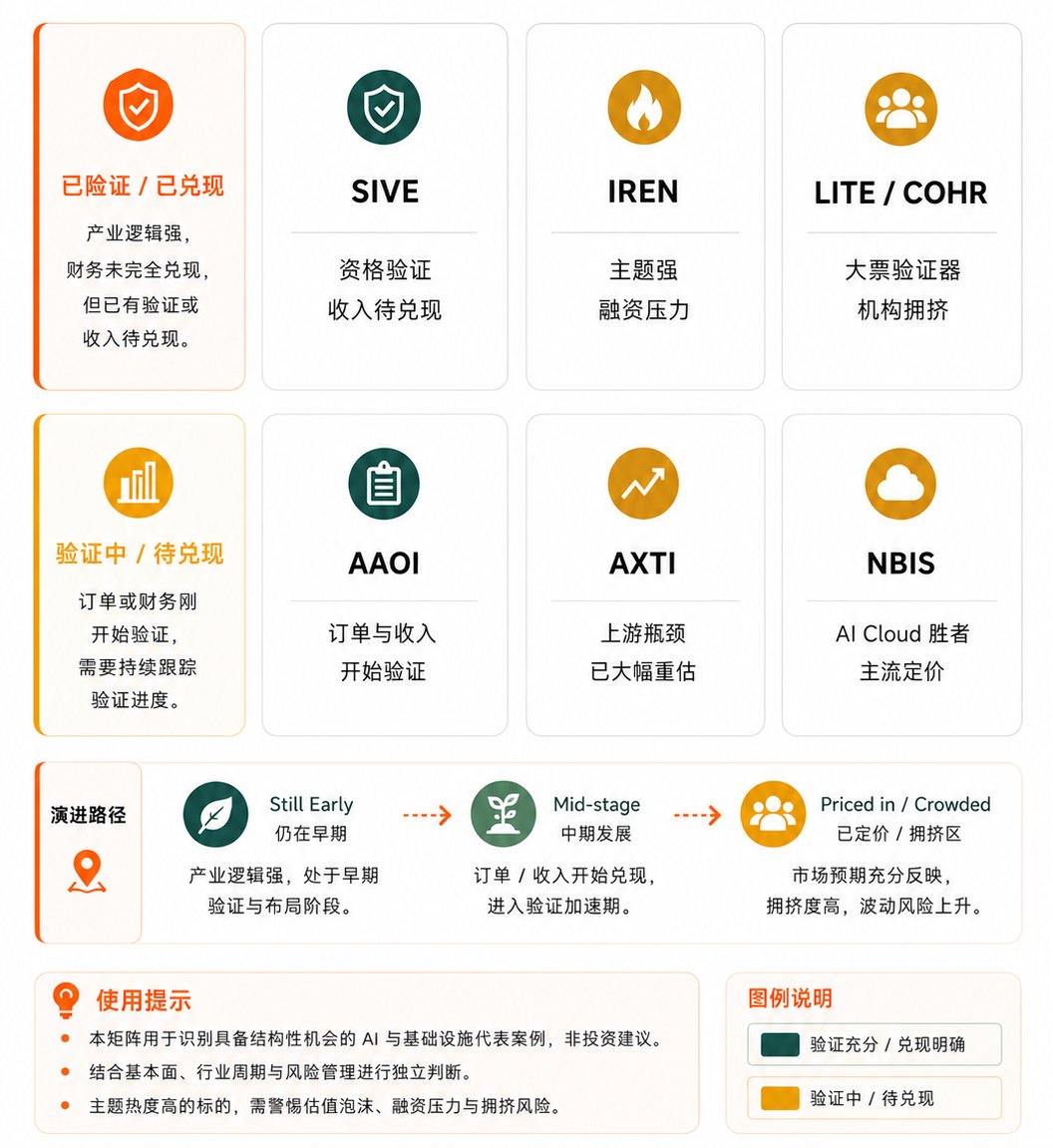
SIVE is such a case. Its attraction lies not in the fact that the current report is already perfect, but in the fact that it may be in a key position in chains such as CPO, 1.6T, LRO, and high-performance lasers. Serenity focuses on whether it has the opportunity to become a core laser supplier for certain architectures and customer chains, rather than simply valuing it using the past twelve months of revenue.
The elasticity of such trades is very large because once the market believes that "qualification verification will eventually turn into revenue realization," the valuation will reflect the future revenue curve in advance. SIVE is more like a qualification verification asset than a fully realized financial asset.
But the risks are equally clear. Qualification verification does not mean revenue has been realized, customer cooperation does not mean profit release, and the 2027 ramp does not mean today's valuation is necessarily reasonable. When the market pays for the future in advance, subsequent financial reports must continuously prove that this future will really come.
So the true value of SIVE is not simply saying "it's still early," but showing a core variable in Serenity's framework: before financial realization, the market will first price qualification, architecture, and supply position.
This is a high-elasticity opportunity and also a high-verification-difficulty trade.
4. From qualification to orders, then to market revaluation
The case of AAOI is easier for ordinary investors to understand than SIVE. Because AAOI has more clearly demonstrated the path from qualification to orders, and then to shipment ramp. It is not a pure early imagination, but an optical communication company that has already begun to see orders and mass production shipment verification.
Serenity's view of AAOI is not simply about the label of "American local optical module factory." This label is too broad and too easily abused by the market. What is truly important is whether AAOI can form visible orders in 800G and higher-speed optical module demand, whether it can move from customer qualification to delivery, and whether it can transform demand into a revenue curve.
The timing when such companies are most likely to be repriced is usually not after the financial report is fully realized, but when the market begins to believe that orders will continue, capacity will be released, and customer relationships will persist.
AAOI's case demonstrates a more complete bottleneck trading chain: first architecture upgrade, then qualification certification; first order clues, then capacity release; first market expectation changes, then financial reports gradually realized.
But it also reminds us that bottleneck trading cannot just look at revenue. Revenue growth is important, and orders are important, but gross margin, capacity utilization, customer concentration, and profitability are equally important. Orders, shipments, and gross margin should be looked at together, not just revenue.
If a company's revenue just goes up, but the profit margin does not improve, or the cost of expansion is too high, then the high expectations given by the market in the early stage will be challenged. What truly determines how far a trade can go is whether orders, capacity, profit margins, and customer relationships can be realized together.
5. Theme first, but don't buy the whole theme
Serenity does not only study materials and optical communications. His judgment in the Neocloud direction reflects another ability: theme rotation and winner selection. That is, first judge which theme will be repriced by the market, and then pick the company most likely to stand out within the theme.
NBIS is a representative in this framework. It is not a material bottleneck in the traditional sense, but a representative of AI cloud and computing power delivery capabilities. For such companies, the key question is not as simple as "do they have GPUs," but: do they have high-quality customers, do they have long-term contracts, do they have power supply sites, do they have financing capabilities, do they have a software stack, do they have high enough utilization, and can they turn heavy capital expenditures into sustainable cash flow.
AI infrastructure is not about who spends more money, but about who can turn Capex into cash flow. The core of AI cloud is not the number of GPUs, but the ROIC determined by customer contracts, power supply, financing, and utilization together.
The significance of NBIS is that it shows another side of Serenity's framework: when a theme has already appeared, don't buy a basket, but find the company most likely to form a positive cycle in the theme. The so-called positive cycle is the mutual reinforcement of customers, financing, resources, delivery capabilities, and market confidence.
This is different from the logic of SIVE and AXTI. SIVE and AXTI are physical bottlenecks in the supply chain, while NBIS is a computing power delivery bottleneck. The former is stuck in devices and materials, while the latter is stuck in capital, power supply, GPUs, and customer contracts.
But in essence, they are all answering the same question: In the process of continued expansion of AI demand, who controls the scarcest link?
6. A good story does not equal a good stock
IREN is a key case for understanding Serenity's risk framework.
IREN has many good stories: AI cloud transformation, NVIDIA cooperation, large-scale power resources, GPU deployment, data center expansion. These are all keywords the market likes.
But Serenity is more sensitive to another question: Will the financing structure swallow up shareholder returns?
This point is very critical. Asset-heavy AI companies are most prone to a mismatch: the industrial direction is right, and the company scale is also expanding, but shareholders may not enjoy the same proportion of benefits. The reason is that expansion needs money, and the money may come from debt, convertible bonds, ATM, additional issuance, or other dilution tools.
When financing pressure is large enough, stock price performance depends not only on business growth but also on whether the market can digest continuous supply. A correct direction but a heavy financing structure is a typical shareholder return risk for AI infrastructure companies.
The significance of IREN is that it shows that "having big customers," "having NVIDIA cooperation," and "having AI transformation" are not enough. If a company must constantly raise funds to realize its story, the odds for existing shareholders must be recalculated.
This is also an easily overlooked side of Serenity's framework: Capital structure is a trading variable, not a financial footnote.
Similarly for AI cloud, NBIS represents the winner selection in the theme, while IREN represents the financing risk in the theme. A company in the right direction is not necessarily a stock with good odds at the current stage.
Direction, company, and stock are three different questions. One of the most valuable parts of Serenity's methodology is separating these three.
7. What is truly learnable is the research order
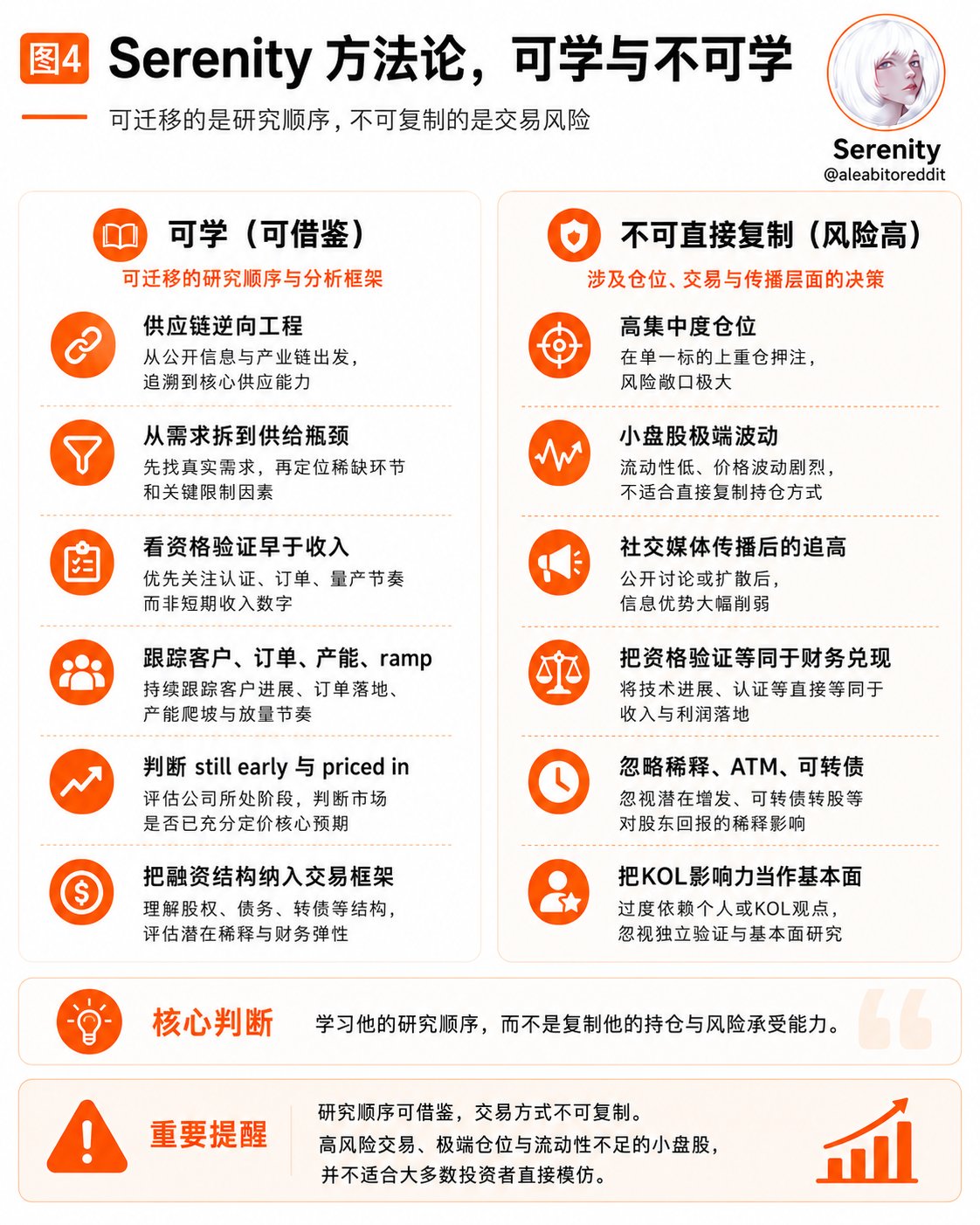
Serenity's method is not complicated, but the execution difficulty is very high. What is truly learnable is not his stock list, but his research order.
First, confirm whether the terminal demand is real enough. AI demand itself cannot rely solely on emotion; it must fall on capital expenditure, architecture upgrades, bandwidth requirements, customer contracts, and power resources.
Second, break down upstream along the demand to find the link with the most rigid supply. Whoever is hardest to expand production, hardest to replace, and has the longest certification cycle is more likely to become a bottleneck.
Third, see if the company is really in a bottleneck position. Not all companies telling AI stories are at key nodes; they must be proven with orders, customers, qualification verification, partners, and capacity expansion.
Fourth, judge what stage the market is in. "Still early" is not about whether the stock price has risen, but about whether industrial verification, institutional participation, order realization, and expectation diffusion have finished. "Priced in" is not that the company is not good, but that too much good news has been absorbed by the price.
Fifth, incorporate capital structure into the trading framework. Especially for AI cloud, data centers, power, and computing power operators, financing costs, dilution pressure, debt structure, and cash flow are more important than the story.
This order is more valuable than any "Serenity concept stock table." Because stocks will change, bottlenecks will migrate, markets will become crowded, and KOL views will be copied, but only the research order can be migrated.
8. The boundaries of this method
Serenity's method is very inspiring, but it cannot be mechanically copied.
First, the volatility of small-cap bottleneck stocks is extremely high. Many targets have no liquidity before being discovered and may become rapidly crowded due to social media dissemination after being discovered.
Second, there is huge uncertainty between qualification verification and revenue realization. Customer verification, cooperation announcements, technical routes, and mass production preparations may all be priced in by the market in advance, but true revenue and profit may not be released on schedule.
Third, valuation is easily distorted. Early bottleneck stocks will look ridiculously expensive using traditional TTM revenue and may look cheap using future TAM. What is truly difficult is judging the realization probability, not making a beautiful valuation table.
Fourth, KOL influence itself will change the trading structure. When a small-cap stock turns from niche research into a social media hit, the original non-consensus advantage will quickly disappear.
Fifth, public posting can show the research framework but cannot fully show position management and stop-loss discipline. If ordinary investors only learn the first half and not risk control, they can easily turn the methodology into chasing highs.
Therefore, the best attitude towards Serenity is not worship or denial, but de-mystified learning.
Learn his deduction path, not his position concentration. Learn his supply chain reverse engineering, not the FOMO in social media. Learn how he finds bottlenecks, and also learn how he is alert to dilution and priced-in factors.
9. AI investment enters the bottleneck pricing stage
Serenity's value is not telling the market what the next stock is, but reminding us: AI investment has entered a more difficult stage.
In the early days, buying the most obvious AI leaders could make money. Now, demand has become a consensus, and what truly needs to be repriced are those tightest, most upstream, and hardest-to-replace supply links behind the demand.
From GPUs to optical interconnects, from optical interconnects to lasers, from lasers to InP substrates, from AI cloud to power and financing structures, the market has been repeating the same process: first trading the most conspicuous leaders, then trading secondary suppliers, and finally looking for overlooked chokepoints.
Serenity is worth studying because he often places his research in the third step in advance.
But this also means that his method naturally has high volatility, high expectations, and high verification difficulty. It is not a stable value investment template, nor is it a list that ordinary people can make money from by copying.
Final judgment: Serenity is not a low-valuation recovery stock selection framework, nor is it an ordinary thematic speculation framework, but a set of high-volatility, high-verification-difficulty AI supply chain bottleneck trading methods.
For today's AI industry chain, direction is no longer scarce; what is scarce is finding bottlenecks that have not yet been fully named. What is truly important in the next stage is not who can tell the AI story best, but who is really stuck in the tightest supply position and can turn that position into revenue, profit, and shareholder returns.
Source: This article is synthesized and organized from Serenity's public X content archives, relevant company announcements, financial reports, and public information. Data and viewpoints are derived from the above materials and are for research and exchange reference only, and do not constitute any investment advice.