Scroll your feed right now and the mood is grim. The cycle's over, crypto's dead, the four-year pattern broke, everyone who told you to buy was wrong. Prices haven't done what people expected, and when prices confuse people, people get bearish. It happens every single time.
I've watched this movie enough times to know how it ends. I've been in crypto for thirteen years, and I've made just about every mistake it's possible to make. So before I tell you why I'm still bullish, let me tell you how I screwed it up, because the mistakes are where the actual lesson lives.
I got into Bitcoin in 2013, at $200 a coin. But the buying isn't the part that matters. Before I bought a single coin, I sat down and wrote what turned out to be the first macro valuation of Bitcoin anyone had ever published.
The method was crude by later standards. I took the above-ground and below-ground supply of gold, the way you'd value a commodity, and imputed that framework onto Bitcoin. If Bitcoin were to become a gold equivalent, the maths said it would be worth a million dollars a coin, with gold roughly where it is today.
That piece went round Silicon Valley and the finance world fast, because nobody had put a macro framework around Bitcoin before. It didn't exist. And I didn't just write it. I recommended it to every one of my GMI subscribers, hedge funds and family offices included. Recommending Bitcoin at $200 to that audience in 2013 was not a comfortable thing to do.
So here was my thesis at the time, and I'll give myself credit because I paid for the right to:
It's worth $200 today, I think it could be worth a million, so I'll discount myself 90% for being an idiot and call it $100k over ten years.
That turned out to be roughly right. We got there.
But being right about the destination and being right about the journey are two very different things.
Here's the journey. I bought at a brilliant price, it doubled, it tripled, then it collapsed 84%. Fine, I told myself, it's a long-term bet, I'll do nothing. Then it exploded again into late 2017, and I looked at my screen one day and it had run to a number I could barely believe. So I sold.
Why? FUD. The fork drama, the "it's a bubble" noise, the little voice telling me I was a hero who'd nailed a 10x and should take the win before I gave it all back.
I sold. And then it went up another 10x without me.
I tried to pretend I didn't feel like a total idiot. But I did.
And it got worse, because when it crashed again I bought back in during COVID, and told myself I was a genius for buying the panic. I wasn't. I'd sold at two grand and rebought at eight or nine. The buying, the selling into strength, the clever little trades around the position... all of it was me actively getting in the way of the one thing that worked.
I did the maths once. The original $200k, if I'd just sat on my hands, would've been worth around a hundred million. That's the power of compounding, and it's also proof that I'm capable of being a complete muppet. The asset did its job. I kept undoing it.
So here's the lesson I paid for in eight figures of foregone gains:
Zoom out, remove the noise, hold. Dead people make the best clients at any brokerage, because they don't touch anything.
That's the confession. Now here's what I understand today that I didn't fully grasp back then.
Bitcoin is the vault
Everything I've written about debasement over the last few weeks lands here. Demographics drive debt, debt drives debasement, and your cash melts at around 8% a year against long-term assets. If you want the full mechanism, go back to my Everything Code piece. The short version is that holding cash is holding a melting ice cube, and the rational response is to own things that can't be printed.
Bitcoin is the purest one of those things. Twenty-one million units, forever, no committee that can vote more into existence. It's the hardest money humans have ever made. It's the store-of-value layer. The vault.
But a vault has a ceiling, and it's important to understand what that ceiling is. Bitcoin's addressable market is the pool of global savings looking for a safe home. Call it gold's ~$35trn plus a slice of everything else people hold to preserve wealth. Bitcoin's bet is that it takes a growing share of that pool over time, and I think it does. Its only real competition is Zcash, the private version of the same idea, which might take 10% of the prize eventually. Bitcoin keeps the rest.
So the vault is real, it works, and it's a fantastic asset to own. Here's the thing though. The vault is only half the story, and it's the smaller half.
The economy gets built on top
Bitcoin isn't programmable. It does one thing beautifully and nothing else, by design. Smart contract platforms are a completely different animal. There are dozens of them, but the three I back are Ethereum, Solana and Sui. The single biggest mistake people make is lumping them in with Bitcoin as "crypto" and asking which coin wins.
What people miss is that they're not even competing for the same job. Bitcoin solves storage. Smart contract platforms solve coordination.
My Exponential Age frameworkexplains that AI, robotics, energy and crypto are all hitting the steep part of their curves at once, and that the economy is about to stop running on human effort and start running on machines. Billions of AI agents, transacting constantly, buying compute, settling with each other at a speed no human ever touches.
Now ask the obvious question. What do they transact on? Not the banking system. You can't run a machine economy on three-day settlement, correspondent banks and clearing houses that close at weekends. Agents need rails that are programmable, instant, and always on. That's what a smart contract platform is. It's the settlement layer for the machine economy the Exponential Age is bringing.
So this isn't a bet on a coin. It's a bet on the infrastructure that the next economy runs on top of. The token isn't a currency, it's your stake in that network, the coordination layer for the digital age.
Which means you can't value them the way you value Bitcoin, and you definitely can't value them like a business. It's not a company. It's an economy, and you value an economy by how much activity happens inside it.
Now put the two addressable markets side by side, because this is the whole argument in one move.
Bitcoin is going after global savings. A ~$35trn prize, gold-sized, and worth owning.
The smart contract platforms are the rails that global real estate (~$400trn), global debt (~$325trn) and global equities (~$125trn) could eventually settle on top of. That's not a bigger prize. It's an order of magnitude bigger.
So the conclusion writes itself. The basket of winning smart contract platforms should ultimately be worth several multiples of Bitcoin in aggregate. Not because Bitcoin fails, it doesn't, it does its job perfectly. But because the economy you build on top of the vault is structurally larger than the vault underneath it. The vault holds your savings. The rails carry the entire economy.
"But they're just utility coins"
I can hear the objection, because it's the most common bear case going, and it's worth taking seriously rather than swatting away. The argument runs like this. Bitcoin is literally engineered for capital preservation, that's its entire purpose, so it accrues value as money. Ethereum, Solana and Sui are just utility, financial plumbing, and plumbing doesn't accrue value the way a pure monetary asset does. Nice technology, bad investment.
But the logic cuts the other way. A pure store of value is capped by the size of the savings pool hunting for a home. That's a big number, but it's a fixed ceiling. An infrastructure asset is capped by the total universe of things that can be built on top of it, and that ceiling keeps rising every time someone ships something new. Low fees aren't a sign of low value. They're the cost of using rails that are becoming more valuable precisely because they're cheap enough to use at scale.
There's a real distinction to draw here, and it matters. An application built on Ethereum, a lending protocol, an exchange, is a business. It has revenue, it has a moat, and you could reasonably value it on cash flow. Ethereum itself is not that. Ethereum accrues value from the aggregate of everything built on it. Turn Ethereum off and you don't lose one company, you lose every layer 2, most of the stablecoin market, all of DeFi, all of it at once. That's the value. It's the ground the businesses stand on, not one of the businesses.
Same logic tells you why layer 2s don't accrue value the way layer 1s do. An L2 rents its security from the base chain and hands a lot of the surplus back down to it. Build a thriving L2 on Ethereum and you're mostly just compounding the value of Ethereum. The base layer is where it settles.
So why is everyone bearish?
Back to the mood we started with. If the long-term case is this strong, why does it feel so bad right now?
The setup has been right for a while: liquidity rising, financial conditions easing… What threw everyone was that the payoff didn't arrive on schedule. The 10/10 blow-up and the disruption around the government shutdowns broke the market's structure and delayed things. And people read a delay as a death.
Nothing in the process has broken. The gap between where crypto is trading and where liquidity says it should be (the jaws, as we call them) has stayed open longer than I expected, but an open gap is a gap that closes, not one that's cancelled.
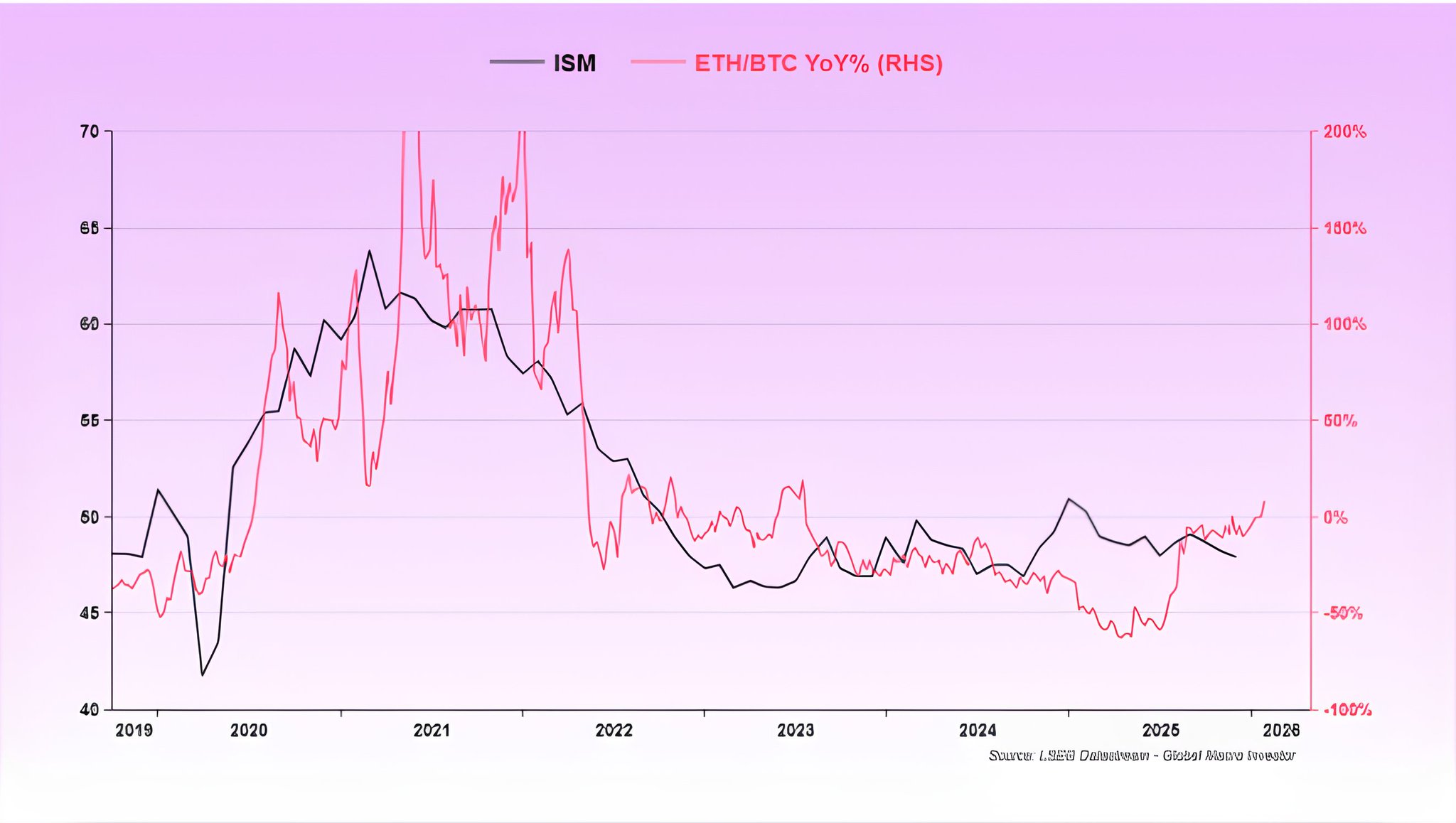
We came out of the lowest period of the ISM below 50 in history, with the business cycle flat on its back, and crypto is driven by activity and investment, which means it needs the business cycle to breathe. For a long time it wasn't breathing. On top of that, Bitcoin's been trading at a liquidity discount, running cold against total liquidity the way it periodically does. It's a more volatile asset than liquidity itself, so it overshoots the upside when it runs hot and undershoots when it runs cold. But over time it tracks liquidity at a correlation of roughly 87%.
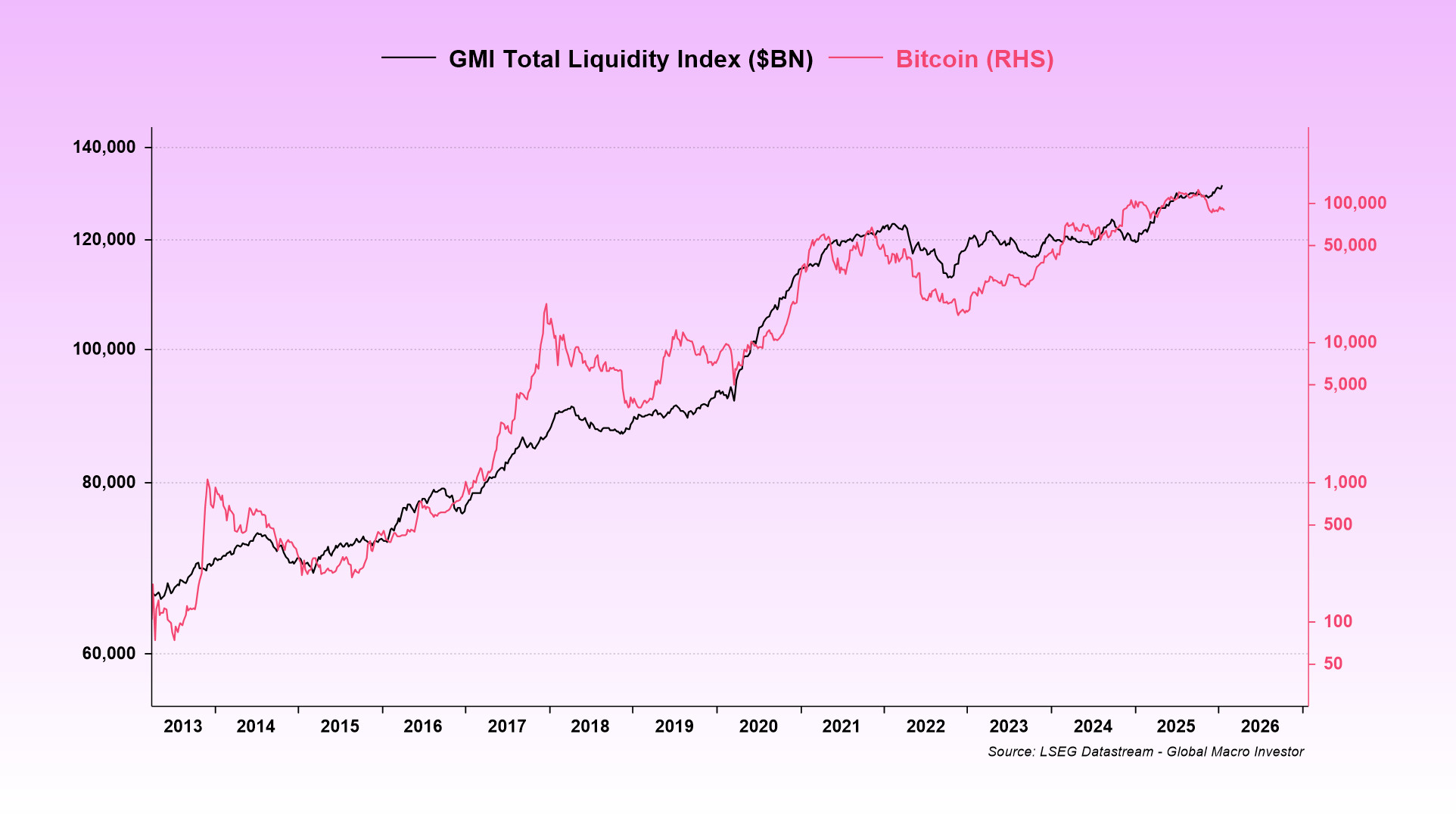
Right now, it’s running cold so people think the thesis is broken. It isn't. The business cycle has already turned. The ISM has been in expansion for six straight months, sitting at 53.3 as of the July print, and history says that's the environment where crypto comes alive. When the cycle is rising, people move further out the risk curve, and the same thing happens in crypto that happens everywhere. Junk outperforms treasuries, small caps outperform mega caps, and ETH and the smart contract platforms outperform Bitcoin, because demand for block space rises with economic activity while demand for Bitcoin rises with savings.
What I actually do with all this
I'm not going to hand you a portfolio or call the bottom. Thirteen years has taught me I can't time it, and neither can you, and pretending otherwise is how you end up selling at two grand.
What I'll tell you is what the confession at the top was really about. This is a long-term game and it's an emotional one, because all our livelihoods are wrapped up in it. The people who win aren't the ones who trade it best. They're the ones who understand what they own, have conviction that network adoption is real, and then hold through the 50% drawdowns that come every couple of years like clockwork.
Zoom out. Remove the noise. Own the vault and own the rails, and let the curve do the work I spent a decade trying to outsmart.
More at raoulpal.com