“Adding schema markup makes it easier for AI to cite you.”
There is plenty of data to support this claim. 53% of pages cited by AI have implemented schema, which is about three times the implementation rate of pages that are not cited.
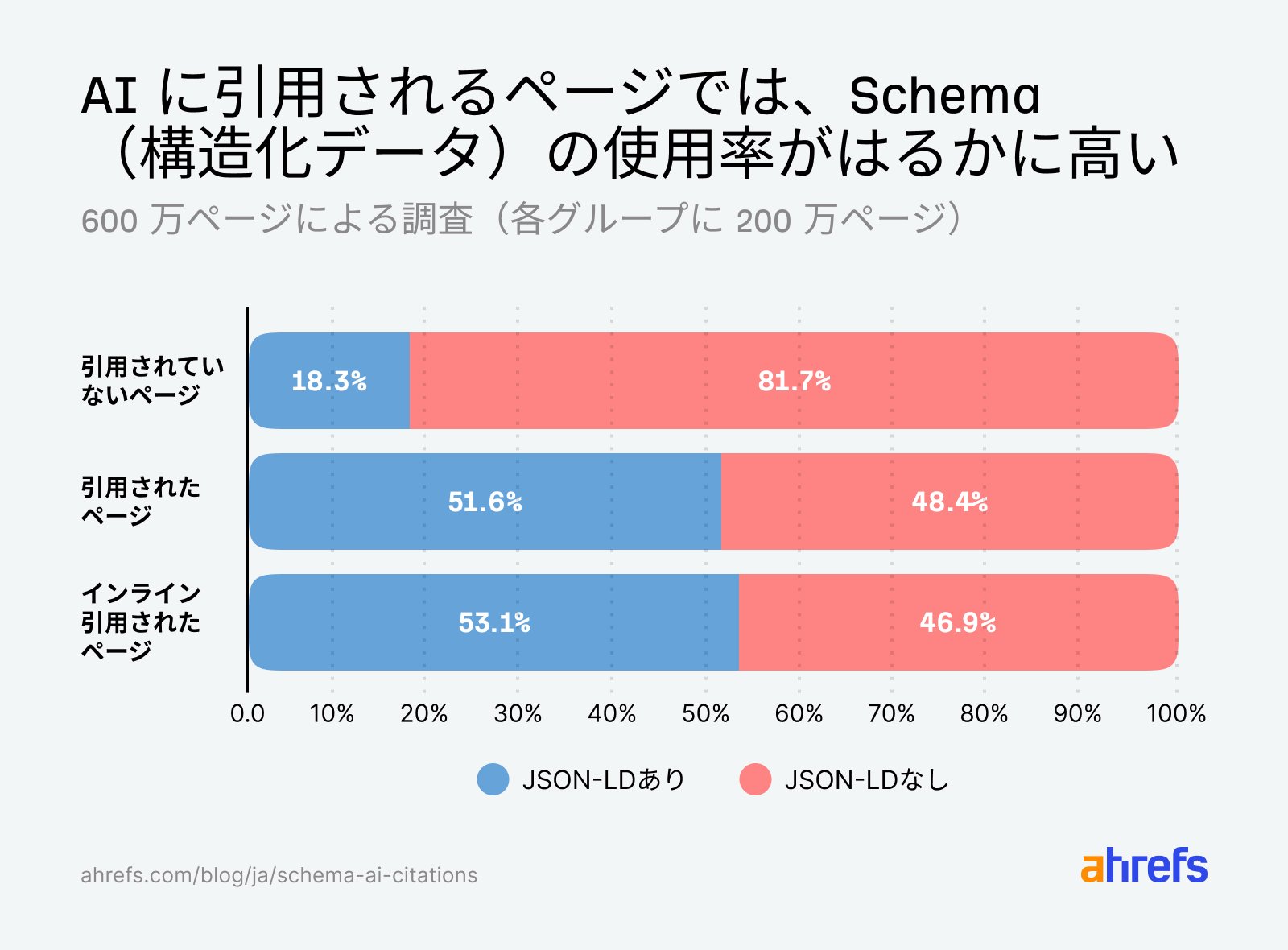
A graph comparing schema markup implementation rates between pages cited by AI and those not cited.
However, after the Ahrefs team verified this with a follow-up study of 1,885 pages, no significant increase was confirmed on any platform.
The Trap of Correlation vs. Causation: Why Observational Data Alone Isn't Enough
The Ahrefs team started this investigation by analyzing 6 million URLs.
Pages cited by AI are about three times more likely to have implemented JSON-LD compared to pages that are not cited. This is the kind of data frequently shared as evidence for the claim that “schema increases AI visibility.”
However, schema markup tends to be implemented on technically sophisticated sites. And such sites possess the following characteristics:
- They publish high-quality content.
- They have built authority.
- They have acquired more backlinks.
- They execute all kinds of measures to get their pages cited by AI.
While it's possible that schema is effective, it might just be piggybacking on the benefits of these other signals.
In other words, observational data alone cannot answer the question: “If I add schema to my page, will it be cited more by AI?”
Experimental Design: Isolating the Effect of Schema
Therefore, the Ahrefs team conducted a second study to isolate the effect of adding schema.
They tracked 1,885 web pages that added JSON-LD schema between August 2025 and March 2026. For each page, they also selected three control URLs from different domains that had similar citation levels but did not add schema.
After matching them with a total of 4,000 control group pages, they measured changes in citation counts across Google AI Overview, AI Mode, and ChatGPT.
By comparing two groups that had the same citation rate before adding schema, it becomes easier to isolate what schema “actually did.”
Result: “No Effect” Across All Three Platforms
The addition of schema did not lead to a significant increase in citations on any platform.
- AI Mode: +2.4% (within the range of noise)
- ChatGPT: +1.2% (within the range of noise)
- AI Overview: −4.6% (statistically significant, but the absolute value is small)
In AI Mode and ChatGPT, the treatment group pages performed slightly better than the control group. However, the difference was very small and well within the range that can be explained by random noise across thousands of URLs.
Overall, it's impossible to determine whether schema had a slight positive effect or no effect at all.
Why Did Only AI Overview Decrease?
The −4.6% in AI Overview is “statistically significant,” meaning the probability of such a difference occurring by pure chance is about 1 in 2,500.
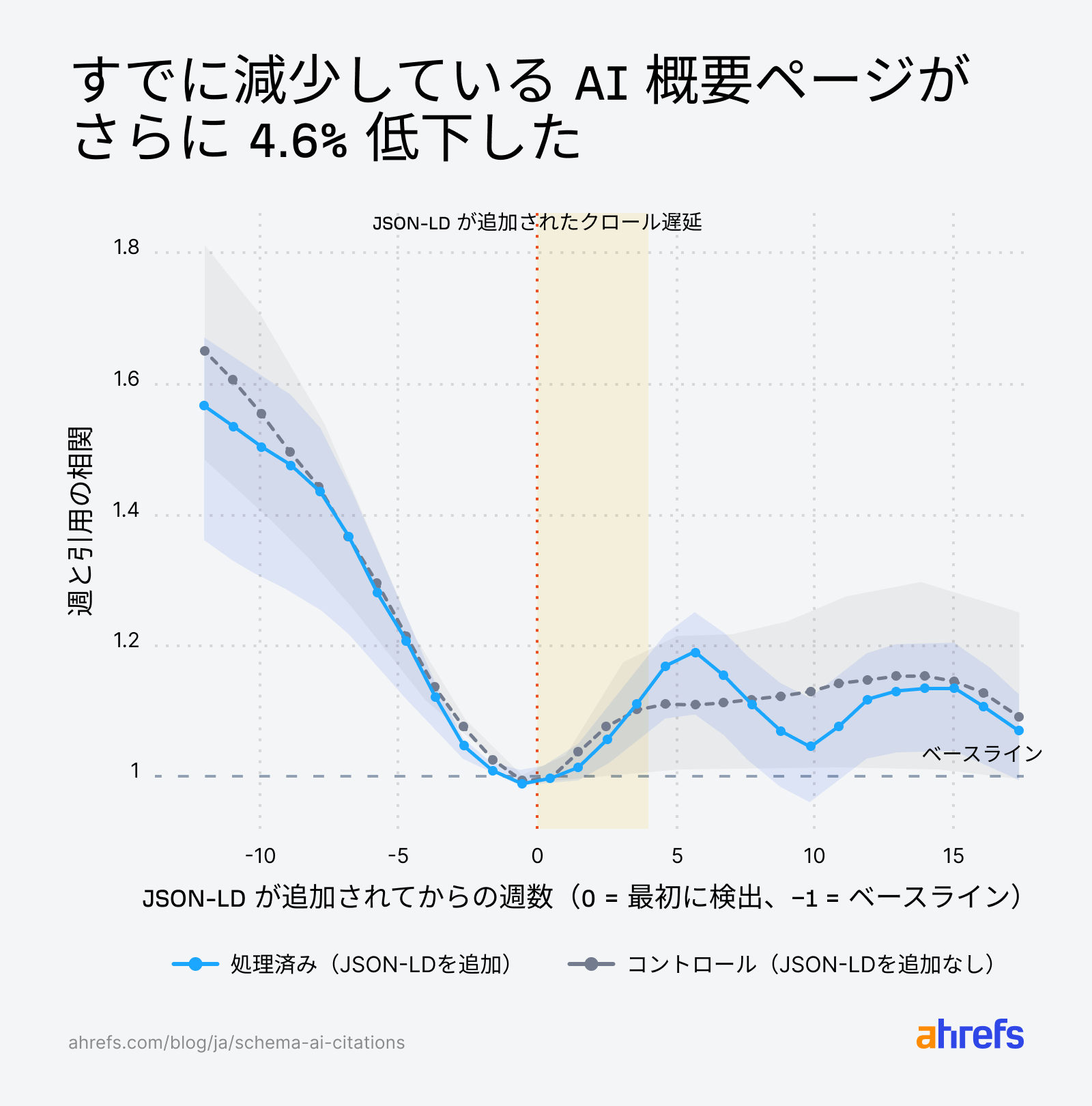
A line graph showing the trend of AI Overview citation counts for the treatment and control groups.
However, before interpreting this as “adding schema decreases citations,” two points should be noted:
The absolute scale is small. It's a decrease of about 12 citations per page per day, while most pages in the sample were receiving hundreds of citations.
Both the treatment and control groups were already on a sharp downward trend “before” the schema was added. It's possible that AI Overview was suppressing this type of content for reasons unrelated to schema.
If adding schema had no effect on citations at all, both groups should have declined at the same pace. The fact that the treatment group declined slightly more suggests that schema might have had a small negative impact.
However, the possibility of mere coincidence cannot be ruled out. This data alone is not conclusive.
The Ahrefs team analyzed the data using four different methods to ensure the conclusion remained consistent regardless of the verification method. Each test examines the question “Did schema have any effect?” from a slightly different angle.
Only when multiple tests show the same conclusion can the results be trusted. For more information, please check the link at the end of the article.
What Should SEO Professionals Do?
Adding JSON-LD to pages already cited by AI did not increase the number of citations.
So why do 53% of AI-cited pages have schema implemented?
The reason is that sites that implement structured data also invest in technical SEO, publish authoritative content, work on link building, and continuously maintain their pages. Even if you removed the schema, it's highly likely that the remaining signals would still lead that page to be cited.
If you are already performing solid basic SEO measures, JSON-LD is unlikely to be a breakthrough. Conversely, if your basic measures are insufficient, it will be difficult to compensate for that lack with schema alone.
Detailed experimental design, results of the four statistical tests, and how to test on your own site are explained in the main Ahrefs blog article.
Main blog article 👉 https://ahrefs.com/blog/ja/schema-ai-citations/