Last October, the founders of Mercor became the youngest self-made billionaires in history.
But they started by scouting engineers through hackathons in India, vetted them through a coding contest, and matched them over Whatsapp.
@mercor_ai is an AI-powered talent marketplace that recruits, vets, and matches domain specialists (doctors, lawyers, engineers, PhDs) to train and evaluate AI models for major labs founded by Brendan Foody, Adarsh Hiremath, and Surya Midha.
This is episode 1 of cold start.
Cold start is a series where I cover the growth mechanics and levers companies used that led to their explosion in popularity.
Most founders today start with a built-in advantage: an ex-apple employee, an ex-VC investor, or an ex-founder.
But the rest of us do not.
This series will cover all of the unscalable growth strategies that got companies off the ground: selling cereal boxes to stay alive, making handmade gift boxes to land early customers, or converting sororities into users.
By the end, you have a thorough idea of exactly how each company went from 0 → 1, and what steps you can steal.
Founding story
Brendan Foody (CEO) grew up in Menlo Park and adopted entrepreneurship in eighth grade reselling Safeway donuts.
He would buy donuts at $5 a dozen and sold them at $2 a piece, cut his price to $1 for two weeks to run a competitor out of business, and moved his stand 20 feet off school grounds when the principal tried to shut him down \[Foody, 20VC].
In high school, Brendan started a cloud consulting business that helped businesses unlock up to $25K in AWS startup credit by building out the websites and filing forms needed to apply to the AWS Program \[First Block].
Adarsh and Surya's story started much earlier - meeting at 10 years old as the only elementary schoolers who wanted to compete in debate. They would compete until high school where they met Brendan on the Bellarmine College Prep debate team \[Hiremath, 20VC].
The idea for Mercor surfaced in 2021 on a senior-year graduation trip when Brendan was complaining that he couldn't find developers fast enough for his AWS consulting clients. Adarsh and Surya realized that some of the best engineers in the world were located in India, underpaid and overlooked.
This was the start of Mercor.
2022: Getting off the ground
- How did they get their first clients?
- What sponsorships did they take on?
- How did they find their first engineers?
Scrappy growth tactics
Mercor started out as a software development agency in January 2022.
Their first clients came from Brendan's classmates at Georgetown. If a company wanted to build a feature or system, they would come to Mercor which had the talent to do work at an affordable price [The Hoya].
Early-stage startups paid Mercor to create an MVP, engineers in India built them, and the three founders kept the profits [GlobeNewswire].
Brendan also used his network at Mercor to help his friends build viral apps, serving as another distribution engine. Brendan worked with a friend on a project called Hoyadle, a spin-off of the online game Wordle. Even though his friend never directly paid Brendan, Mercor started to appear alongside Hoyadle in articles.
💡
Working with viral apps/companies will serve as its own distribution. Everyone chases big logos (OAI, Meta, etc) but you shouldn't overlook the attention smaller projects bring (ex: JMail).
Brendan continued these campus growth tactics by pitching Mercor to Georgetown's Entrepreneurship Challenge, winning the $10,000 undergraduate grand prize and leading them to issue their own press release to announce a projected $40K revenue month.
Hiring Engineers
To source engineers, Mercor turned to IITs (Indian Institutes of Technology) using compensation arbitrage to out-bid offers from big-tech companies.
They started off partnering with the IIT coding clubs for direct referrals, then sponsored hackathons across the IITs for a cash prize and "an opportunity to work at Mercor."
For these competitions, they awarded the top placements 3,000, 2,000, and 1,000 Rupees, adding up to about $71 total.
This might seem like a severe underpayment, but big tech offers in India paid the equivalent of around $5 an hour, allowing Mercor to outbid them for their time \[1-to-100].
💡
Recruit in areas you can give an unfair advantage. In this case, Mercor could outbid big tech salaries based on geography, other alternatives would be job opportunities, connections, etc.
Mercor also ran Facebook ads to look for candidates, a frequently overlooked method of hiring.
One of Mercor's best engineers came through one of these ads. They had failed Adarsh's manual interview, sent Adarsh a long message dissecting exactly what he got wrong, then got hired and became one of their best engineers \[20VC].
2023: Scaling a Pivot
- How did Mercor's pivot actually happen?
- How did they run a marketplace with no product?
- How did they get to $1M ARR with no marketing?
On January 1, 2023, Mercor relaunched as a talent marketplace.
Startups paid around $500 a week and Mercor matched them to an engineer in India, taking roughly 30 percent \[Fortune].
This pivot happened naturally, driven by the demand of their clients. As the engineers continued to build exceptional software, Mercor became known for their people rather than the products they built.
Mercor's clients started to ask if they could hire their engineers directly, skipping the software portion of the agency.
💡
Don't be afraid to pivot into customer demand. Pinterest started off as a shopping catalog, but after people used it for collecting and saving items, that became the product.
At the start of the pivot, almost all matching was done manually.
Brendan and Surya personally reviewed resumes and conducted the interviews \[Foody, VectorShift]. They would connect these founders and engineers through WhatsApp and used extremely simple software like Google Sheets to organize and PandaDoc to send out contracts.
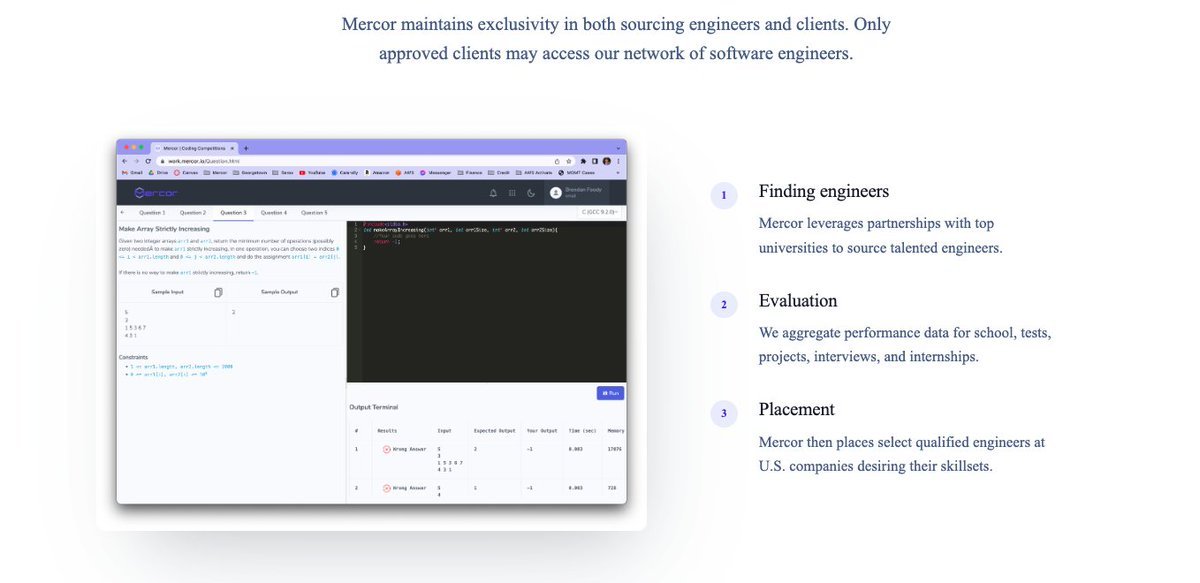
mercor's old website from 2023
The Mercor team also built coding competitions and challenges to screen out applicants quickly. They framed it as a way to practice coding in a way that gets you hired, allowing employers to directly see the top talent.
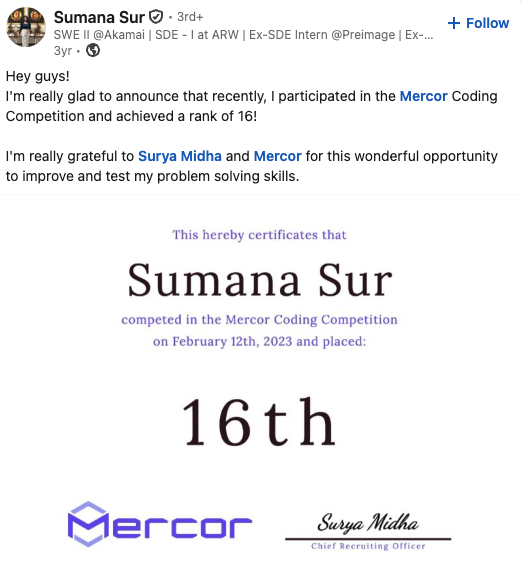
mercor coding competitions
💡
Creating shareable moments within a product is extremely important. Whether it is a unique loading animation or a flex (ex: spotify wrapped), people naturally feel inclined to post about it.
Along this path, they started to discover signals in applicants. For example, Brendan realized that candidates who had studied abroad in Western countries were far more likely to work well with US companies, a correlation they found manually and later encoded \[VectorShift].
Eventually the manual process broke so they automated the system by using a prompt-engineered version of GPT-4 to score profiles in the Google Form and used an AI interviewer to ask technical questions.
This process became so good that companies asked to buy the AI interviewer as a standalone product - to which Mercor obviously rejected \[VectorShift].
Company Side
In March 2023, Mercor's website didn't let companies instantly sign up and start hiring - it made them apply.
Mercor set up an application system where only approved companies could access the network of engineers, making the talent feel premium and gatekept.
💡
Even if the backend system isn't fully developed, making the experience feel exclusive → feels like a premium product.
Once a client actually onboarded an engineer, Mercor stayed involved in the recruiting process.
Typically, hiring an individual contractor in India means contracts, tax forms, and currency transfers for the startup; Mercor handled this entire process, removing the biggest blocker to using overseas talent.
By staying involved in this process, they could monitor the customer experience: who extended their contract, who churned, who got a raise. They used that data to fine-tune their AI model and improve matching predictions, ultimately using it to create an AI interviewer.
💡
Make it as easy as possible for someone to use your product (remove blockers). Working closely with teams throughout the process provides data about how well your product is adopted.
Up until this point, Mercor was completely bootstrapped. They got customers through a community called Prod, a student-run founder community.
Almost every initial customer of their talent marketplace was from Prod, including @Etched, an AI chip startup now worth over $10 billion. They relied almost solely on Prod and chained referrals from their customers for their entire go-to-market.
Mercor didn't use corporate social media accounts until January 2024 when they jumpstarted platforms like X, Instagram, and Youtube to announce their $3.6M raise from General Catalyst.
From this point onwards, Mercor took off.
2024-Now: Escape Velocity
In 2024, Mercor started to land bigger enterprise companies.
OpenAI in particular, came to fruition after Brendan cold-emailed Shaun VanWeelden, OpenAI's head of human data operations.
VanWeelden tested Brendan to find Math Olympiad winners - in which Mercor delivered 25 in a day. Mercor eventually became OpenAI's largest data vendor within nine months, and eventually hired VanWeelden himself \[SF Standard].
In June 2025, Meta bought 49% of Scale AI (Mercor's biggest competitor) leading Mercor's run rate to quadruple \[20VC]. Scale AI's customers didn't want their data to be sent to a competitor like Meta, so Mercor ended up growing exponentially.
Today, Mercor runs at roughly a $2 billion revenue run rate and is reportedly in talks to raise $500 million at a $20 billion valuation \[Forbes, July 2026].
Reflections
Mercor heavily utilized their proximity to go from 0 → 1.
Their classmates became their first clients, they used builder communities like Prod to expand, and pivoted the product based on client demand.
Growth strategies like these don't involve flashy social media stunts or launch videos, but rather catering deeply to a specific need and chaining referrals to land bigger contracts.
In situations like these, the product doesn't have to be at a perfect point to adopt users.
Doing things that are "unscalable" provides insight into which parts of the process are most important to automate - revealing the biggest priorities to build out...or even pivot into.
Their playbook:
- Utilize social networks: student communities (Prod) and classmates for your initial clients
- Find arbitrage opportunities: source from overlooked pools (IIT hackathons, Facebook ads) where you can outbid local options
- Follow customer pull: analyze the features that have the most traction and don't be afraid to pivot into it
- Get started...even manually: deliver the value by hand first to discover what actually matters, then automate it
- Remove friction: handle any blockers that would prevent customers from using your product
- Build exclusivity: limit access so the product feels exclusive/premium
- Leverage referral chains: anchor on a big client (like OpenAI), overdeliver, and scale into enterprise