Imagine you want to research the fitness app market before launching a product. Before this was two weeks of work - TikTok, Reddit, App Store, competitors, reviews, trends. One by one. Manually. And either you spend your own time or pay a research team $3,000-5,000 for a report that arrives a week later.
Bookmark This and follow - I'm Sprytix, a developer who builds AI systems and automation pipelines that turn technology into real income. DMs open.
With Kimi K2.6 Agent Swarm this is one prompt and a few hours. 300 agents research everything in parallel and return a finished report while you work on something else.
Two weeks became a few hours. And what used to cost $5,000 to a research team now costs cents in API usage.
1Kimi K2.5 Agent Swarm:2Parallel agents per run: 1003Tool calls: 1,50045Kimi K2.6 Agent Swarm:6Parallel agents per run: 3007Coordinated steps: 4,0008Output: real files - reports, spreadsheets,9 presentations, dashboards10How it launches: automatically - you set the goal,11 Kimi decides the decomposition
What Agent Swarm actually is
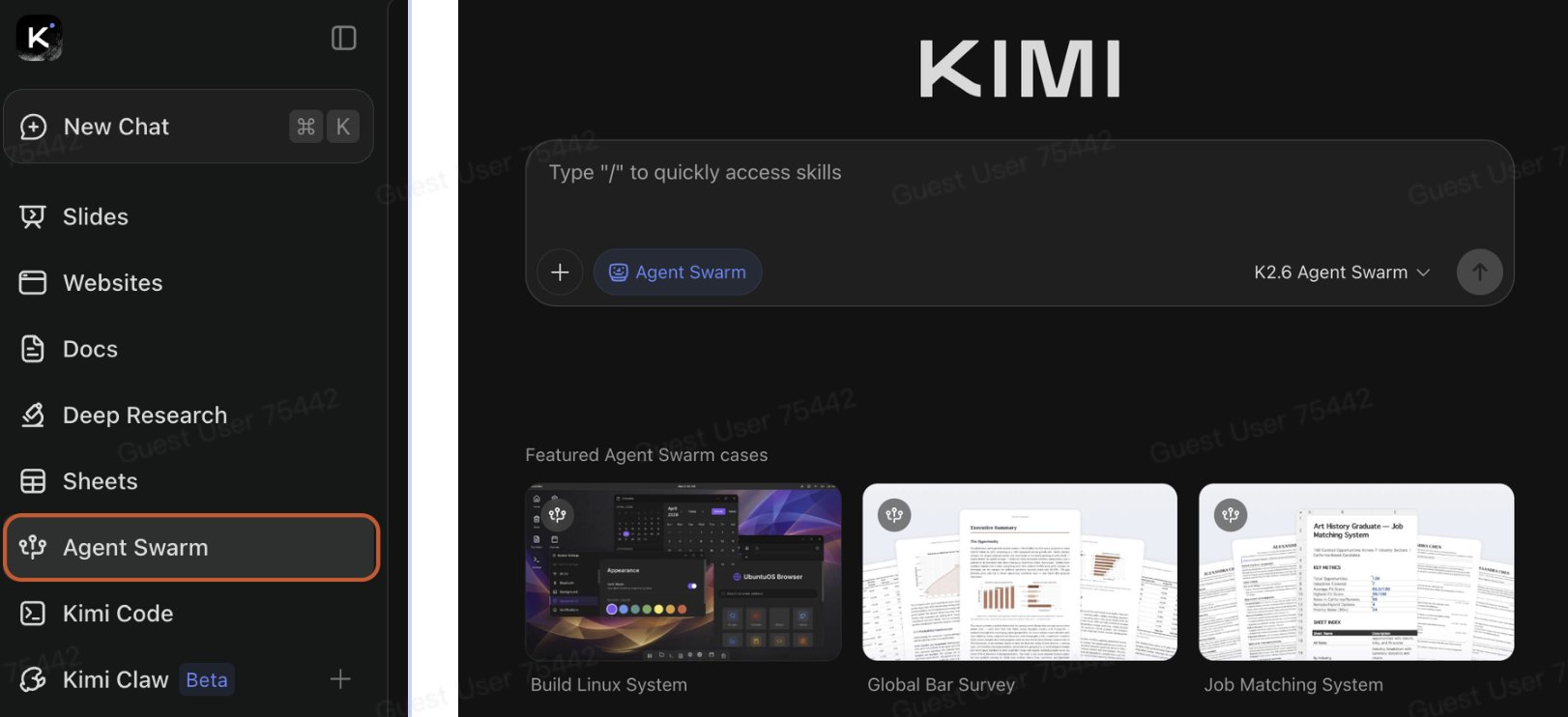
Most people who write about Agent Swarm describe it wrong. They say it's a team of AI specialists - one agent for design, one for code, one for marketing. That's not what it is and that's exactly why they don't get real results from it.
Agent Swarm is not a team. It's massive parallelization.
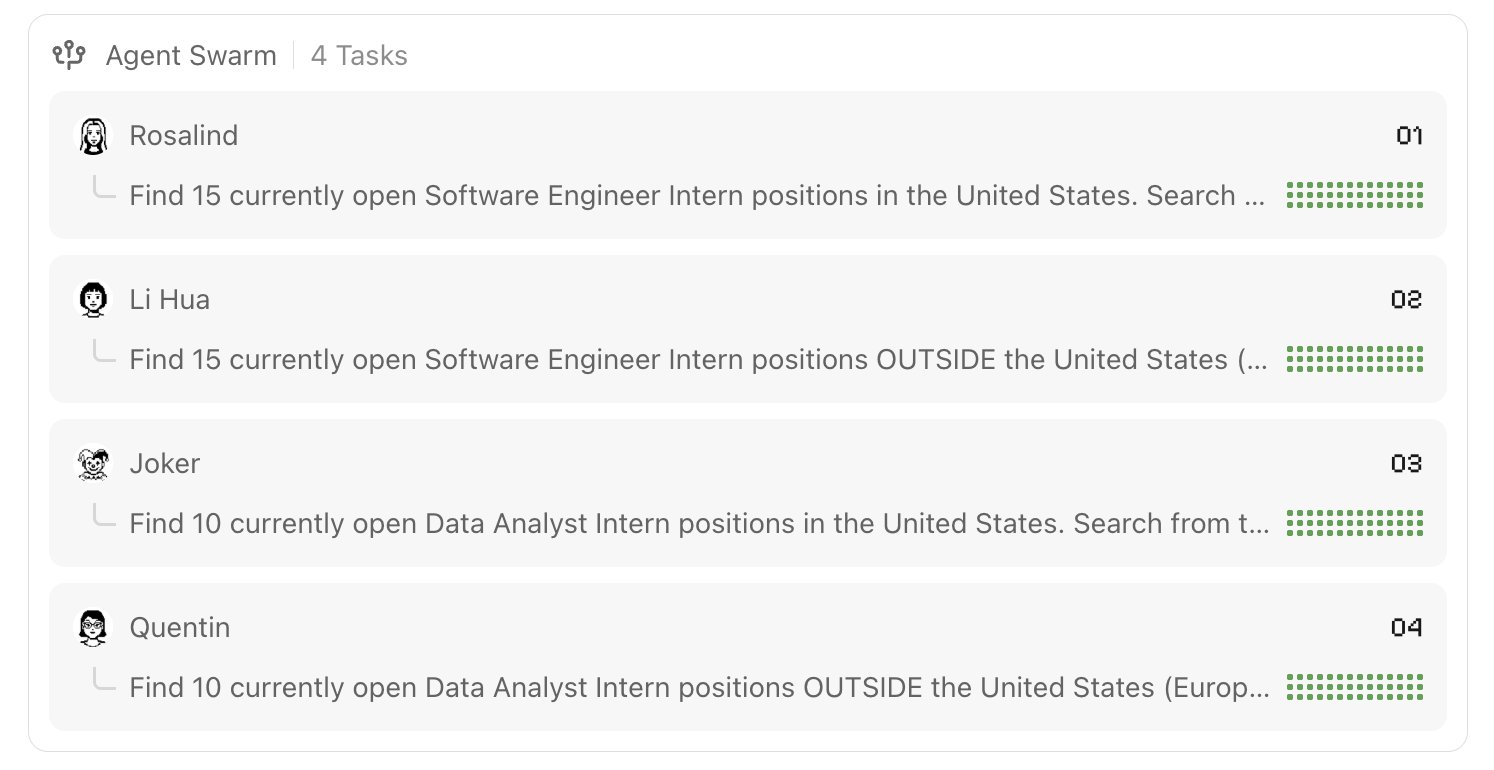
Kimi K2.6 doesn't assign roles to agents. You set a goal and Kimi decides automatically how to decompose the problem, how many parallel investigations to run and how to aggregate everything back into one result. You don't see the structure. You don't configure the agents. You just describe what you want to know.
This is exactly what separates Kimi K2.6 from every other agent framework right now. CrewAI requires you to build the agents. LangGraph requires you to build the graph. AutoGen requires you to define the structure. Kimi K2.6 requires you to describe the goal - and the swarm builds itself.
Real example: market research in one prompt
Moonshot shows this example in their official blog. You want to find the top 3 YouTube creators across 100 different niches. Doing this sequentially - one niche at a time - would take days. Kimi K2.6 creates 100 parallel agents, each researching one niche simultaneously, and returns all 100 results in a single run.
For a founder building a fitness product this looks like this. Instead of two weeks of sequential research - one prompt:
1Research the fitness app market for summer 2026.23I want to understand:4- what problems users actually complain about5- what content angles go viral on TikTok6- what features people actually pay for7- where competitors are failing their users8- what gaps exist in the current market910Deliver a complete market intelligence report11with specific findings and actionable insights.
Kimi K2.6 automatically decides how to break this into parallel investigations, how many agents to deploy across each source and how to synthesize everything into one report. You get a complete picture of the market in a few hours instead of two weeks.
And what matters - the result is not a chat response. It's real files.
What comes out the other end
This is the part most articles miss. The output of Agent Swarm is not text in a chat window. It's structured deliverables that go directly into your work.
One Agent Swarm run can deliver:
1Research outputs:2- 100,000-word literature review3- 20,000-row dataset4- competitive analysis across 50 companies56Document outputs:7- full market research report with citations8- spreadsheet with structured data9- presentation with findings and recommendations10- dashboard with visualized insights1112Content outputs:13- 100+ content variations across different angles14- structured content calendar15- SEO analysis with keyword opportunities
These aren't summaries of chat conversations. These are structured materials that previously required weeks of manual work or an expensive research team.
Document to Skill: your knowledge becomes swarm knowledge
Kimi K2.6 has a mechanism most people don't know exists - Document to Skill. Any PDF, DOCX, spreadsheet or presentation can be converted into knowledge that the entire swarm uses across every parallel investigation.
You upload a fitness market report, a competitive analysis or a collection of customer interviews. Kimi K2.6 converts this into swarm knowledge - and now every parallel agent in every subsequent run has access to that context, using it to ground research in your specific domain rather than general training data.
1You upload:2Fitness Market Report 2026.pdf3Customer Interview Transcripts.docx4Competitor Analysis Q2 2026.xlsx56Kimi K2.6 converts into swarm knowledge.78Result:9Every one of the 300 parallel agents uses10these documents as a knowledge base.11Reports become more accurate and relevant12with every document you add.
The more you feed into Kimi K2.6 - the smarter every subsequent run becomes. This is compounding knowledge that gives you an advantage that grows over time.
Where this saves real time and money
Here's where it gets concrete. There are three types of work where parallelization is critical and where Agent Swarm gives the biggest return.
Market research before launching a product. Before this was either two weeks of your time or $3,000-5,000 to a research team and a week of waiting. With Agent Swarm it's one prompt and a few hours. If you launch 2-3 products a year the savings on research alone is $6,000-15,000 and months of time.
Competitive monitoring. Instead of manually checking five competitor apps every week Agent Swarm monitors pricing changes, new features, App Store reviews and social mentions across all competitors in parallel and delivers a weekly brief automatically. Zero time cost after the initial setup.
Content at scale. Instead of writing one TikTok hook at a time and testing what works Agent Swarm generates 300 variations simultaneously - different angles, different audiences, different formats. You select the strongest ones instead of coming up with each one manually.
1What used to take weeks → now takes hours:23Market research:4Before: 2 weeks or $5,000 to a team5Now: 1 prompt, a few hours67Competitive analysis:8Before: 3-5 days manually9Now: 1 automated run1011Content variations:12Before: days of copywriting13Now: 300 variations in one run1415Weekly monitoring:16Before: 4-6 hours manually every week17Now: automatic, zero time
The core difference most people miss
Agent Swarm doesn't replace people with specific roles. It removes the sequential constraint from work that is parallel by nature.
Research is parallel work. Multiple sources need to be investigated simultaneously to get a complete picture. Humans do it sequentially because we can only focus on one thing at a time. Agent Swarm does it the way the work is actually meant to be done - everything at once, coordinated by a system that knows how to aggregate parallel findings into something coherent.
1Sequential work (how humans do it):2Source 1 → Source 2 → Source 3 → Synthesis3Time: weeks45Parallel work (Agent Swarm):6Source 1 ↘7Source 2 → Coordinator → Synthesis8Source 3 ↗9Time: hours
You don't configure this parallel structure. You describe what you want to know and Kimi K2.6 decides how to organize 300 parallel investigations to give you a complete answer.
Two weeks became a few hours. Work that cost $5,000 now costs cents. And the only thing that stays human is the question you ask and the decision you make based on the answer.
Most people read about this. A few actually try it. The difference between them is measured in how much time and money they spend on work that Kimi K2.6 can do in parallel while they focus on what actually matters.
/ If this was useful - follow, the next one drops here first.